 Preview
 Send
Send Share
Share
 Details

 Download
 Similars
 X-Ray
X-Ray Diaporama
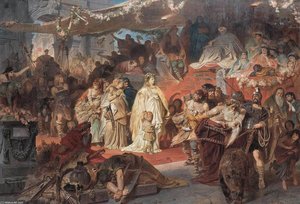
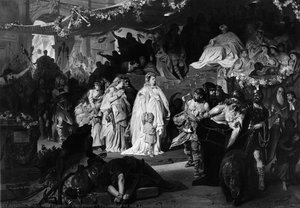
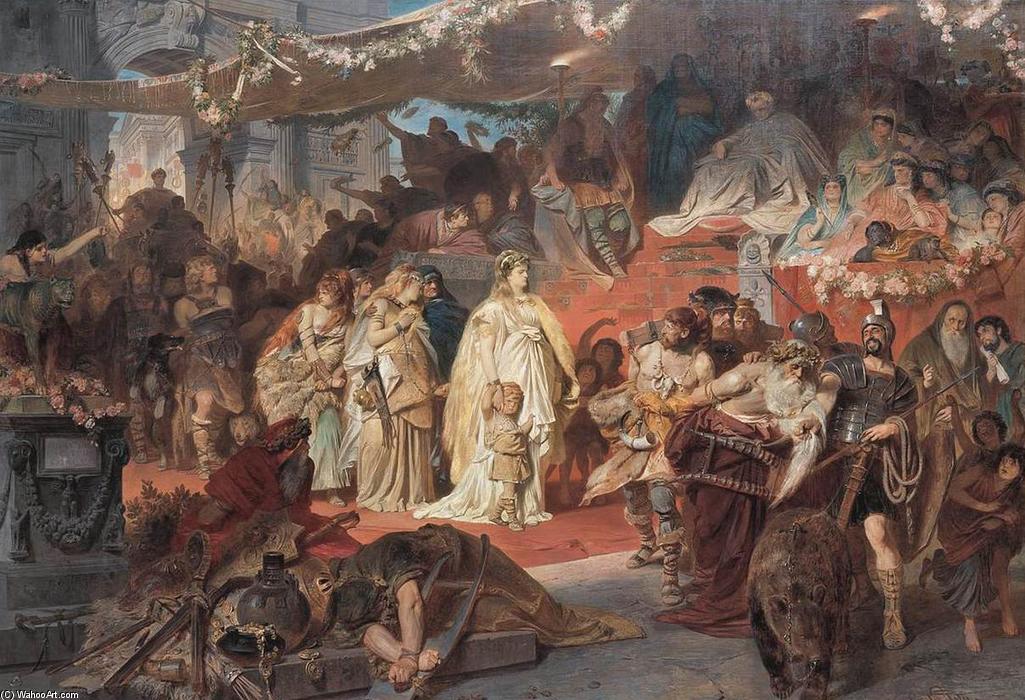
Thusnelda Led in Germanicus' Triumph
 Acrylic On Canvas
- WallArt
- Realism
 1873
1873 490.0 x 710.0 cm
 Neue Pinakothek
 Read More
Hand Made Oil Reproduction
Hand-painted oil on canvas in your size and frame, made to order by our artists. ( Buy Print Buy Image)




P118B $10

P118H $10

P118W $10

P438Z $10

P508JH $12

P508YH $12

P805H $10

P805Z $10

P919BZ $10

P919G $10

P919XJ $10

P959ZH $10

P968JZ $12

W106C $8

W218G $10

W218JH $8

W218Y $10

W307PJ $10

W316G $10

W316PJ $8

W316Y $10

W398PJ $8

W4111J $10

W500HY $15

W500JH $15

W692G $12

W849H $8

W940BG $15

W953PJ $8




Pick from our preset sizes that match the artwork's original proportions.

You may enter your own dimensions to fit a specific frame or space. If your selected size does not match the original image's proportions, we will either crop the artwork or extend the painting with additional hand-painted elements. A digital mockup will be sent for your approval before production begins.
Please note that the on-screen preview does not reflect the actual cropping or extension. Only the mockup will accurately show the final composition.
While custom sizes are available, we recommend selecting a dimension from the predefined list to preserve the original proportions.
After order, ArtsDot.com team will email client for instructions and provide a mockup preview
Worldwide Delivery () in 3/4 weeks instead of standard 5 weeks. (17 August). No compromise on quality.

Free Worldwide Express Shipping

High-Quality Linen Canvas

Full Shipping Insurance

Customs Tax Refund Guarantee

True Color Matching Guarantee

60-Day Return Policy (Defects Only)

100% Money-Back Guarantee

Bulk Discount Offer
 Glass option is only available in size under 110 CM

Thusnelda Led in Germanicus' Triumph
Reproduction Medium
Reproduction Size
-


Total Price
$ 263
Artwork Description
The Canvas Unfolds: A Journey into Piloty's "Thusnelda Led in Germanicus’ Triumph"
Karl Theodor von Piloty’s “Thusnelda Led in Germanicus’ Triumph,” completed in 1873, isn’t merely a painting; it’s a meticulously crafted tableau vivant – a frozen moment of profound historical drama and emotional resonance. Housed within the esteemed Neue Pinakothek in Munich, this monumental oil on canvas (measuring an impressive 490 x 710 cm) transports us directly to the aftermath of the Battle of Teutoburg Forest, a pivotal event that dramatically shaped the course of Roman history. Piloty’s skill lies not just in his technical prowess but in his ability to imbue a complex historical narrative with palpable human feeling, creating an artwork that continues to captivate viewers over a century later.

(Image: Thusnelda Led in Germanicus’ Triumph by Karl Theodor von Piloty)
A Scene of Captive Majesty: The Narrative and Symbolism
The painting depicts a scene of calculated grandeur – the triumphal procession of Roman soldiers leading Thusnelda, the wife of the Germanic chieftain Arminius, through an elaborate archway. Thusnelda herself is presented with a striking blend of vulnerability and defiant dignity. Captured after the devastating defeat of Varus’ legions, she embodies both the tragedy of her situation and the strategic importance of her capture to Rome. The scene isn't simply a record of historical events; it’s laden with symbolism. The Roman soldiers, rendered in meticulous detail, represent imperial power and control, while Thusnelda’s posture – regal yet sorrowful – speaks volumes about the complexities of war and its impact on individuals caught within its vortex.
Crucially, Piloty doesn't shy away from portraying the emotional weight of the event. The faces of the Roman officers convey a mixture of triumph and perhaps even a touch of detached curiosity, while Thusnelda’s expression is one of quiet sorrow mingled with an underlying strength. The inclusion of Arminius’ brother, Segimuntus, observing the scene from the sidelines, adds another layer of intrigue – a reminder of the personal cost of conflict and the fractured loyalties that fueled the rebellion.
Technique and Artistic Vision: Piloty's Realist Approach
Piloty was a leading figure in the German realist movement, deeply influenced by the historical paintings he encountered during his travels to Belgium. This influence is evident in his meticulous attention to detail – from the intricate folds of the soldiers’ armor to the richly textured fabrics of Thusnelda's garments. He masterfully employs chiaroscuro (the use of strong contrasts between light and dark) to create a sense of depth and drama, drawing the viewer’s eye into the heart of the scene. The composition itself is carefully orchestrated, guiding the gaze across the canvas and emphasizing key figures and elements.
Furthermore, Piloty's understanding of color is remarkable. He utilizes a rich palette – deep reds, blues, and golds – to evoke the opulence of Roman imperial power while simultaneously conveying the somber mood of the scene. The lighting, strategically placed, highlights Thusnelda’s face, drawing attention to her emotional state and solidifying her as the focal point of the painting.
A Legacy of Historical Drama: Piloty's Influence and Enduring Appeal
“Thusnelda Led in Germanicus’ Triumph” stands as a testament to Karl Theodor von Piloty’s artistic vision and his ability to transform historical events into compelling works of art. His meticulous realism, combined with his profound understanding of human emotion, ensures that the painting continues to resonate with viewers today. It's a powerful reminder of the complexities of conquest, the enduring impact of war, and the poignant stories of individuals caught in the crosscurrents of history. Reproductions of this masterpiece offer a unique opportunity to bring this dramatic scene into your home or office, serving as both an artistic statement and a window into the past.
Related Artworks
Artist Biography
Karl Theodor von Piloty: Life and Legacy
Early Life and Education
- Karl Theodor von Piloty was born in Munich, Germany, in 1826.
- His father, Ferdinand Piloty, was a well-respected lithographer, providing Karl with early exposure to the art world.
- In 1840, he enrolled at the Munich Academy, studying under artists such as Karl Schorn and Julius Schnorr von Karolsfeld.
- A pivotal moment in his artistic development came with the exhibition of Belgian history paintings – *The Compromise of the Nobles* and *The Abdication of Charles V* – which impressed him with their realistic approach to historical subjects.
Artistic Development and Influences
- Following studies in Belgium, France, and England, Piloty initially focused on genre painting. His work *Die Amme (The Wet Nurse)* gained attention for its originality in 1853.
- He soon transitioned to historical subjects, receiving a commission from King Maximilian II for *The Accession of Maximilian I to the Catholic League in 1609* (1854).
- Piloty’s style was significantly shaped by his admiration for the realistic depiction of history found in the Belgian paintings he encountered early in his career.
- He moved away from earlier Romantic tendencies towards a more detailed and historically accurate representation, becoming a leading figure in German Realism.
Major Works and Achievements
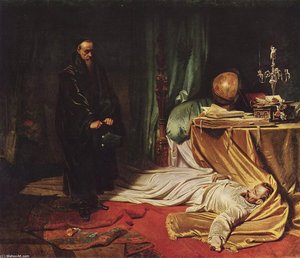
- Some of Piloty’s most renowned works include: Seni at the Dead Body of Wallenstein (1855), *The Battle of the White Mountain near Prague*, *Nero Dancing Upon the Ruins of Rome* (1861), *Godfrey of Bouillon on a Pilgrimage to the Holy Land* (1861), *Galileo in Prison* (1864), and *The Death of Alexander the Great* (unfinished).
- He also completed numerous mural paintings for the royal palace in Munich, including *The Discovery of America* commissioned by Baron von Schach.
- In 1874, Piloty was appointed keeper of the Munich Academy and subsequently ennobled by the King of Bavaria.
Teaching and Legacy
- Piloty became a highly influential teacher at the Munich Academy, succeeding his brother-in-law Karl Schorn as professor in 1856.
- Among his most famous pupils were Hans Makart, Franz von Lenbach, Franz Defregger, Gabriel von Max, Georgios Jakobides, and Eduard von Grützner – artists who would go on to shape the course of German painting.
- He is considered a key figure in establishing Munich as a major center for historical painting during the 19th century.
Historical Significance
- Karl Theodor von Piloty was the foremost representative of the Realistic school in Germany, bridging the gap between Romanticism and modern artistic movements.
- His dramatic compositions, meticulous detail, and focus on historical accuracy set a new standard for German history painting.
- Piloty’s influence extended beyond his own paintings through his teaching, shaping generations of artists and solidifying Munich's reputation as an artistic hub.
- He remains a significant figure in the study of 19th-century art and the development of German Realism.
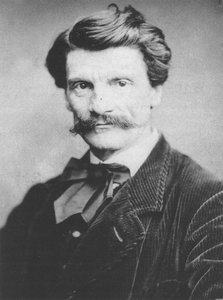
Karl Theodor von Piloty
1826 - 1886 , Germany
Quick Facts
- Birth Date: 1826
- Birth Place: Munich, Germany
- Death Date: 1886
- Influenced:
- Hans Makart
- Franz von Lenbach
- Franz Defregger
- Gabriel von Max
- Georgios Jakobides
- Eduard von Grützner
- Influenced By:
- Edouard de Bièfve
- Louis Gallait
- Movement: Realism
- Name: Karl Theodor von Piloty
- Nationality: German
- Notable Works:
- Die Amme (The Wet Nurse)
- Seni at the Dead Body of Wallenstein
- Nero Dancing Upon the Ruins of Rome
- Thusnelda Led in Germanicus' Triumph
- The Death of Alexander the Great
Related Articles
Bartolomeo Pinelli: Neoclassical Linearity & Roman Topography of Memory
Explore the captivating world of Bartolomeo Pinelli, a master Italian engraver renowned for his evocative Roman scenes & historical narratives. Discover his art and legacy with ArtsDot.
Sebastiano del Piombo: Bridging Venetian Colorism & Roman Grand Manner Portraiture
Explore the captivating art of Sebastiano del Piombo, a Renaissance master bridging Venetian colorism & Roman grandeur. Discover his iconic portraits and lasting influence on art history. Learn more at ArtsDot.
Pietro da Cortona: Baroque Grandeur & the Synthesis of Roman Painting
Explore the life & masterpieces of Pietro da Cortona, a defining figure of the Italian Baroque. Discover his stunning frescoes at Palazzo Barberini and lasting influence on Roman art history. Learn more with ArtsDot.
Echoes of 1873: Transition & Innovation in European Painting
Explore the pivotal year of 1873 in European painting! Discover Realism's final flourish & Impressionism’s rise with expert insights from ArtsDot.com. High-quality reproductions & art consultation.
Giovanni Paolo Panini: Capturing Roman Grandeur – A Vedute Master's Legacy
Explore the captivating world of Giovanni Paolo Panini, master of Roman vedute painting. Discover his technique, iconic works, influence on art history & collecting advice from experts at ArtsDot.