 Preview
 Send
Send Share
Share
 Details

 Download
 Similars
 X-Ray
X-Ray Diaporama
Suprematism
 Lithography
- WallArt
- Geometric Suprematism
 1920
1920- Modern
 49.0 x 69.0 cm
 Read More
Hand Made Oil Reproduction
Hand-painted oil on canvas in your size and frame, made to order by our artists. ( Buy Print Buy Image)




P118B $10

P118H $10

P118W $10

P438Z $10

P508JH $12

P508YH $12

P805H $10

P805Z $10

P919BZ $10

P919G $10

P919XJ $10

P959ZH $10

P968JZ $12

W106C $8

W218G $10

W218JH $8

W218Y $10

W307PJ $10

W316G $10

W316PJ $8

W316Y $10

W398PJ $8

W4111J $10

W500HY $15

W500JH $15

W692G $12

W849H $8

W940BG $15

W953PJ $8




Pick from our preset sizes that match the artwork's original proportions.

You may enter your own dimensions to fit a specific frame or space. If your selected size does not match the original image's proportions, we will either crop the artwork or extend the painting with additional hand-painted elements. A digital mockup will be sent for your approval before production begins.
Please note that the on-screen preview does not reflect the actual cropping or extension. Only the mockup will accurately show the final composition.
While custom sizes are available, we recommend selecting a dimension from the predefined list to preserve the original proportions.
After order, ArtsDot.com team will email client for instructions and provide a mockup preview
Worldwide Delivery () in 3/4 weeks instead of standard 5 weeks. (21 August). No compromise on quality.

Free Worldwide Express Shipping

High-Quality Linen Canvas

Full Shipping Insurance

Customs Tax Refund Guarantee

True Color Matching Guarantee

60-Day Return Policy (Defects Only)

100% Money-Back Guarantee

Bulk Discount Offer
 Glass option is only available in size under 110 CM

Suprematism
Reproduction Medium
Reproduction Size
-


Total Price
$ 263
Artwork Description
The Essence of Pure Feeling: A Journey into Suprematism
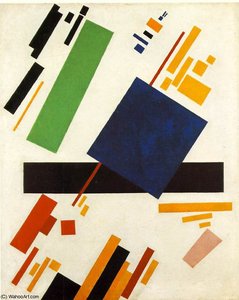
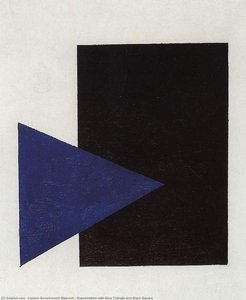
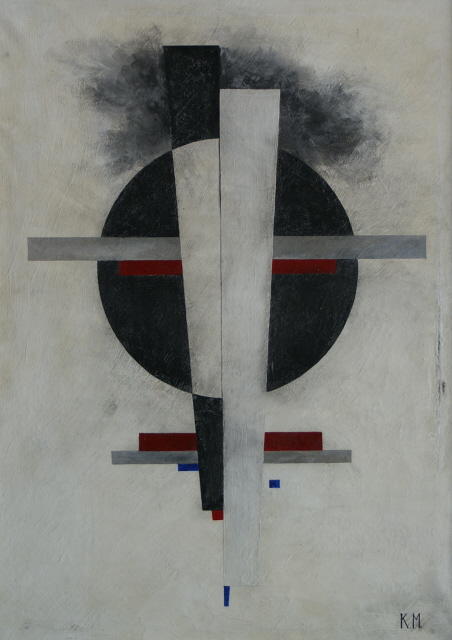
To encounter Kazimir Malevich’s Suprematism is to step away from the noisy, representational world and enter a realm of profound, silent clarity. Completed in 1920, this work serves as a radical manifesto of the early twentieth-century avant-garde, marking a decisive break from the obligation of art to mimic nature. Instead of landscapes or portraits, Malevich presents us with a distilled visual language—a composition where a singular circle, traced with a delicate blue outline, is intersected by a bold red line. This is not merely a geometric exercise; it is an invitation to experience the supremacy of pure feeling, stripped of all worldly distractions and reduced to its most essential, spiritual components.
The piece functions as a window into the "zero point" of creativity. By utilizing black and white lithography on paper, Malevich achieved a level of conceptual precision that avoids any unnecessary decorative flourish. The starkness of the medium forces the viewer to confront the weight of the shapes themselves. There is an undeniable tension in the way the red line cuts through the blue-rimmed circle, creating a sense of dynamic equilibrium. For the modern collector or interior designer, this painting offers a sophisticated focal point that commands attention through its minimalism, providing a sense of intellectual depth and structural balance to any curated space.
Symbolism and the Cosmic Infinite
Beyond its striking visual geometry, Suprematism is steeped in deep philosophical symbolism. The circle, rendered with its ethereal blue boundary, acts as a metaphor for the cosmos—a symbol of infinite space, unity, and the eternal. It represents a state of being that transcends the physical boundaries of our daily lives. When the red line intersects this celestial form, it introduces the concept of the "zero point." This is not an act of destruction or annihilation, but rather a moment of profound beginning. It signifies the birth of pure consciousness and the limitless potential of the human imagination when liberated from the constraints of objective reality.
Malevich’s journey from the lush landscapes of his Ukrainian upbringing to the radical abstractions of the Russian avant-garde is etched into every stroke of this work. He sought to find a "new truth" that could not be found in the imitation of objects, but only in the vibration of color and the arrangement of form. For those seeking to decorate a contemporary environment, this artwork brings an aura of contemplative stillness. It serves as a reminder that within simplicity lies complexity, and within the void, there is infinite possibility.
A Timeless Legacy for Modern Interiors
In the context of modern art history, Malevich’s 1920 masterpiece remains an undiminable cornerstone of abstraction. Its influence can be felt in everything from mid-century modernism to contemporary minimalist architecture. The painting does not merely sit upon a wall; it transforms the atmosphere of a room, injecting a sense of historical importance and avant-garde spirit. Whether placed in a professional gallery setting or as a centerpiece in a high-end residential lounge, its clean lines and striking contrast harmonize beautifully with modern textures like polished concrete, natural wood, or sleek glass.
Owning a high-quality reproduction of this work allows one to possess a fragment of the revolution that redefined what art could be. It is an investment in a legacy of courage—the courage to strip away the known and embrace the unknown. For the discerning eye, Suprematism is more than a painting; it is a profound encounter with the infinite, captured in a moment of perfect, geometric grace.
Related Artworks
Artist Biography
Kazimir Malevich: A Pioneer of Abstract Art
Early Life and Influences
- Born in Kyiv Oblast, Ukraine in 1878 to a Polish family, Kazimir Severinovich Malevich’s early life was shaped by the rural Ukrainian landscape and its rich folk culture.
- His upbringing instilled in him an appreciation for traditional artistic expressions that would later subtly influence his work.
- Formal training began in Kyiv, but Malevich quickly sought broader artistic horizons, moving towards Moscow and eventually engaging with the burgeoning avant-garde movements of Europe.
- Key Influences: Early exposure to folk art, combined with a desire for modern expression, formed the foundation of his unique style.
Artistic Development & Key Movements
- Initially, Malevich explored various styles including Impressionism, Symbolism, Fauvism, and Cubism. A pivotal trip to Paris in 1912 exposed him to the latest developments in European art.
- He gradually moved away from representational forms, seeking a purely artistic language based on geometric shapes and color.
- This led to the development of Suprematism around 1915 – an abstract movement focused on “the supremacy of pure feeling” in art.
- Suprematism rejected any attempt to depict objects from the visible world, instead prioritizing basic geometric forms like squares, circles, and rectangles.
Major Achievements & Notable Works
- Black Square (1915): Arguably his most famous work, it represents a radical departure from traditional art and is considered a foundational piece of abstract painting.
- White on White (1918): A series exploring the purity of form and color, featuring white geometric shapes against a white background – pushing abstraction to its limits.
- Stroyuschiysya dom [House under Construction] (1916): An early example of Suprematism showcasing his unique perspective on Ukrainian culture through abstract forms.
- He also wrote extensively on art theory, articulating the philosophical principles behind Suprematism and advocating for a new artistic consciousness.
Historical Significance & Legacy
- Malevich’s work profoundly impacted the development of 20th-century abstract art, influencing movements like Minimalism and Constructivism.
- He challenged conventional notions of representation and paved the way for non-objective art.
- His ideas about pure feeling and geometric abstraction continue to resonate with artists today.
- Despite facing political persecution under Stalin – initially supported, then suppressed – Malevich persevered in his practice and teaching.
- Influence on Later Artists: He directly influenced artists like El Lissitzky and indirectly shaped countless others through the enduring legacy of Suprematism.
Later Life & Death
- In his later years, Malevich revisited figurative painting, attempting to synthesize his abstract principles with representational forms.
- He continued to teach and write about art until his death in Leningrad (now St. Petersburg) in 1935.
- His work remained relatively obscure for decades after his death but experienced a resurgence of interest in the latter half of the 20th century, solidifying his place as one of the most important figures in modern art history.

Kazimir Malevich
1878 - 1935 , Ukraine
Quick Facts
- Artistic Movement Or Style: Suprematism, Abstract Art
- Artists Or Movements Influenced By This Artist:
- Minimalism
- Constructivism
- El Lissitzky
- Artists Who Influenced This Artist:
- Cubism
- Fauvism
- Impressionism
- Date Of Birth: 1878
- Date Of Death: 1935
- Full Name: Kazimir Severinovich Malevich
- Nationality: Ukrainian/Russian
- Notable Artworks:
- Black Square
- White on White
- House under Construction
- Place Of Birth: Kyiv, Ukraine
Related Articles
Kazimir Malevich: 25 Masterpieces of Suprematism & Abstract Art | ArtsDot
Explore 25 iconic artworks by Kazimir Malevich, pioneer of Suprematism & abstract art. Discover the stories behind 'Black Square' and more! Find museum-quality prints & elevate your home decor with ArtsDot.com.

Geometric Abstraction's 10 Defining Masterpieces | Art for Your Home - ArtsDot
Explore 10 defining masterpieces of Geometric Abstraction! Discover Kandinsky, Mondrian & Malevich’s iconic works. Find museum-quality art reproductions and curated decor ideas to elevate your home at ArtsDot.com.
Beyond Form & Color: Geometric Abstraction's Evolution in 20th/21st Century Art
Explore the evolution of geometric abstraction from Cubism to contemporary art. Discover key artists like Malevich & Mondrian, investment insights, and expert collecting advice at ArtsDot.
Kazimir Malevich: Pioneering Suprematism & the Quest for Non-Objective Art
Explore the revolutionary art of Kazimir Malevich & his groundbreaking Suprematism movement. Discover the origins, core principles, and lasting impact of this pivotal force in modern abstract painting.
Beyond Form & Color: Geometric Abstraction's Enduring Legacy in Art History
Explore the captivating world of geometric abstraction! Discover its origins, key artists like Malevich & Mondrian, and why this movement remains highly valued by art collectors today. Expert insights at ArtsDot.