 Preview
 Send
Send Share
Share
 Details

 Download
 Similars
 X-Ray
X-Ray Diaporama
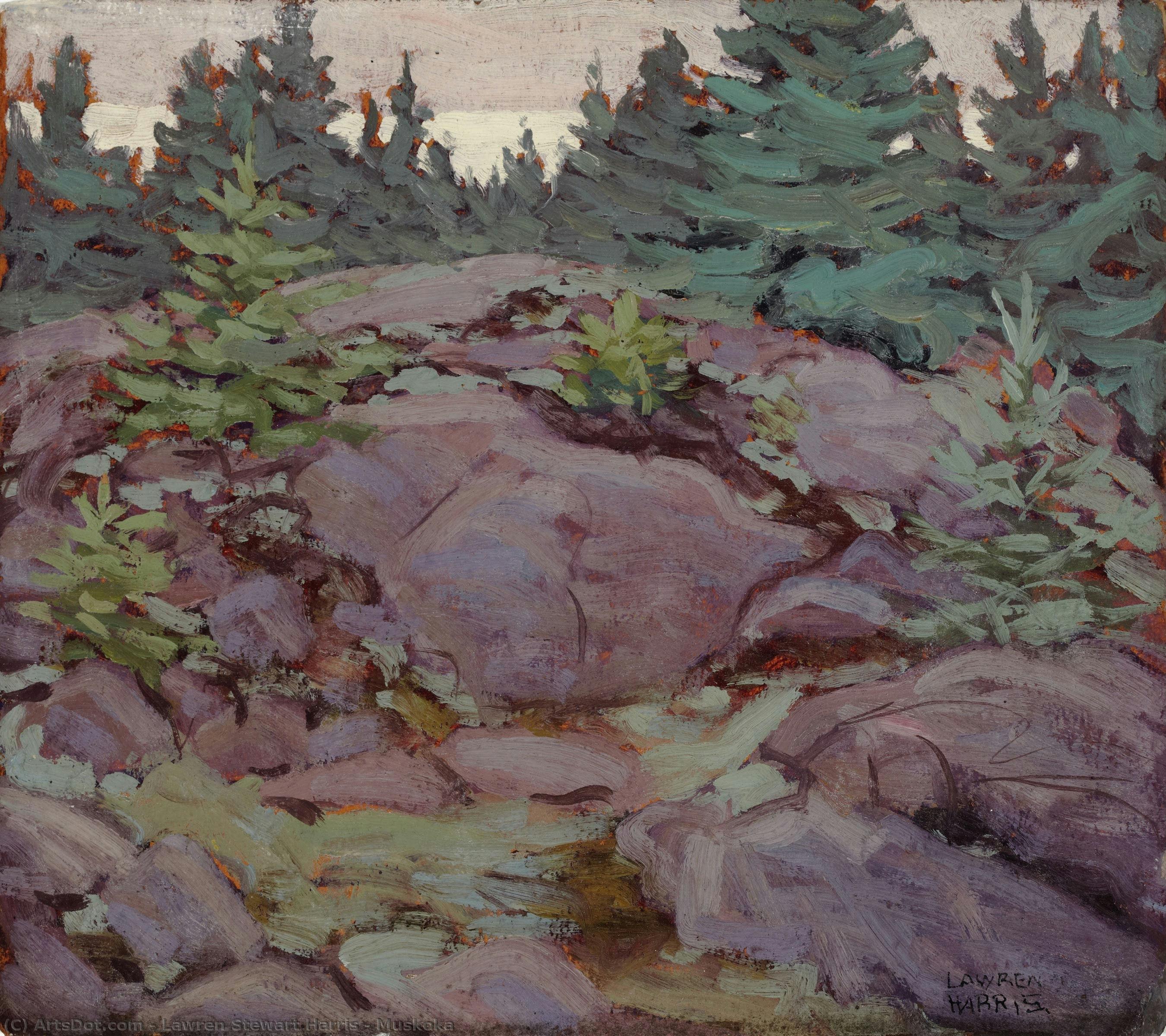
Muskoka


 Read More
Hand Made Oil Reproduction
Hand-painted oil on canvas in your size and frame, made to order by our artists. ( Buy Print Buy Image)




P118B $10

P118H $10

P118W $10

P438Z $10

P508JH $12

P508YH $12

P805H $10

P805Z $10

P919BZ $10

P919G $10

P919XJ $10

P959ZH $10

P968JZ $12

W106C $8

W218G $10

W218JH $8

W218Y $10

W307PJ $10

W316G $10

W316PJ $8

W316Y $10

W398PJ $8

W4111J $10

W500HY $15

W500JH $15

W692G $12

W849H $8

W940BG $15

W953PJ $8




Pick from our preset sizes that match the artwork's original proportions.

You may enter your own dimensions to fit a specific frame or space. If your selected size does not match the original image's proportions, we will either crop the artwork or extend the painting with additional hand-painted elements. A digital mockup will be sent for your approval before production begins.
Please note that the on-screen preview does not reflect the actual cropping or extension. Only the mockup will accurately show the final composition.
While custom sizes are available, we recommend selecting a dimension from the predefined list to preserve the original proportions.
After order, ArtsDot.com team will email client for instructions and provide a mockup preview
Worldwide Delivery () in 3/4 weeks instead of standard 5 weeks. (17 August). No compromise on quality.

Free Worldwide Express Shipping

High-Quality Linen Canvas

Full Shipping Insurance

Customs Tax Refund Guarantee

True Color Matching Guarantee

60-Day Return Policy (Defects Only)

100% Money-Back Guarantee

Bulk Discount Offer
 Glass option is only available in size under 110 CM

Muskoka
Reproduction Medium
Reproduction Size
-


Total Price
$ 263
Artwork Description
A Vision of the Canadian Wilderness
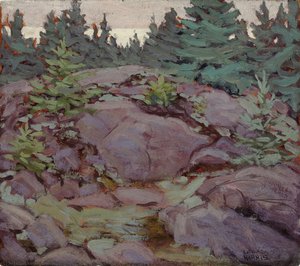
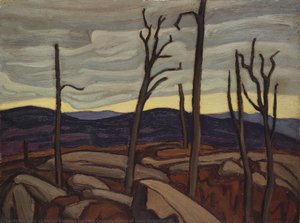
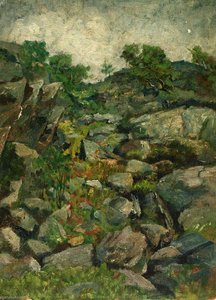
In the heart of the Canadian landscape, where the rugged terrain of Muskoka meets the sky, Lawren Stewart Harris captures a moment of profound stillness and natural grandeur. This 1920 masterpiece serves as more than just a depiction of a rocky hillside; it is an invitation into a world where the earth feels both ancient and alive. The painting presents a sweeping view of a massive, textured rock formation, draped in a dense tapestry of pine trees that cling to the stone with quiet resilience. Through his masterful use of light and shadow, Harris creates a sense of immense depth, drawing the viewer’s eye upward through the layered foliage toward the unseen heights of the wilderness. The composition is balanced by the subtle inclusion of small figures nestled within the landscape, providing a poignant scale that emphasizes the vastness of the natural world while suggesting a harmonious, almost spiritual connection between humanity and the wild.
The technique employed in this work reflects Harris’s pivotal role in shaping a uniquely Canadian aesthetic. Moving away from the delicate, impressionistic traditions of Europe, Harris utilized a more structured and robust approach to define the character of the North. Each brushstroke contributes to the tactile quality of the scene, from the rough, weathered surfaces of the granite outcrops to the soft, dark needles of the coniferous trees. His ability to manipulate light creates a luminous atmosphere that seems to radiate from within the canvas itself, capturing that specific, crisp clarity found in the Ontario highlands. For the discerning collector or interior designer, this piece offers a sophisticated interplay of organic textures and tonal depth, making it a commanding focal point that brings the serene, untamed spirit of the Canadian Shield into any refined space.
Historical Significance and Spiritual Resonance
To understand Muskoka is to understand the birth of a national identity. As a founding member of the legendary Group of Seven, Lawren Stewart Harris sought to move beyond mere topographical recording to find the "soul" of the landscape. During this era, Canadian artists were striving to break free from colonial influences to create an art form that resonated with the rugged, unyielding spirit of their homeland. This painting, dating from 1920, sits at a crucial juncture in his career where his style began to transition toward the more stylized, almost spiritual minimalism for which he is globally renowned. The landscape is not merely a subject; it is a vessel for contemplation.
The symbolism embedded within the work speaks to themes of endurance and solitude. The steadfastness of the rocks and the upward reach of the pines serve as metaphors for strength and growth amidst adversity. There is a quiet, meditative quality to the scene that evokes a sense of peace, making it an ideal acquisition for those looking to introduce a sense of tranquility and timelessness into their environment. Whether displayed in a contemporary gallery setting or a classic study, this reproduction of Harris’s vision serves as a window into a pristine era of Canadian history, offering an enduring emotional impact that continues to inspire awe and reverence in all who behold it.
Related Artworks
Artist Biography
A Pioneer of the Canadian Spirit: The Life and Art of Lawren Stewart Harris
Lawren Stewart Harris, born in Brantford, Ontario, in 1885, wasn’t merely a painter; he was an architect of Canadian identity. Emerging from a privileged background – his family's wealth stemming from the Massey-Harris agricultural machinery empire – Harris possessed the financial freedom to dedicate himself wholly to artistic exploration. This independence allowed him to forge a path distinct from European traditions, becoming a pivotal figure in defining a uniquely Canadian aesthetic. From an early age, he demonstrated a keen interest in art, pursuing formal training first in Berlin and then returning to Canada with a broadened perspective, yet one that would soon be redirected towards capturing the essence of his homeland.
Harris’s artistic journey truly ignited with his involvement in the formation of the Group of Seven. This collective of artists – including J.E.H. MacDonald, Franklin Carmichael, and A.Y. Jackson – shared a revolutionary vision: to move beyond imitation of European styles and depict the raw, untamed beauty of the Canadian landscape with bold originality. Harris wasn’t simply a member; he was a catalyst, providing both financial support and intellectual leadership that propelled the group forward. He believed in a spiritual connection to the land, viewing the vast forests, rugged mountains, and icy northern expanses as subjects worthy of profound artistic reverence.
The Evolution of Style: From Impressionism to Abstraction
Harris’s style underwent a remarkable transformation throughout his career. Initially influenced by Impressionism and Post-Impressionism acquired during his European studies, his early works displayed a vibrant palette and a focus on capturing light and atmosphere. However, this approach soon gave way to something far more distinctive. Inspired by the stark beauty of Algoma and later, the dramatic landscapes of Lake Superior and the Arctic, Harris began to simplify his compositions, reducing forms to their essential geometric shapes and employing a restrained color scheme. This wasn’t merely an aesthetic choice; it was a deliberate attempt to convey the spiritual power and enduring quality of the Canadian wilderness.
The 1920s marked a period of radical experimentation for Harris. He increasingly moved towards abstraction, stripping away representational details in favor of conveying emotional and symbolic meaning through color, line, and form. Notably, he even ceased signing and dating his works, believing that the art should stand on its own merit, unburdened by the artist’s identity or historical context. This bold move underscored his commitment to a purely visual experience, inviting viewers to engage with the paintings on a deeper, more intuitive level. Later in life, Harris embraced complete abstraction, co-founding the Transcendental Painting Group in New Mexico and exploring non-objective art that sought to express universal spiritual truths.
Legacy and Impact: A Lasting Impression
Lawren Harris’s contributions to Canadian art are immeasurable. As a founding member of the Group of Seven, he played an instrumental role in establishing Canada's first internationally recognized modern art movement. His paintings not only captured the physical beauty of the landscape but also evoked a sense of national pride and identity. He helped Canadians see their own country with new eyes, recognizing its unique character and spiritual significance.
Beyond his artistic achievements, Harris was a dedicated advocate for Canadian culture. He actively promoted the work of other artists and championed the importance of art education. His influence extended beyond painting, inspiring generations of artists to explore their own creative visions and embrace the challenges of forging a distinctly Canadian voice in the global art world.
In 1969, Harris was rightfully honored as a Companion of the Order of Canada, recognizing his lifetime dedication to artistic excellence and his profound impact on the nation’s cultural landscape. His works continue to be exhibited in major museums across Canada and internationally, ensuring that his legacy endures for generations to come. To experience the power of Lawren Harris is to connect with the very soul of Canada – a land of vastness, beauty, and enduring spirit.
- Notable Works: “Above Lake Superior” (1922), “Algoma Country,” “Houses, Chestnut Street”, "Northern Lake", "Mountains, Moraine Lake".
- Further Exploration: Discover more about Lawren Harris on Wikipedia and explore the collection at The McMichael Canadian Art Collection.
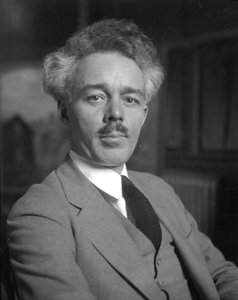
Lawren Stewart Harris
1885 - 1970 , Canada
Quick Facts
- Artistic Movement Or Style: Group of Seven, Minimalism
- Artists Or Movements Influenced By This Artist: ['Canadian Modern Art']
- Date Of Birth: October 23, 1885
- Date Of Death: January 29, 1970
- Full Name: Lawren Stewart Harris
- Nationality: Canadian
- Notable Artworks:
- Above Lake Superior
- Algoma Country
- Houses, Chestnut Street
- Northern Lake
- Place Of Birth: Brantford, Canada
Related Articles

Beyond the Horizon: 10 Landscape Masterpieces for Your Home Decor
Journey through 10 breathtaking landscape paintings by Monet, Van Gogh & more! Explore iconic artworks, artistic techniques & find inspiration for your home decor. Museum-quality reproductions at ArtsDot.com. Discover all masterpieces on ArtsDot.com
Arboreal Echoes: A Historical & Artistic Exploration of Trees in Painting
Explore the rich history of trees in painting! Discover symbolism, Romantic masterpieces by Caspar David Friedrich & beyond. A curated journey for art enthusiasts.

Romantic Landscapes: 10 Masterpieces for Your Home | ArtsDot
Journey through 10 Romantic landscape masterpieces by Friedrich, Turner & Cole. Explore emotional art, sublime nature scenes & iconic 19th-century paintings. Find museum-quality reproductions for your home at ArtsDot.com – discover the full collection online!

John Constable's Masterpieces: Explore 25 Iconic Landscapes for Your Home
Journey through John Constable's 25 most celebrated landscapes. Explore Romanticism, Dedham Vale & his masterful use of light in iconic paintings like 'Hay Wain'. Find museum-quality art reproductions and elevate your home decor on ArtsDot.com.
Arboreal Echoes: A Historical & Artistic Exploration of Trees in Painting
Explore the rich history of trees in painting! Discover symbolism, Romantic masterpieces by Caspar David Friedrich & beyond. A curated journey for art enthusiasts.