Preview
 Send
Send Share
Share
 Details

 Download
 Similars
 X-Ray
X-Ray Diaporama
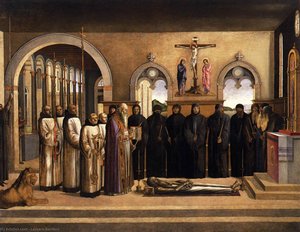
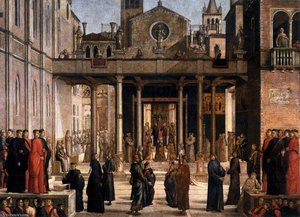
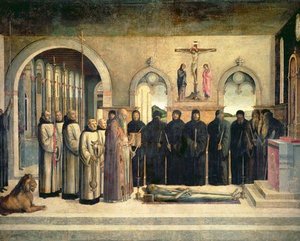
Funeral of St Jerome
 Oil On Canvas
- WallArt
- Venetian Renaissance
 1470
1470- Renaissance
 209.0 x 263.0 cm
 Gallerie dell'Accademia
 Read More
Hand Made Oil Reproduction
Hand-painted oil on canvas in your size and frame, made to order by our artists. ( Buy Print Buy Image)




P118B $10

P118H $10

P118W $10

P438Z $10

P508JH $12

P508YH $12

P805H $10

P805Z $10

P919BZ $10

P919G $10

P919XJ $10

P959ZH $10

P968JZ $12

W106C $8

W218G $10

W218JH $8

W218Y $10

W307PJ $10

W316G $10

W316PJ $8

W316Y $10

W398PJ $8

W4111J $10

W500HY $15

W500JH $15

W692G $12

W849H $8

W940BG $15

W953PJ $8




Pick from our preset sizes that match the artwork's original proportions.

You may enter your own dimensions to fit a specific frame or space. If your selected size does not match the original image's proportions, we will either crop the artwork or extend the painting with additional hand-painted elements. A digital mockup will be sent for your approval before production begins.
Please note that the on-screen preview does not reflect the actual cropping or extension. Only the mockup will accurately show the final composition.
While custom sizes are available, we recommend selecting a dimension from the predefined list to preserve the original proportions.
After order, ArtsDot.com team will email client for instructions and provide a mockup preview
Worldwide Delivery () in 3/4 weeks instead of standard 5 weeks. (17 August). No compromise on quality.

Free Worldwide Express Shipping

High-Quality Linen Canvas

Full Shipping Insurance

Customs Tax Refund Guarantee

True Color Matching Guarantee

60-Day Return Policy (Defects Only)

100% Money-Back Guarantee

Bulk Discount Offer
 Glass option is only available in size under 110 CM

Funeral of St Jerome
Reproduction Medium
Reproduction Size
-


Total Price
$ 263
Artwork Description
A Solemn Procession: The Drama of St Jerome's Funeral
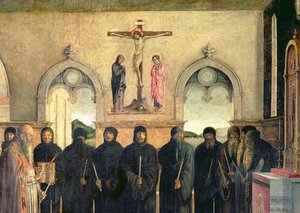
To stand before this depiction of the Funeral of St Jerome is to be enveloped in an atmosphere of profound, hushed reverence. Lazzaro Bastiani masterfully captures a moment suspended between earthly sorrow and divine promise. The scene unfolds as a somber procession, its weight palpable in the dark drapery of the mourners who gather around the central focus: the cross bearing the figure of Jesus Christ. This is not merely a depiction of mourning; it is a monumental meditation on sacrifice, redemption, and the enduring nature of faith that has echoed through centuries of art.
Venetian Renaissance Mastery in Pigment
Painted around 1470 by Lazzaro Bastiani, this work stands as a testament to the vibrant yet deeply spiritual currents flowing through the Venetian Renaissance. While Bastiani’s career saw him influenced by masters like Andrea Mantegna, his hand here exhibits a unique ability to balance dramatic narrative with meticulous detail. Observe the handling of the figures; the somber black garments worn by the monks and nuns are rendered with a depth that suggests texture and gravity. The composition guides the eye inexorably toward the cross, while peripheral details—such as the visible clock face on the right—anchor the eternal drama within a specific, measurable time, suggesting that even in eternity, moments pass.
Symbolism Woven into Shadow and Light
The symbolism inherent in this piece is rich and multi-layered. The funeral itself speaks to the cycle of life and death, yet the presence of Christ elevates it beyond mere grief. The gathering figures represent humanity confronting its deepest sorrows while simultaneously being drawn toward spiritual solace. The contrast between the dark mourning attire and the implied light emanating from the divine figure on the cross creates a powerful visual dialectic—the struggle between shadow and grace. For the collector or designer, this piece offers not just decoration, but a profound focal point for contemplation within any space.
An Emotional Resonance for Modern Spaces
The emotional impact of this painting is immediate and deeply moving. It invites quiet reflection, encouraging the viewer to pause their modern haste and consider themes of mortality and enduring belief. Reproducing such an artwork allows one to bring a piece of historical gravitas into contemporary living or design. Whether placed in a library corner meant for deep thought, or within a formal hall requiring an air of timeless dignity, this Funeral of St Jerome serves as a powerful anchor—a visual sermon rendered in oil paint.
Related Artworks





Artist Biography
The Venetian Legacy of Lazzaro Bastiani
Lazzaro Bastiani stands as a significant, albeit somewhat enigmatic, figure within the Venetian artistic landscape of the fifteenth and sixteenth centuries. Born in Padua in 1429, he emerged as a painter during a period marked by burgeoning humanist ideals and unparalleled artistic innovation—a time when Venice reigned supreme as a commercial powerhouse and cultural epicenter. While his output wasn’t as prolific or celebrated as contemporaries like Titian or Bellini, Bastiani nonetheless contributed substantially to the stylistic evolution of Venetian painting, particularly within the Scuola Grande di San Marco and its associated workshops.
Bastiani's artistic journey began in Padua, where he honed his skills under the tutelage of Andrea Mantegna—a master whose influence is palpable in Bastiani’s early works. This foundation in the rigorous, sculptural style of Mantegna provided him with a technical precision that would later blend seamlessly with the softer, more atmospheric qualities of the Venetian school. Records indicate that he swiftly established himself as a painter in Venice by 1460, securing commissions for altarpieces commissioned by the Procurators of San Marco, demonstrating an immediate grasp of the prevailing artistic tastes and expectations of the Venetian elite. Notably, his payment rate mirrored that of Giovanni Bellini at the time, signifying his recognition as a rising talent within the influential Bellini workshop—a connection that undoubtedly shaped his stylistic development.
A Collaborative Spirit in the Heart of Venice
Bastiani’s involvement with the Scuola Grande di San Marco proved pivotal to his career. From the 1480s onwards, he collaborated closely with Gentile Bellini, engaging in ambitious projects aimed at glorifying Venetian civic pride and commemorating important religious events. Their partnership exemplifies the collaborative spirit characteristic of Venetian painting during this era—a tradition where shared workshops and collective commissions allowed for a rich exchange of ideas and techniques. Through these large-scale endeavors, Bastiani helped weave the narrative of Venetian identity into the very fabric of its religious and civic institutions.
His mastery is perhaps most evident in his ability to balance sacred solemnity with human emotion. In works such as St. Veneranda Enthroned and the Madonna of Humility, one can observe a delicate interplay of light and shadow that breathes life into the divine subjects. His religious compositions often served as more than mere decoration; they were profound theological statements designed to inspire devotion. This is particularly evident in his detailed depictions of sacred ceremonies, such as The Relic of the Holy Cross is offered to the Scuola Grande di San Giovanni Evangelista, where he captures the intricate ritualism and communal fervor of the period with remarkable clarity.
Artistic Significance and Enduring Influence
As his career progressed, Bastiani’s work became a bridge between the structured, linear traditions of the early Renaissance and the more fluid, color-driven approach that would eventually define the High Renaissance in Venice. His ability to integrate the monumental presence of Mantegnesque figures with the luminous, atmospheric qualities pioneered by the Bellini family allowed him to create works that were both physically imposing and spiritually resonant.
Though history often focuses on the titans of the Venetian school, the contributions of Lazzaro Bastiani remain vital to understanding the cohesive movement of 15th-century art. His legacy is found in:
- The development of the Venetian altarpiece: Refining the use of religious iconography to serve both church and state.
- Collaborative excellence: Demonstrating how workshop partnerships drove the innovation of the Renaissance era.
- Stylistic synthesis: Merging Paduan precision with Venetian luminosity, creating a unique visual language for his era.
By the time of his death in 1512, Bastiani had left an indelible mark on the workshops of Venice, ensuring that his influence would ripple through the generations of painters who followed him into the golden age of the Venetian Renaissance.

Lazzaro Bastiani
1429 - 1512 , Italy
Quick Facts
- Artistic Movement Or Style: Renaissance
- Artists Who Influenced This Artist:
- Giovanni Bellini
- Gentile Bellini
- Date Of Birth: Padua, Italy (1429)
- Date Of Death: 1512
- Full Name: Lazzaro Bastiani
- Nationality: Italian
- Notable Artworks:
- St. Jerome
- Madonna of Humility
- Madonna and Child enthroned with St. George
- Place Of Birth: Venice
Related Articles

Jacopo Tintoretto's Masterpieces: 25 Paintings That Define Venetian Drama | ArtsDot
Explore 25 breathtaking masterpieces by Jacopo Tintoretto, the Venetian master of drama and light. Discover the stories behind iconic Renaissance paintings & find museum-quality art reproductions to elevate your home decor on ArtsDot.com.

Giclée Prints: Archival Quality & Aesthetic Nuances for the Discerning Collector
Explore the world of giclée prints with ArtsDot. Learn about archival quality, aesthetic nuances & investment potential. Expert guidance for discerning art collectors seeking museum-quality reproductions and lasting value.

The Enduring Legacy of Fine Art Prints: Technique, History & Aesthetic Impact
Explore the rich history & techniques of fine art prints. Discover investment potential, assess authenticity, and learn how to preserve your collection with expert guidance. Trusted insights for discerning collectors.

Echoes of Time: Exploring the Enduring Appeal & Historical Context of Vintage Art Prints
Explore the captivating world of vintage art prints! Discover their history, collecting tips & enduring appeal. Expert insights on chromolithography and building a legacy collection with ArtsDot.

El Greco's Masterpieces: Explore 25 Iconic Paintings & Spiritual Visions | ArtsDot
Journey through El Greco's 25 most iconic paintings! Explore the spiritual depth & dramatic beauty of this Spanish Renaissance master. Discover art history, techniques & find museum-quality reproductions for your home at ArtsDot.com.