 Preview
 Send
Send Share
Share
 Details

 Download
 Similars
 X-Ray
X-Ray Diaporama
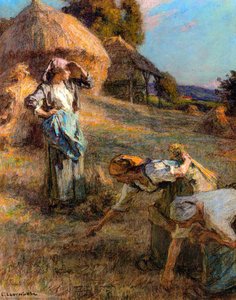
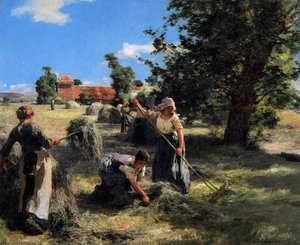
La Fenaison

 Read More
Hand Made Oil Reproduction
Hand-painted oil on canvas in your size and frame, made to order by our artists. ( Buy Print Buy Image)




































Pick from our preset sizes that match the artwork's original proportions.

You may enter your own dimensions to fit a specific frame or space. If your selected size does not match the original image's proportions, we will either crop the artwork or extend the painting with additional hand-painted elements. A digital mockup will be sent for your approval before production begins.
Please note that the on-screen preview does not reflect the actual cropping or extension. Only the mockup will accurately show the final composition.
While custom sizes are available, we recommend selecting a dimension from the predefined list to preserve the original proportions.
After order, ArtsDot.com team will email client for instructions and provide a mockup preview
Worldwide Delivery () in 3/4 weeks instead of standard 5 weeks. (16 August). No compromise on quality.

Free Worldwide Express Shipping

High-Quality Linen Canvas

Full Shipping Insurance

Customs Tax Refund Guarantee

True Color Matching Guarantee

60-Day Return Policy (Defects Only)

100% Money-Back Guarantee

Bulk Discount Offer
 Glass option is only available in size under 110 CM

La Fenaison
Reproduction Medium
Reproduction Size
-


Total Price
$ 263
Artwork Description
The Painting's Context and Significance
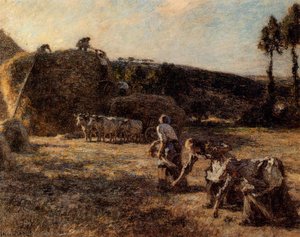
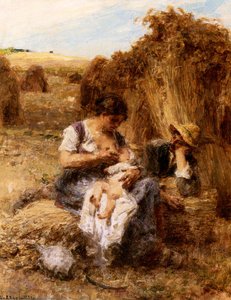
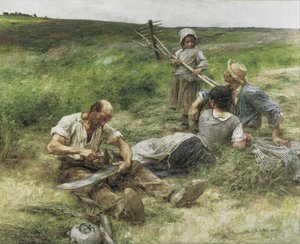
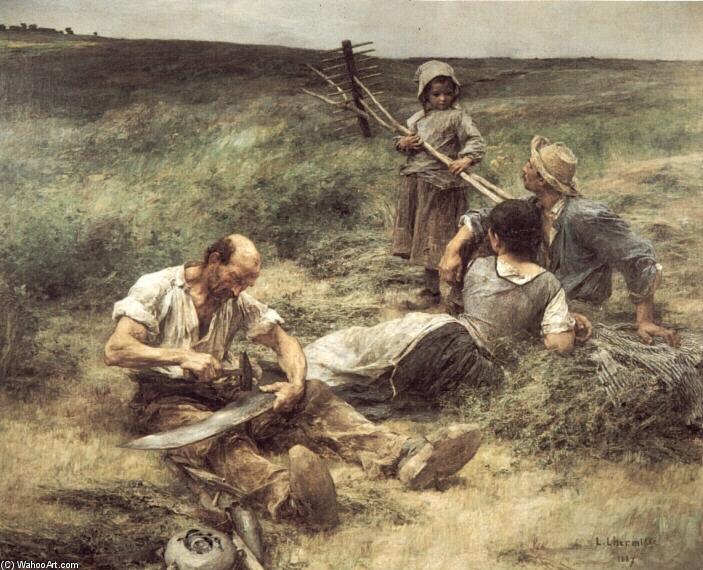
Léon Augustin L'hermitte, a renowned French realist painter, created La Fenaison as part of his extensive series depicting rural scenes. This oil painting is a testament to the artist's ability to capture the essence of hard labor and teamwork in the countryside.The Composition and Details
The painting features four main figures engaged in various activities within a field. A man stands on the left, while another sits in the middle, cutting something with a knife. Two more individuals are positioned on the right side, observing their colleague's work. An additional figure is visible at the far right edge of the canvas. The field itself contains several objects, including two piles of hay and a chair near the center.Artistic Style and Technique
L'hermitte's use of realism in La Fenaison highlights his skill in capturing the mundane yet significant aspects of rural life. The painting's atmosphere conveys the sense of hard labor and cooperation among the workers, emphasizing their dedication to their tasks.Artist's Background and Achievements
L'hermitte was a student of Lecoq de Boisbaudran and gained recognition after his show in the Paris Salon in 1864. He received numerous awards, including the French Legion of Honour. His work is characterized by its focus on rural scenes, showcasing peasants at work.Relevance to Art History
La Fenaison is part of a broader collection of paintings that reflect L'hermitte's interest in depicting everyday life in the countryside. This style of realism was influential in the development of art during his time and continues to be appreciated today.Availability and Reproduction
For those interested in owning a piece of this artistic history, handmade oil painting reproductions of La Fenaison are available at ArtsDot.com. This platform offers high-quality reproductions that capture the essence of L'hermitte's original work.Conclusion
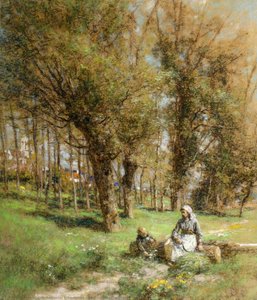
La Fenaison by Léon Augustin L'hermitte is a significant piece in the realm of rural realism. Its depiction of hard labor and teamwork serves as a testament to the artist's skill and dedication to his craft. For art enthusiasts, this painting offers a glimpse into the lives of rural workers during the late 19th century.- Repos pendant la fenaison by Léon Augustin L'hermitte
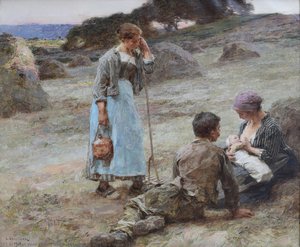
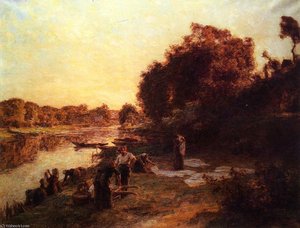
- Washerwomen Setting The Linens Out To Dry by Léon Augustin L'hermitte
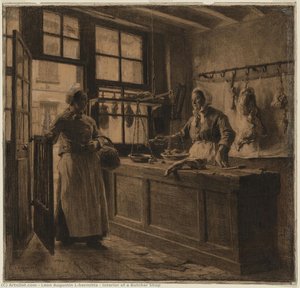
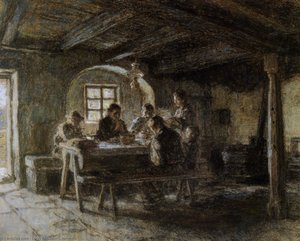
- Interior of a Butcher Shop by Léon Augustin L'hermitte
Learn more about the Forest Lawn Museum in Glendale, California, and its collection of art pieces at The Museum Forest Lawn Museum (Glendale, United States).
Related Artworks
Artist Biography
Léon Augustin L'Hermitte: A Life Dedicated to Realism
Early Life and Training
Léon Augustin L'Hermitte, a prominent French realist painter and etcher, was born on July 31, 1844, in Mont-Saint-Père, France. His upbringing within the rural landscapes of Picardy profoundly shaped his artistic vision. Recognizing his talent, his father, a schoolteacher, provided early encouragement. L'Hermitte formally began his training at the Special School of Drawing and Mathematics (the “Petite École”) under Horace Lecoq de Boisbaudran, laying a strong foundation in draftsmanship. He continued his studies at the prestigious Paris School of Fine Arts.Rise to Prominence and Artistic Style
L'Hermitte’s breakthrough came with his debut at the Paris Salon in 1864, garnering initial recognition. His dedication to depicting rural life and the working class resonated with audiences and critics alike. He quickly established himself as a leading figure within the realist movement. His innovative use of pastels was particularly admired. In 1884, he was honored with the French Legion of Honour, followed by the Grand Prize at the Exposition Universelle in 1889 – testaments to his growing reputation and artistic merit. His style is characterized by a sensitive portrayal of everyday life, focusing on dignity and hardship within rural communities.Influences and Artistic Development
Jean-François Millet served as a significant influence on L'Hermitte’s work, particularly in his choice of subject matter and empathetic depiction of peasant life. L'Hermitte shared Millet’s commitment to portraying the realities of rural existence with honesty and respect. He also drew inspiration from the broader realist movement, seeking to represent the world as it was, without idealization or romanticism. His early training emphasized meticulous observation and technical skill, which he later applied to his distinctive pastel technique.Notable Works and Themes
- Interior of a Butcher Shop: A detailed depiction of working-class life, showcasing L'Hermitte’s mastery of composition and realism.
- The Gleaners (1887): Captures the essence of rural labor and the dignity of those who toiled in the fields.
- La Fenaison: Illustrates a scene of haymaking, highlighting the communal aspects of agricultural work.
- Le Passeur: A poignant portrayal of a ferryman and his passengers.
- Pelerinage Pour L'Enfant Malade. Eglise De Plein-Pied, Bourges: Depicts a religious procession, showcasing the spiritual life of rural communities.
Legacy and Historical Significance
L'Hermitte’s contributions to the realist movement have secured his place in art history. His paintings are featured in prominent museums worldwide, including those in Amsterdam, Boston, Brussels, Cleveland, Philadelphia, and Washington D.C.. He was elected a full member of the Academy of Fine Arts in 1905, further solidifying his artistic standing. Vincent van Gogh himself praised L'Hermitte’s work for its beauty and emotional depth. L'Hermitte’s legacy lies in his ability to capture the essence of rural life with sensitivity and skill, offering a valuable glimpse into 19th-century French society. He died in 1925, leaving behind a body of work that continues to inspire and resonate with audiences today.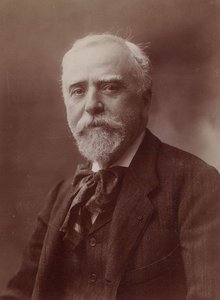
léon augustin l'hermitte
1844 - 1925 , France
Quick Facts
- Birth Date: July 31, 1844
- Birth Place: Mont-Saint-Père, France
- Death Date: 1925
- Influenced: Vincent van Gogh
- Influenced By: Jean-François Millet
- Movement: Realism
- Name: Léon Augustin L'Hermitte
- Nationality: French
- Notable Works:
- Interior of a butcher shop
- The gleaners
- La Fenaison
- Le Passeur
- Pelerinage Pour L'Enfant Malade