 Send
Send Share
Share
 Details

 Download
 Similars
 Diaporama
Cotton-Mill Worker, North Carolina
 Black and White Photography
- Photo
- Documentary Photography
 1908
1908- 19th Century
 11.0 x 16.0 cm
 J. Paul Getty Museum
 Read More
Hand Made Oil Reproduction
Hand-painted oil on canvas in your size and frame, made to order by our artists. ( Buy Print Buy Image)




































Pick from our preset sizes that match the artwork's original proportions.

You may enter your own dimensions to fit a specific frame or space. If your selected size does not match the original image's proportions, we will either crop the artwork or extend the painting with additional hand-painted elements. A digital mockup will be sent for your approval before production begins.
Please note that the on-screen preview does not reflect the actual cropping or extension. Only the mockup will accurately show the final composition.
While custom sizes are available, we recommend selecting a dimension from the predefined list to preserve the original proportions.
After order, ArtsDot.com team will email client for instructions and provide a mockup preview
Worldwide Delivery () in 3/4 weeks instead of standard 5 weeks. (22 August). No compromise on quality.

Free Worldwide Express Shipping

High-Quality Linen Canvas

Full Shipping Insurance

Customs Tax Refund Guarantee

True Color Matching Guarantee

60-Day Return Policy (Defects Only)

100% Money-Back Guarantee

Bulk Discount Offer
 Glass option is only available in size under 110 CM

Cotton-Mill Worker, North Carolina
Reproduction Medium
Reproduction Size
-


Total Price
$ 263
Artwork Description
The Weight of Industry: A Glimpse into Early 20th Century Labor
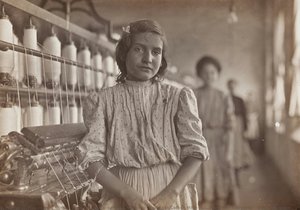
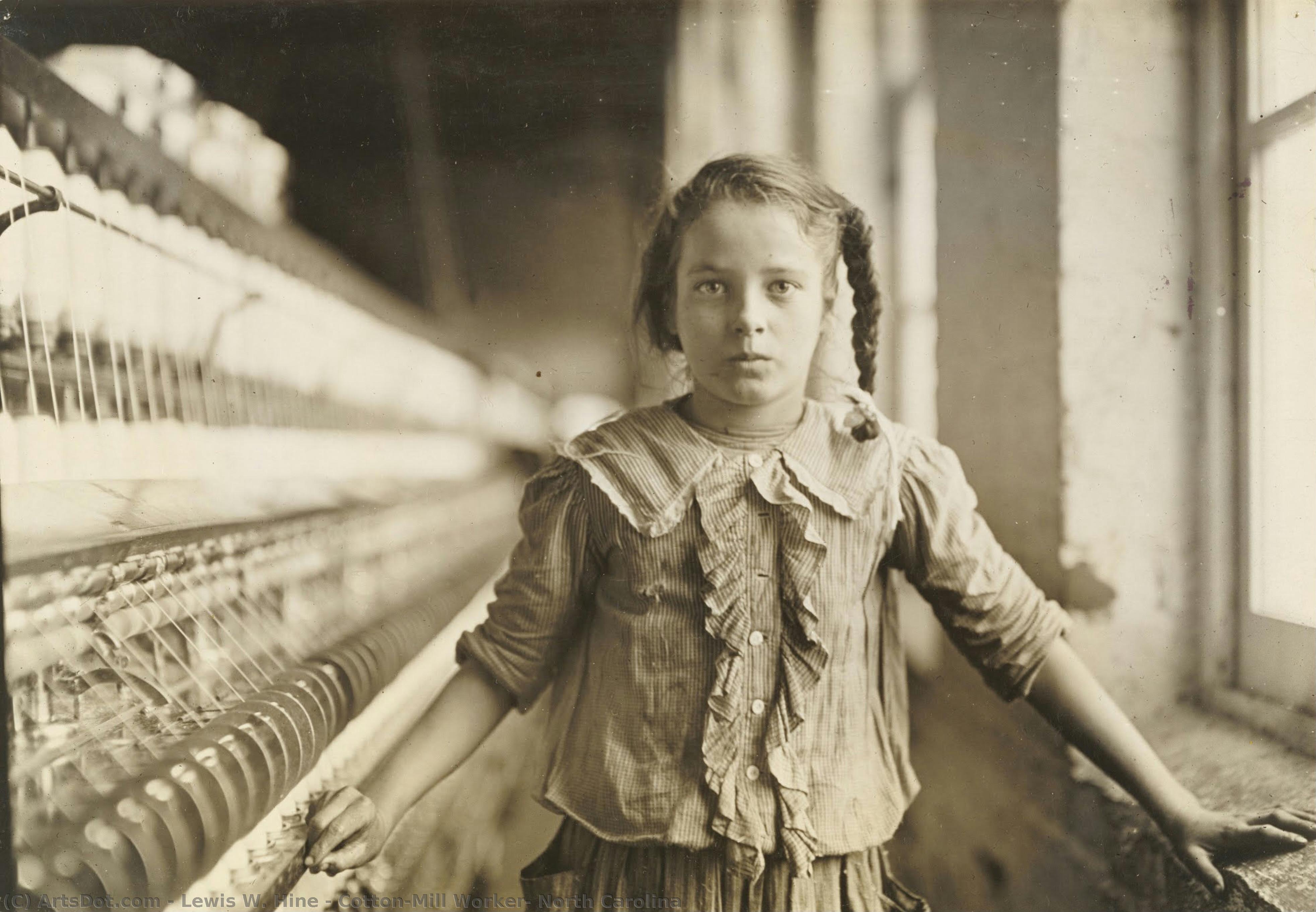
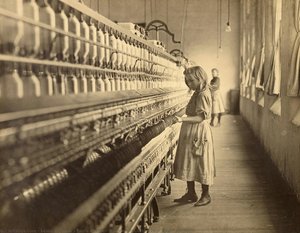
This arresting photograph, Cotton-Mill Worker, North Carolina, by Lewis Hine, is far more than a mere record of an industrial scene; it is a profound social document rendered with unflinching clarity. Dating from 1908, the image transports us directly into the heart of America's burgeoning textile industry during the early decades of the twentieth century. The composition centers on a young girl, no older than twelve or thirteen, whose quiet presence stands in stark contrast to the overwhelming mechanical energy surrounding her. Hine masterfully frames her between the cool expanse of a window and the relentless geometry of the cotton loom that seems to stretch into an infinite vanishing point. One cannot help but feel the palpable weight of history emanating from this monochrome capture.
Composition, Technique, and Visual Language
Technically, the photograph exemplifies the documentary style characteristic of pioneering social photographers. The black and white medium strips away the distraction of color, forcing the viewer to confront texture, line, and shadow with an almost brutal intimacy. Notice the interplay between strong horizontal lines—the structural beams of the mill, the taut threads of the machinery—and the softer, organic curves defining the girl’s face and the drape of her shabby cotton dress. The contrast is breathtaking: the rigid, repetitive order of the machine versus the fragile humanity at its core. Depth is achieved through meticulous layering; the foreground holds the subject, the midground is consumed by the complex machinery, and the background recedes into a hazy industrial depth. It is a study in contrasts, rendered with the high detail inherent to early photographic processes.
Symbolism of Labor and Resilience
The symbolism woven into this portrait is rich and deeply moving. The girl herself becomes an emblem of both vulnerability and endurance. Consider the striking detail of her hair: cropped short on the side facing the loom, perhaps symbolizing conformity or the harsh demands of the workplace, while a long, braided ponytail flows outward toward the window, seemingly nourished by the outside light—a potent visual metaphor for unspent potential or the yearning for freedom. Her wrinkled, faded garment speaks volumes about the daily grind, yet her poised stance suggests an innate resilience that refuses to be entirely subsumed by the machinery of production. This image compels us to contemplate the cost of progress.
An Echo for Modern Spaces
For collectors and designers alike, this piece offers a powerful narrative anchor. While its subject matter speaks to historical hardship, its aesthetic power—the dramatic use of line, the stark tonal contrast, and the undeniable emotional resonance—makes it a compelling focal point. Reproducing this work allows one to integrate a piece of potent social commentary into a contemporary setting. It invites quiet contemplation, transforming a wall from mere decoration into a site for reflection on labor, time, and the enduring spirit of youth against the backdrop of relentless industry.
Related Artworks

Artist Biography
Claude Monet: Capturing the Ephemeral Light
Oscar-Claude Monet, born in Le Havre, Normandy, on November 14, 1840, wasn’t simply a painter; he was an architect of perception. His life and work are inextricably linked to his relentless pursuit of capturing the fleeting, ever-changing qualities of light and atmosphere – a philosophy that defined Impressionism and continues to resonate profoundly today. From humble beginnings as a caricaturist selling sketches on the beaches of Normandy, Monet’s journey culminated in becoming one of the most celebrated figures in art history, not for grand narratives or historical scenes, but for his ability to distill the essence of a moment onto canvas.
Monet's early artistic education was unconventional. Initially discouraged by his father’s desire for him to pursue a career in business, he found mentorship with Eugène Boudin, a key figure in establishing *plein air* painting – working outdoors directly from nature. Boudin instilled in Monet the vital importance of observing and recording light as it shifted across landscapes, a principle that would become central to his artistic practice. This focus on direct observation contrasted sharply with the academic traditions dominating the art world at the time, where artists meticulously copied from models or historical subjects within studio settings.
Paris proved to be a crucible for Monet’s evolving style. He enrolled in Charles Gleyre's studio, encountering fellow aspiring artists like Pierre-Auguste Renoir and Frédéric Bazille. This group shared a desire to break free from the constraints of traditional academic painting, experimenting with looser brushstrokes, brighter colors, and an emphasis on capturing the immediate impression of a scene rather than striving for photographic realism. The Franco-Prussian War (1870-1871) forced Monet into exile in England, where he studied the works of John Constable and Joseph Mallord William Turner – artists who had both explored the effects of light and atmosphere with remarkable sensitivity. These encounters profoundly influenced Monet’s approach to color and composition.
The Birth of Impressionism
Returning to Paris in 1874, Monet played a pivotal role in establishing what would become known as Impressionism. The year marked a turning point, not just for the art world but also for French society. Following the humiliating defeat in the Franco-Prussian War and the subsequent brief but violent reign of the Paris Commune, Parisians sought solace and distraction through cultural pursuits. Monet, along with Renoir, Alfred Sisley, and others, organized an independent exhibition in 1874 – the “Salon des Refusés” (Exhibition of Rejected Works) – showcasing their innovative approach to painting. This event directly challenged the established Salon system, which favored historical and mythological subjects rendered with meticulous detail.
The critic Louis Leroy, writing a scathing review in *Le Charivari*, coined the term “Impressionism” after Monet’s painting *Impression, Sunrise* (1872). The title, initially intended as an insult, ironically became the defining label for this new movement. Monet's work, and that of his fellow Impressionists, was characterized by a deliberate lack of finish, visible brushstrokes, and a focus on capturing the fleeting effects of light and color. Rather than attempting to represent objects with photographic accuracy, they aimed to convey their *impression* – their subjective experience of seeing.
Series and the Pursuit of Light
Monet’s artistic ambition extended beyond simply recording individual scenes; he sought to understand the fundamental principles governing how light interacts with the world. This led him to embark on a series of ambitious projects, meticulously documenting the changing effects of light on familiar subjects over time. The most famous examples include his paintings of haystacks (1890-1891), Rouen Cathedral (1892-1894), and the water lilies in his garden at Giverny (1897-1926).
These series weren’t merely repetitions of the same subject; they were investigations into the nature of light itself. Monet would paint the same scene multiple times, each time capturing a different aspect of the light – whether it was the warm glow of morning, the cool shadows of midday, or the silvery hues of twilight. He employed a technique known as *méthode en plein air* (working outdoors), allowing him to directly observe and translate these fleeting effects onto canvas. The resulting paintings are not portraits of objects but rather studies in light and color, revealing the dynamic interplay between them.
Legacy and Influence
Claude Monet’s legacy is immense and multifaceted. He fundamentally altered the course of art history, paving the way for modernism by rejecting academic conventions and embracing subjective perception. His emphasis on *plein air* painting, his innovative use of color, and his exploration of light revolutionized artistic practice, inspiring generations of artists to look beyond mere representation and capture the essence of their experiences.
Beyond his artistic achievements, Monet’s life itself became a subject of fascination. His devotion to nature, his meticulous observation skills, and his unwavering commitment to his artistic vision made him an enduring symbol of creativity and perseverance. He died on December 5, 1926, at the age of 86, leaving behind a vast body of work that continues to captivate and inspire viewers around the world. His gardens at Giverny remain open to the public as a testament to his artistic legacy, offering visitors a glimpse into the world that shaped his extraordinary vision.
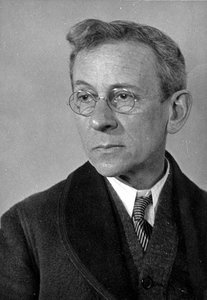
lewis wickes hine
1874 - 1940 , United States of America
Quick Facts
- Artistic Movement Or Style: Impressionism
- Artists Or Movements Influenced By This Artist:
- Post-Impressionism
- Modernism
- Artists Who Influenced This Artist:
- Eugène Boudin
- John Constable
- Joseph Mallord William Turner
- Date Of Birth: November 14, 1840
- Date Of Death: December 5, 1926
- Full Name: Claude Oscar Monet
- Nationality: French
- Notable Artworks:
- Impression, Sunrise
- Water Lilies series
- Rouen Cathedral series
- Place Of Birth: Le Havre, France
Related Articles
Marianne North's Masterpieces: 25 Botanical Paintings That Bloom With Adventure | ArtsDot
Journey through the vibrant world of Marianne North’s botanical paintings! Explore 25 iconic artworks from this Victorian artist, celebrating exotic flora & travel. Find museum-quality reproductions and curated decor ideas at ArtsDot.com.

Beyond the Lens: Photography's Enduring Influence on Modern & Contemporary Art
Explore photography's pivotal role in shaping modern & contemporary art. Discover key movements, influential artists like Stieglitz, and expert collecting advice from ArtsDot.

Pictorialism: A Search for Artistic Photography's Soul – Aesthetics, Techniques & Legacy
Explore the captivating world of Pictorialism – a pivotal movement that transformed photography into fine art. Discover key artists like Stieglitz & Käsebier, techniques, and collecting tips from experts.

Monochrome Visions: Exploring the Aesthetic & Historical Significance of Black & White Photography
Explore the rich history & artistic power of black and white photography. From early techniques to iconic masters like Ansel Adams, discover why monochrome continues to captivate art lovers today. Expert insights for collectors.

Witnessing History Through Lens & Light: Documentary Photography's Enduring Legacy
Explore the powerful history of documentary photography – from its origins to contemporary masters like Gordon Parks & W. Eugene Smith. Discover how this art form shapes our understanding of society and witness pivotal moments in time.
![[Self-Portrait with Newsboy]](/media/artworks/images-thumb/4b/25/4b254aa0d60e3a85f58cd7f0e967d9ff.jpg)