 Preview
 Send
Send Share
Share
 Details

 Download
 Similars
 X-Ray
X-Ray Diaporama
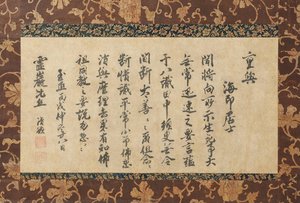
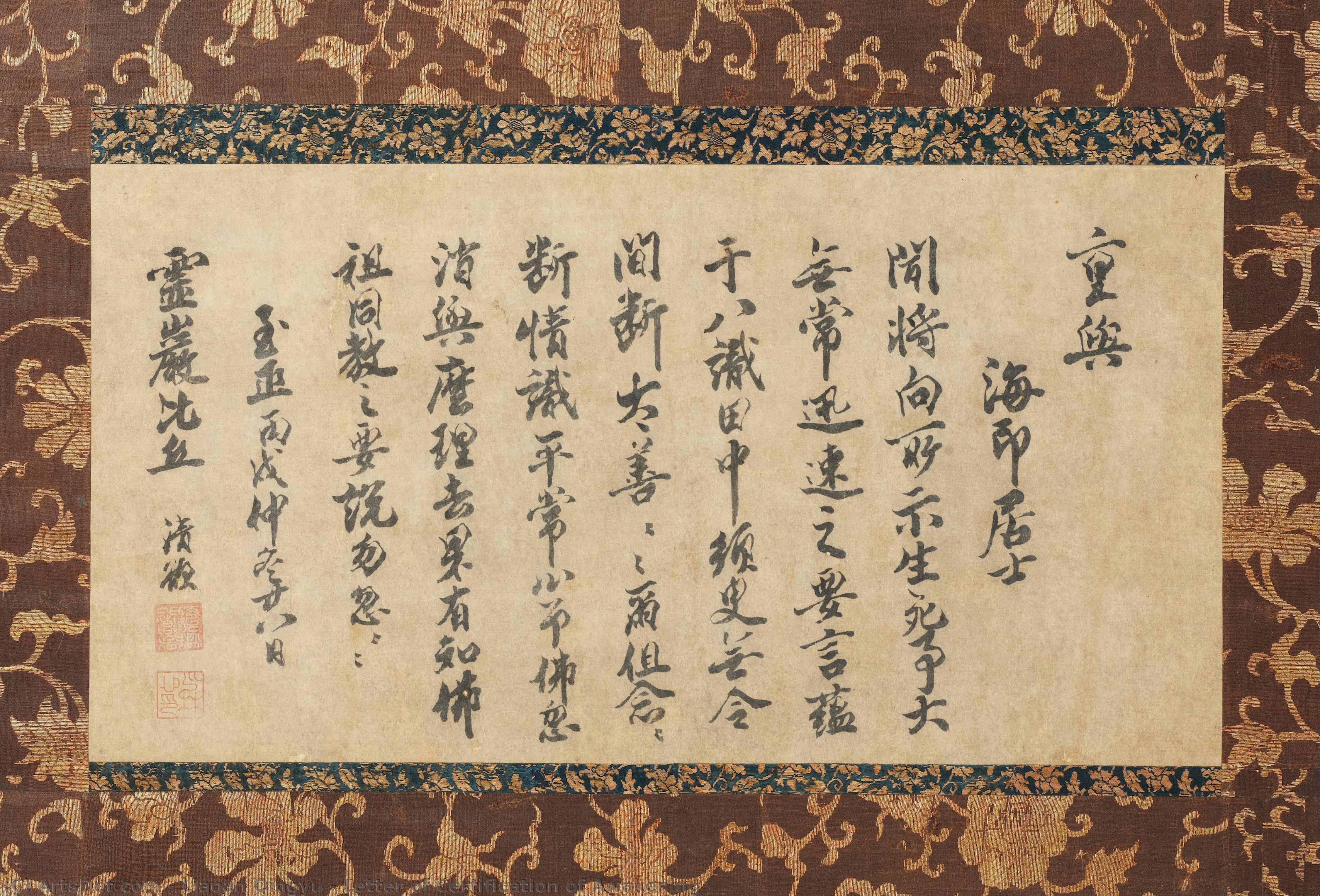
Letter of Certification of Awakening


 Read More
Hand Made Oil Reproduction
Hand-painted oil on canvas in your size and frame, made to order by our artists. ( Buy Print Buy Image)




































Pick from our preset sizes that match the artwork's original proportions.

You may enter your own dimensions to fit a specific frame or space. If your selected size does not match the original image's proportions, we will either crop the artwork or extend the painting with additional hand-painted elements. A digital mockup will be sent for your approval before production begins.
Please note that the on-screen preview does not reflect the actual cropping or extension. Only the mockup will accurately show the final composition.
While custom sizes are available, we recommend selecting a dimension from the predefined list to preserve the original proportions.
After order, ArtsDot.com team will email client for instructions and provide a mockup preview
Worldwide Delivery () in 3/4 weeks instead of standard 5 weeks. (29 August). No compromise on quality.

Free Worldwide Express Shipping

High-Quality Linen Canvas

Full Shipping Insurance

Customs Tax Refund Guarantee

True Color Matching Guarantee

60-Day Return Policy (Defects Only)

100% Money-Back Guarantee

Bulk Discount Offer
 Glass option is only available in size under 110 CM

Letter of Certification of Awakening
Reproduction Medium
Reproduction Size
-


Total Price
$ 263
Related Artworks








Artist Biography
Filippo Rusuti: A Roman Pioneer of the Thirteenth Century
Filippo Rusuti, a name often overshadowed by his more celebrated contemporaries, stands as a pivotal figure in the artistic landscape of 13th-century Rome. Born around 1255 and passing away in 1363, Rusuti’s career spanned nearly four decades, witnessing a dramatic shift in artistic styles and techniques within Italy. While he may not possess the immediate fame of Giotto or Duccio, his contributions to the burgeoning Roman school – a movement that bridged Byzantine formality with nascent naturalism – are profoundly significant. His legacy lies primarily in his frescoes, particularly those adorning the Upper Basilica of San Francesco d’Assisi and fragments within the Santa Maria Maggiore mosaic, offering invaluable insights into the artistic currents of his time.
Rusuti's early career unfolded in Rome between 1288 and 1297. He belonged to a collective of artists – alongside Jacopo Torriti and Pietro Cavallini – who formed the core of the Roman school, a group that skillfully blended the traditions of Byzantine art with emerging Italian sensibilities. This period saw him working on the ambitious fresco decoration of Assisi’s Upper Basilica, a project where he collaborated closely with Torriti, contributing to scenes from the Book of Genesis. The creation of Adam and Eve, and elements of Noah's Ark, are among his most recognizable achievements within this monumental undertaking.
A singular testament to Rusuti’s artistry is the upper register of the mosaic decoration on the old facade of Santa Maria Maggiore in Rome, dating back to 1288-1297. Here, he’s identified through the presence of Cardinal Pietro Colonna, a key figure who linked him to papal circles. Art historians believe that the lower register of this same mosaic – depicting the founding of Santa Maria Liberiana – represents the work of his followers, built upon the foundation laid by Rusuti's initial designs. This collaborative process highlights the dynamic nature of artistic development during the period.
Further evidence of Rusuti’s influence extends to France, where he traveled to Poitiers around 1309, at the invitation of King Charles IV. Documents from that era – now sadly lost – detail his service in the French court, suggesting a period of considerable artistic activity and recognition. Subsequently, around 1320, Rusuti journeyed to Naples, joining Cavallini within the Angevin court. He contributed to the fresco decoration of Santa Maria Donna Regina Vecchia, where his figures are believed to represent the Prophets – a testament to his continued skill and adaptability across diverse artistic environments.
Remarkably, in 2010, art historian Alfred Breitman attributed frescoes discovered within a tower of the Palazzo del Senato in Rome to Rusuti, a finding corroborated by contemporary historians. Even more recently, in 2018, the identification of the icon of Santa Maria del Popolo as a work by Rusuti was announced during restoration efforts, solidifying his place as a key figure in the artistic heritage of Rome.
The Byzantine Roots and Roman Innovation
Rusuti’s artistic foundation is deeply rooted in the traditions of Byzantine art. Like many artists of his time, he inherited the formal elegance, rich colors, and symbolic depth characteristic of this style, which had profoundly influenced Italian painting for centuries. However, Rusuti wasn't merely a faithful imitator; he skillfully integrated these established elements with emerging Italian techniques and sensibilities. The influence of Cimabue is particularly evident in his early works, demonstrating a clear lineage of artistic development.
The frescoes at Assisi represent a crucial turning point in Rusuti’s career. While maintaining the Byzantine emphasis on hierarchical composition and stylized figures, he began to introduce subtle shifts towards greater naturalism – a move that would become increasingly prominent in the work of Giotto and his successors. His depictions of Adam and Eve, for example, demonstrate a nascent understanding of human anatomy and expression, foreshadowing the more realistic portrayals that would characterize later Italian art.
Furthermore, Rusuti’s work reflects the broader intellectual climate of the 13th century – a period marked by renewed interest in classical antiquity. While he remained firmly within the Byzantine tradition, his compositions and decorative elements often incorporated motifs and stylistic cues derived from Roman art, signaling a growing awareness of the artistic heritage of the ancient world.
Key Works and Artistic Techniques
Despite the fragmentary nature of our knowledge about Rusuti’s oeuvre, several key works offer valuable insights into his artistic techniques and creative vision. The upper register mosaic of Santa Maria Maggiore stands as perhaps his most significant surviving achievement, showcasing his mastery of Byzantine mosaic techniques – a medium characterized by its luminous colors, intricate detail, and symbolic power.
The frescoes at the Upper Basilica of San Francesco d’Assisi are equally important, providing a glimpse into Rusuti’s approach to narrative painting. His depictions of scenes from Genesis demonstrate his ability to convey complex theological concepts through carefully constructed compositions and expressive figures. The use of color is particularly noteworthy – Rusuti employed a vibrant palette of reds, blues, and golds to create visually arresting images that captivated the viewers of his time.
Rusuti’s work also reveals a sophisticated understanding of perspective and spatial relationships. While not fully embracing linear perspective as it would later develop in Renaissance art, he skillfully created a sense of depth and volume through the use of overlapping forms, atmospheric effects, and carefully rendered details. This demonstrates his innovative approach to creating illusionistic space within the confines of fresco painting.
Historical Significance and Legacy
Filippo Rusuti’s significance lies not in producing individual masterpieces that rival those of his more famous contemporaries, but rather in his role as a pivotal figure in the development of Roman art. He represents a crucial link between the Byzantine tradition and the emerging Italian Renaissance, embodying the artistic dynamism of 13th-century Rome.
His work served as an important training ground for subsequent generations of artists, including Giotto and Duccio, who would build upon his innovations and further refine the techniques of Italian painting. Rusuti’s legacy is therefore inextricably linked to the broader trajectory of Western art – a testament to his enduring influence on the development of artistic style and technique.
Despite being largely forgotten for centuries, recent scholarship has begun to re-evaluate Rusuti's contributions, recognizing him as a key player in the vibrant artistic scene of 13th-century Rome. His frescoes continue to offer valuable insights into the cultural and intellectual currents of his time, reminding us that even artists who operate on the margins of history can leave an indelible mark on the course of art.
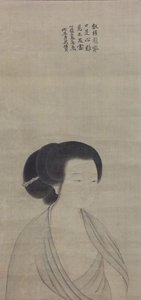
liaoan qingyu
1288 - 1363 , China
Quick Facts
- Artistic Movement Or Style: Roman School
- Artists Or Movements Influenced By This Artist:
- Duccio
- Cimabue
- Artists Who Influenced This Artist:
- Jacopo Torriti
- Pietro Cavallini
- Date Of Death: 1363
- Full Name: Filippo Rusuti
- Nationality: Italian
- Notable Artworks:
- Genesis frescoes
- Adam and Eve
- Noah’s Ark
- Santa Maria Maggiore mosaic
- Life of Christ scenes
- Place Of Birth: Rome, Italy