 Preview
 Send
Send Share
Share
 Details

 Download
 Similars
 X-Ray
X-Ray Diaporama
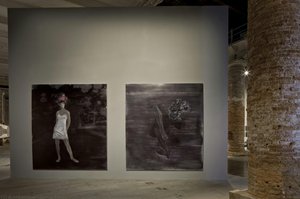
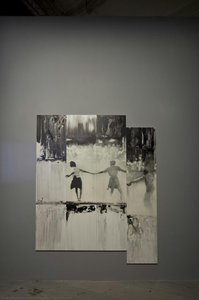
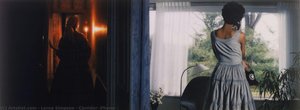
Slip (left) and Suspended (right)


 Read More
Hand Made Oil Reproduction
Hand-painted oil on canvas in your size and frame, made to order by our artists. ( Buy Print Buy Image)




P118B $10

P118H $10

P118W $10

P438Z $10

P508JH $12

P508YH $12

P805H $10

P805Z $10

P919BZ $10

P919G $10

P919XJ $10

P959ZH $10

P968JZ $12

W106C $8

W218G $10

W218JH $8

W218Y $10

W307PJ $10

W316G $10

W316PJ $8

W316Y $10

W398PJ $8

W4111J $10

W500HY $15

W500JH $15

W692G $12

W849H $8

W940BG $15

W953PJ $8




Pick from our preset sizes that match the artwork's original proportions.

You may enter your own dimensions to fit a specific frame or space. If your selected size does not match the original image's proportions, we will either crop the artwork or extend the painting with additional hand-painted elements. A digital mockup will be sent for your approval before production begins.
Please note that the on-screen preview does not reflect the actual cropping or extension. Only the mockup will accurately show the final composition.
While custom sizes are available, we recommend selecting a dimension from the predefined list to preserve the original proportions.
After order, ArtsDot.com team will email client for instructions and provide a mockup preview
Worldwide Delivery () in 3/4 weeks instead of standard 5 weeks. (18 August). No compromise on quality.

Free Worldwide Express Shipping

High-Quality Linen Canvas

Full Shipping Insurance

Customs Tax Refund Guarantee

True Color Matching Guarantee

60-Day Return Policy (Defects Only)

100% Money-Back Guarantee

Bulk Discount Offer
 Glass option is only available in size under 110 CM

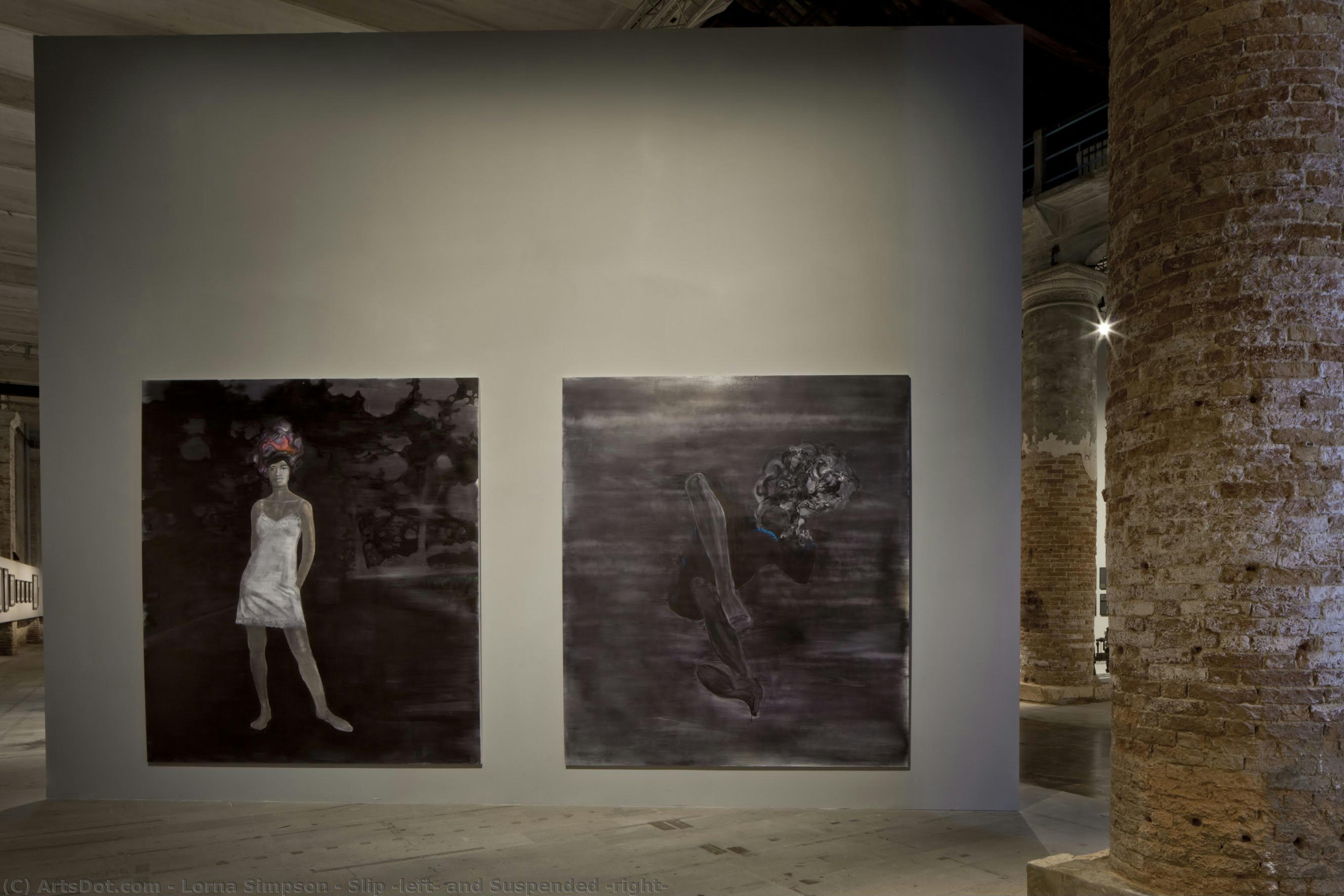
Slip (left) and Suspended (right)
Reproduction Medium
Reproduction Size
-


Total Price
$ 263
Artwork Description
Lorna Simpson’s “Slip (left) and Suspended (right)” – A Study in Fragmented Identity
Lorna Simpson's "Slip (left) and Suspended (right)," created in 2015, isn’t merely a photograph; it’s an invitation to contemplate the elusive nature of selfhood. Executed as a diptych on gessoed wood panels, the work immediately commands attention with its stark black-and-white palette and the unsettling juxtaposition of two seemingly simple scenes. Simpson, a towering figure in contemporary American art, consistently challenges conventional representations within photography, particularly those concerning gender, race, and memory – themes that resonate powerfully within this piece.
The composition itself is deceptively straightforward. Each panel presents a partial view: the left depicts a woman standing beside a man holding a tennis racket, while the right shows a figure suspended in mid-air, also clutching a racquet. Neither image offers complete resolution; both are deliberately fragmented, cropped at the edges to create a sense of incompleteness and ambiguity. This deliberate lack of closure is central to Simpson’s artistic strategy – she isn't interested in providing definitive answers but rather in prompting viewers to actively engage with the work and construct their own interpretations.
The Language of Gesture and Performance
Simpson’s early career was deeply rooted in conceptual and performative photography, a lineage that profoundly informs “Slip (left) and Suspended (right).” Her signature style, often featuring back views of African-American women in loose-fitting garments, aimed to circumvent stereotypical representations. Here, the gesture is paramount. The figures’ postures – poised, expectant, slightly awkward – suggest a moment caught between action and stillness, hinting at an unspoken narrative. The tennis rackets themselves become symbolic objects, representing competition, leisure, or perhaps even the constraints of societal expectations.
The choice of black-and-white photography further amplifies this sense of ambiguity. Without the distraction of color, the focus shifts entirely to form and texture. The subtle variations in shading and the delicate grain of the wood create a tactile quality, inviting viewers to examine the surface of the image with meticulous attention. It’s a technique reminiscent of documentary photographers who sought to capture truth through unadorned representation.
Historical Context and Simpson's Exploration of Representation
Born in Brooklyn, New York, in 1960, Simpson’s work consistently interrogates the ways in which black subjects are portrayed within American visual culture. Her early photographs, often featuring women with their backs to the camera, deliberately obscured identity while simultaneously drawing attention to the body and its relationship to power. “Slip (left) and Suspended (right)” builds upon this legacy, continuing her exploration of representation and challenging viewers to consider how images shape our understanding of ourselves and others.
Simpson’s engagement with performance theory is also evident in this piece. The fragmented figures evoke a sense of staged action – as if captured during a fleeting moment from a theatrical production. This connection to performance highlights the constructed nature of identity, suggesting that we are all, to some extent, performing roles for others.
Emotional Resonance and Visual Impact
Despite its apparent simplicity, “Slip (left) and Suspended (right)” possesses a profound emotional resonance. The ambiguity of the scene creates a sense of unease, prompting viewers to question what is being left unsaid. The suspended figure, in particular, evokes feelings of vulnerability and uncertainty – a silent plea or perhaps a moment of contemplation.
Ultimately, Simpson’s work invites us to consider the complexities of identity, the limitations of representation, and the power of visual language. “Slip (left) and Suspended (right)” is not just a photograph; it's an invitation to engage in a dialogue about who we are, how we see ourselves, and how we are seen by others.
Related Artworks
Artist Biography
Lorna Simpson: Unraveling Identity Through Image and Word
Born in Brooklyn, New York, in 1960, Lorna Simpson stands as a towering figure in contemporary American art—a photographer and multimedia artist whose work has profoundly interrogated the complexities of identity, gender, race, and history. Her career, blossoming in the late 1980s and early 1990s, quickly established her as a vital voice challenging conventional representations within photography and broader cultural discourse. Simpson’s journey is one of persistent questioning, innovative techniques, and a commitment to revealing the often-hidden narratives embedded within seemingly straightforward images.
Simpson's formative years were steeped in artistic exposure. Her parents, a Jamaican-Cuban father and an African-American mother, fostered a deep appreciation for the arts from a young age, taking her regularly to plays, museums, concerts, and dance performances. This early immersion profoundly shaped her perspective and fueled a desire to explore themes of representation and social commentary through her own creative lens. She honed her skills at the High School of Art and Design before pursuing formal education at the School of Visual Arts in New York City and later earning an MFA from the University of California, San Diego. It was during this period that she began experimenting with combining photography with text—a signature technique that would become central to her artistic practice. Early influences included conceptual art pioneers like Allan Kaprow and the work of filmmakers Jean-Pierre Gorin, whose strategies for manipulating image and narrative resonated deeply with Simpson’s own ambitions.
The Power of the Photo-Text Installation
Simpson's breakthrough came with photo-text installations such as Guarded Conditions (1987) and Square Deal (1988). These works, often featuring photographs of unidentified Black figures accompanied by carefully chosen words, directly confronted stereotypes surrounding African American women in American culture. By decoupling the image from a singular, fixed meaning through the addition of text, she forced viewers to confront their own biases and the ways in which language can both construct and deconstruct identity. This method of interrogating the gaze became her hallmark, turning the act of looking into an analytical process.
Her practice expanded far beyond the confines of traditional photography, embracing film, sculpture, and installation to create immersive environments. In these works, the interplay between what is seen and what is read creates a tension that mirrors the fragmented nature of memory and history. Through her use of silence and absence, she invites the audience to fill in the gaps, making the viewer an active participant in the construction of meaning.
Legacy and Historical Significance
The historical significance of Lorna Simpson's contribution to the art world cannot be overstated. She broke significant barriers, notably becoming the first African-American woman to represent the United States at the Venice Biennale in 1990. This milestone marked a pivotal moment in the recognition of Black female perspectives within the global contemporary art canon.
Her enduring impact can be seen through several key achievements:
- Redefining Photography: Moving the medium away from mere documentation toward a conceptual tool for social critique.
- Intersectionality in Art: Pioneering an approach that simultaneously addresses race, gender, and class, providing a blueprint for subsequent generations of multimedia artists.
- Cultural Discourse: Forcing a confrontation with the historical erasure of Black identities within American visual culture.
Today, Simpson's work continues to resonate as a profound meditation on the human condition. Her ability to weave together the visceral impact of the image with the intellectual weight of the word ensures that her art remains not just a reflection of history, but an active force in shaping our understanding of it.
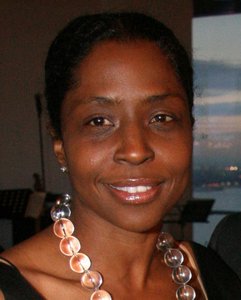
Lorna Simpson
1960 - , United States of America
Quick Facts
- Artistic Movement Or Style: Conceptual photography”
- Artists Or Movements Influenced By This Artist:
- David Hammons
- Afrofuturism
- Date Of Birth: August 13, 1960
- Full Name: Lorna Simpson
- Guarded Conditions",
"Square Deal",
"Slip (Left) & Suspended (Right)"
],
"Artists Who Influenced This Artist:
- Allan Kaprow
- Eleanor Antin
- Identity Art: Notable artworks
- Nationality: American
- Photo-Text: Multimedia art
- Place Of Birth: Brooklyn, USA
Related Articles

Monochrome Visions: Exploring the Aesthetic & Historical Significance of Black & White Photography
Explore the rich history & artistic power of black and white photography. From early techniques to iconic masters like Ansel Adams, discover why monochrome continues to captivate art lovers today. Expert insights for collectors.

White on Canvas: 10 Masterpieces & Timeless Elegance for Your Home Decor
Explore 10 iconic white paintings by Monet, Whistler & Rothko! Discover the stories behind these serene masterpieces and their impact on art history. Find museum-quality reproductions for your home decor at .

Beyond the Lens: Photography's Enduring Influence on Modern & Contemporary Art
Explore photography's pivotal role in shaping modern & contemporary art. Discover key movements, influential artists like Stieglitz, and expert collecting advice from ArtsDot.

Dark Masterpieces: 10 Iconic Paintings Dominated by Black Tones |
Explore 10 iconic paintings dominated by black tones, from Rembrandt’s chiaroscuro to Goya's dark expressions. Discover the stories behind these masterpieces & find museum-quality art reproductions for your home at .

Pictorialism: A Search for Artistic Photography's Soul – Aesthetics, Techniques & Legacy
Explore the captivating world of Pictorialism – a pivotal movement that transformed photography into fine art. Discover key artists like Stieglitz & Käsebier, techniques, and collecting tips from experts.