 Preview
 Send
Send Share
Share
 Details

 Download
 Similars
 X-Ray
X-Ray Diaporama
Portrait of Bob
 Oil On Canvas
- WallArt
- Contemporary Realism
 1936
1936- Modern
 104.0 x 88.0 cm
 Crystal Bridges Museum of American Art
 Read More
Hand Made Oil Reproduction
Hand-painted oil on canvas in your size and frame, made to order by our artists. ( Buy Print Buy Image)




P118B $10

P118H $10

P118W $10

P438Z $10

P508JH $12

P508YH $12

P805H $10

P805Z $10

P919BZ $10

P919G $10

P919XJ $10

P959ZH $10

P968JZ $12

W106C $8

W218G $10

W218JH $8

W218Y $10

W307PJ $10

W316G $10

W316PJ $8

W316Y $10

W398PJ $8

W4111J $10

W500HY $15

W500JH $15

W692G $12

W849H $8

W940BG $15

W953PJ $8




Pick from our preset sizes that match the artwork's original proportions.

You may enter your own dimensions to fit a specific frame or space. If your selected size does not match the original image's proportions, we will either crop the artwork or extend the painting with additional hand-painted elements. A digital mockup will be sent for your approval before production begins.
Please note that the on-screen preview does not reflect the actual cropping or extension. Only the mockup will accurately show the final composition.
While custom sizes are available, we recommend selecting a dimension from the predefined list to preserve the original proportions.
After order, ArtsDot.com team will email client for instructions and provide a mockup preview
Worldwide Delivery () in 3/4 weeks instead of standard 5 weeks. (17 August). No compromise on quality.

Free Worldwide Express Shipping

High-Quality Linen Canvas

Full Shipping Insurance

Customs Tax Refund Guarantee

True Color Matching Guarantee

60-Day Return Policy (Defects Only)

100% Money-Back Guarantee

Bulk Discount Offer
 Glass option is only available in size under 110 CM

Portrait of Bob
Reproduction Medium
Reproduction Size
-


Total Price
$ 263
Artwork Description
A Moment Frozen in Time: The Captivating Presence of Bob
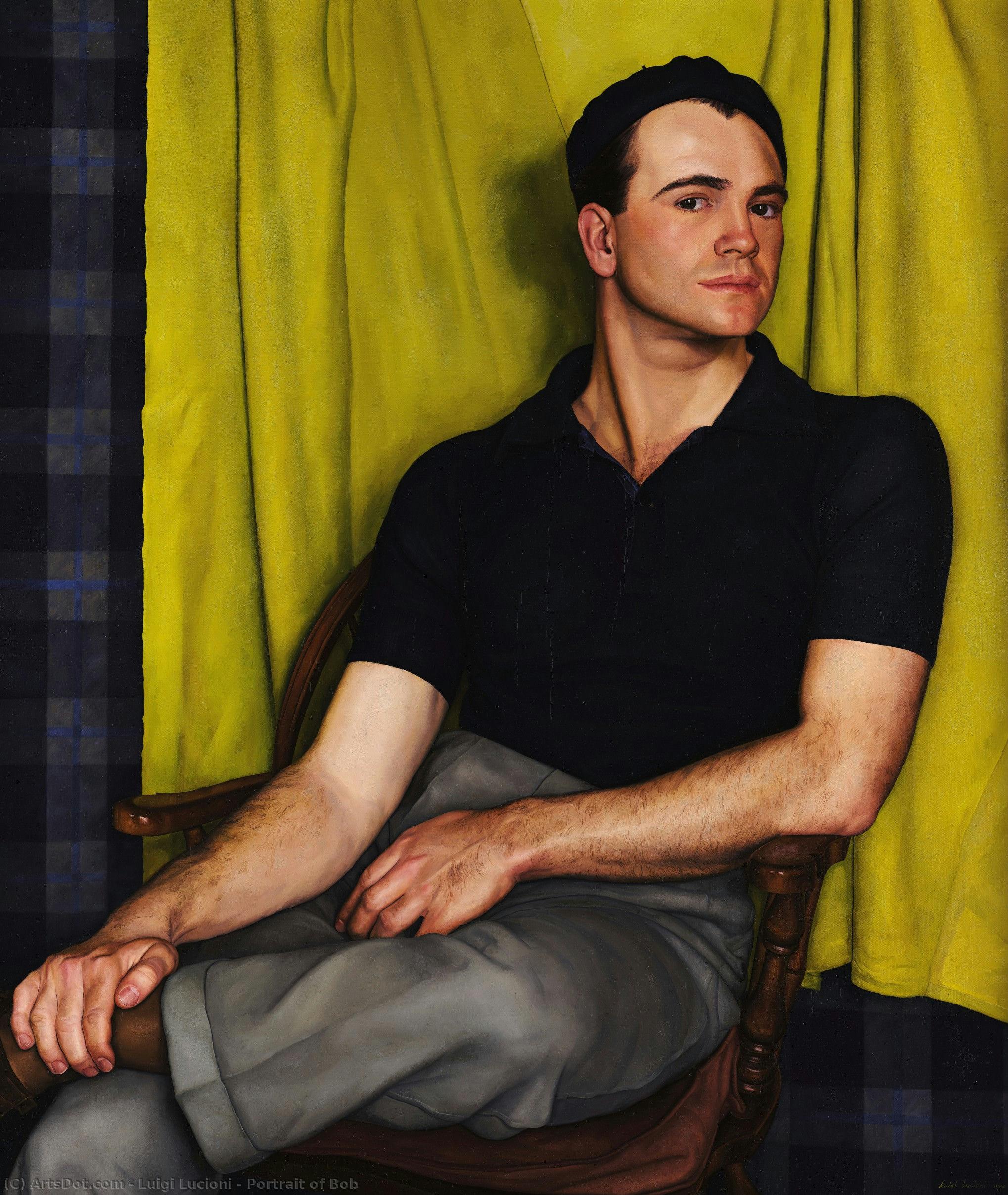
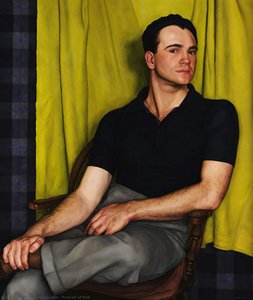
In the quiet intimacy of Luigi Lucioni’s 1936 masterpiece, Portrait of Bob, we are invited into a private encounter with a young man whose gaze seems to bridge the gap between the past and the present. The subject, Bob Elser, sits with a poised yet relaxed posture, his body arranged in a cross-legged position that suggests a moment of profound contemplation or perhaps a brief respite from the world outside. There is an undeniable magnetic quality to his expression; he casts a provocative, searching eye toward the viewer, creating a psychological tension that is both unsettling and deeply engaging. This is not merely a likeness of a person, but a study of character, where every subtle tilt of the head and every flicker of light in the eyes tells a story of youthful introspection.
The composition is a masterclass in balance and visual impact. Lucioni utilizes a vibrant, sun-drenched yellow curtain as a backdrop, which serves to push the figure forward, making the subject almost tactile in its immediacy. This brilliant splash of color is brilliantly contrasted by the darker, more grounded elements of the scene, such as the rich textures of the plaid fabric and the solid presence of the chair. The interplay between the luminous background and the shadowed, detailed rendering of the man’s features creates a sense of three-dimensional depth that draws the eye inward, much like looking into a window of another era.
Mastery of Light and Texture
Technically, Portrait of Bob stands as a testament to Lucioni’s extraordinary skill in the realm of realism. The artist employs a meticulous approach to light, using directional illumination to sculpt the man's face and define the folds of his clothing. This careful manipulation of shadow—a technique reminiscent of the Old Masters—adds a layer of sculptural weight to the figure, ensuring he does not merely sit against the background but occupies the space with physical authority. The textures within the painting are remarkably varied; one can almost feel the smoothness of the subject's skin, the coarse weave of the plaid cloth, and the polished, cool surface of the wooden chair.
While the foundation of the work is rooted in rigorous realism, there is a subtle, impressionistic breath within the brushwork. The way light dances across the yellow backdrop and the soft blending of tones in the shadows suggest a sensitivity to atmosphere that prevents the piece from feeling static or overly clinical. For the discerning collector or interior designer, this duality makes the painting exceptionally versatile. It possesses the formal dignity required for a classical gallery setting, yet its vibrant color palette and emotive energy allow it to breathe life into a modern, contemporary living space.
An Enduring Legacy for the Modern Collector
Beyond its aesthetic brilliance, the painting carries a profound emotional resonance. It captures the essence of an era—the mid-1930s—a time of transition and searching. As an Italian-American artist, Lucioni often infused his work with a sense of dual identity and quiet resilience, themes that are palpable in the steady, observant gaze of Bob. The portrait serves as a symbol of the beauty found in stillness and the dignity inherent in the human form.
For those looking to adorn their homes with art that inspires conversation and evokes emotion, a high-quality reproduction of this work offers an unparalleled opportunity. It is more than a decoration; it is an invitation to pause, to observe, and to connect with the quiet strength of the human spirit. Whether placed in a sunlit study or a sophisticated dining room, Portrait of Bob brings with it a sense of history, a mastery of light, and a timeless elegance that continues to captivate the heart.
Related Artworks


Artist Biography
A Life Rooted in Two Worlds: The Art of Luigi Lucioni
Luigi Lucioni, born Giuseppe Luigi Carlo Benevenuto Lucioni on November 4, 1900, embodied the poignant experience of the Italian immigrant striving for artistic expression in a new land. His story isn’t simply one of personal ambition, but a testament to the enduring power of memory, the pull of heritage, and the search for an American identity forged from Old World roots. Lucioni's early life unfolded in Malnate, Italy, a small town nestled amongst the foothills of the Alps near Milan. The landscape—a tapestry of hills and mountainsides—would become a recurring motif throughout his career, not merely as a subject but as a symbol of belonging and a source of profound emotional resonance. His family’s modest circumstances – a two-room apartment lacking basic comforts – instilled in him a deep appreciation for simplicity and the beauty found within everyday life. The weight of tradition was palpable; his parents, seeking to appease his grandmother's religious sensibilities, bestowed upon him a lengthy name invoking three saints, a gesture that foreshadowed the artist’s lifelong negotiation between personal vision and societal expectations. His mother, whom he affectionately called “La Bella Beati,” exerted a strong influence, instilling discipline and a sensitivity that would later inform his meticulous approach to painting.From Italy to America: Early Training and Artistic Awakening
The Lucioni family's emigration to the United States in 1911 marked a pivotal shift in young Luigi’s life. Settling in Union City, New Jersey, he witnessed firsthand the challenges and opportunities of immigrant life while his father resumed his trade as a coppersmith. Despite these hardships, Lucioni’s artistic inclinations persisted. He began formal training at Cooper Union, followed by studies at the National Academy of Design, supplementing his education with work as an illustrator. A crucial period in his development came with his fellowship to the Tiffany Foundation in Oyster Bay, Long Island. There, under the guidance of established artists like John Sloan and Kenneth Hayes Miller, he encountered a diverse range of artistic approaches and began to explore landscape painting—a genre that would become central to his oeuvre. This exposure broadened his horizons, yet it was a return trip to Italy in 1925 that solidified his artistic direction. Immersing himself in the masterpieces of the Renaissance, Lucioni absorbed the technical mastery and compositional principles that would characterize his work.The Rise of an American Still Life Master
Lucioni quickly gained recognition for his exquisitely rendered still lifes—compositions characterized by a remarkable attention to detail, luminous color palettes, and a sense of quiet dignity. Paintings like *Dahlias and Apples* (1931), which was acquired by the Metropolitan Museum of Art in 1932 – making him the youngest contemporary artist represented in their collection – established his reputation as a leading American painter. His success during the Depression era, when many artists struggled to find patronage, underscored his unique ability to connect with audiences through timeless themes and masterful technique. He didn’t merely depict objects; he imbued them with a sense of presence and symbolic weight, reflecting both personal memories and broader cultural values. This period also saw him exhibiting regularly at prestigious venues like the Carnegie International and the Corcoran Biennial, cementing his position within the American art world.Vermont and the Search for an American Arcadia
In 1930, Lucioni received a commission from Electra Havemeyer Webb to paint a landscape of Vermont as a wedding gift. This marked the beginning of a lifelong connection with the state’s rural beauty—a landscape that resonated deeply with his memories of northern Italy and offered him a sense of peace and belonging. He eventually purchased a farmhouse and barn near Manchester Depot, transforming the latter into a studio where he would spend the next fifty years creating art inspired by the surrounding countryside. Vermont became more than just a subject for Lucioni; it represented an idealized vision of America—a place where traditional values were preserved and the natural world remained untamed. His paintings from this period often evoke a sense of nostalgia, capturing the serenity and simplicity of rural life while simultaneously reflecting his own personal journey of assimilation and artistic fulfillment.Legacy and Historical Significance
Luigi Lucioni’s work stands as a testament to the enduring power of observation, the importance of cultural heritage, and the search for meaning in a rapidly changing world. His paintings—still lifes, landscapes, and portraits alike—are characterized by a remarkable technical skill, a luminous color palette, and a profound sense of emotional depth. He successfully bridged the gap between European tradition and American modernism, creating a unique artistic voice that resonated with audiences throughout his career. Lucioni’s legacy extends beyond his individual works; he represents a generation of Italian-American artists who enriched the cultural landscape of the United States while grappling with questions of identity, belonging, and the pursuit of the American dream. His art continues to inspire and captivate viewers today, offering a glimpse into a world where beauty, resilience, and memory converge.- Influences: Italian Renaissance masters, John Sloan, Kenneth Hayes Miller.
- Major Themes: Still life, landscape painting, portraits, the immigrant experience, rural American life.
- Key Achievements: Acquisition of *Dahlias and Apples* by the Metropolitan Museum of Art (1932), recognition as a leading American still life painter, establishment of a studio in Vermont.
luigi lucioni
1900 - 1988
Quick Facts
- Artistic Movement Or Style: Still life, Landscape
- Date Of Birth: November 4, 1900
- Date Of Death: July 22, 1988
- Full Name: Luigi Lucioni
- Nationality: Italian-American
- Notable Artworks:
- Portrait of Bob
- Birches and Beyond
- Restful Ruins
- Place Of Birth: Malnate, Italy
Related Articles

The Enduring Legacy of Oil on Canvas: Technique, History & Aesthetic Impact
Explore the rich history & techniques of oil painting – from Renaissance masters to Impressionism. Discover pigments, layering methods, and why this timeless medium endures. Expert insights for artists & art enthusiasts.

Oil on Canvas: A Historical & Technical Exploration of a Timeless Artistic Medium
Explore the rich history & enduring techniques of oil painting on canvas. Discover the science behind its longevity, conservation practices, and contemporary relevance. Expert insights for art enthusiasts.

The Enduring Power of Painting: A Historical & Contemporary Exploration of Form and Emotion
Explore the rich history & enduring techniques of oil painting with ArtsDot. Discover masterpieces, learn about art collecting, and find authentic handmade reproductions crafted by skilled artists.

The Enduring Legacy of Oil on Canvas: Technique, History & Contemporary Practice
Explore the rich history & enduring techniques of oil painting on canvas. Discover the science behind its longevity, conservation practices, and contemporary relevance. Expert insights for art enthusiasts.
Oil on Board Masters: 10 Paintings That Redefined Art | ArtsDot
Explore 10 legendary 'Oil on Board' masterpieces by Van Gogh, Monet & more! Discover art history, iconic styles like Impressionism, and find museum-quality reproductions to elevate your home decor. Explore the full collection online at ArtsDot.com.