 Preview
 Send
Send Share
Share
 Details

 Download
 Similars
 X-Ray
X-Ray Diaporama
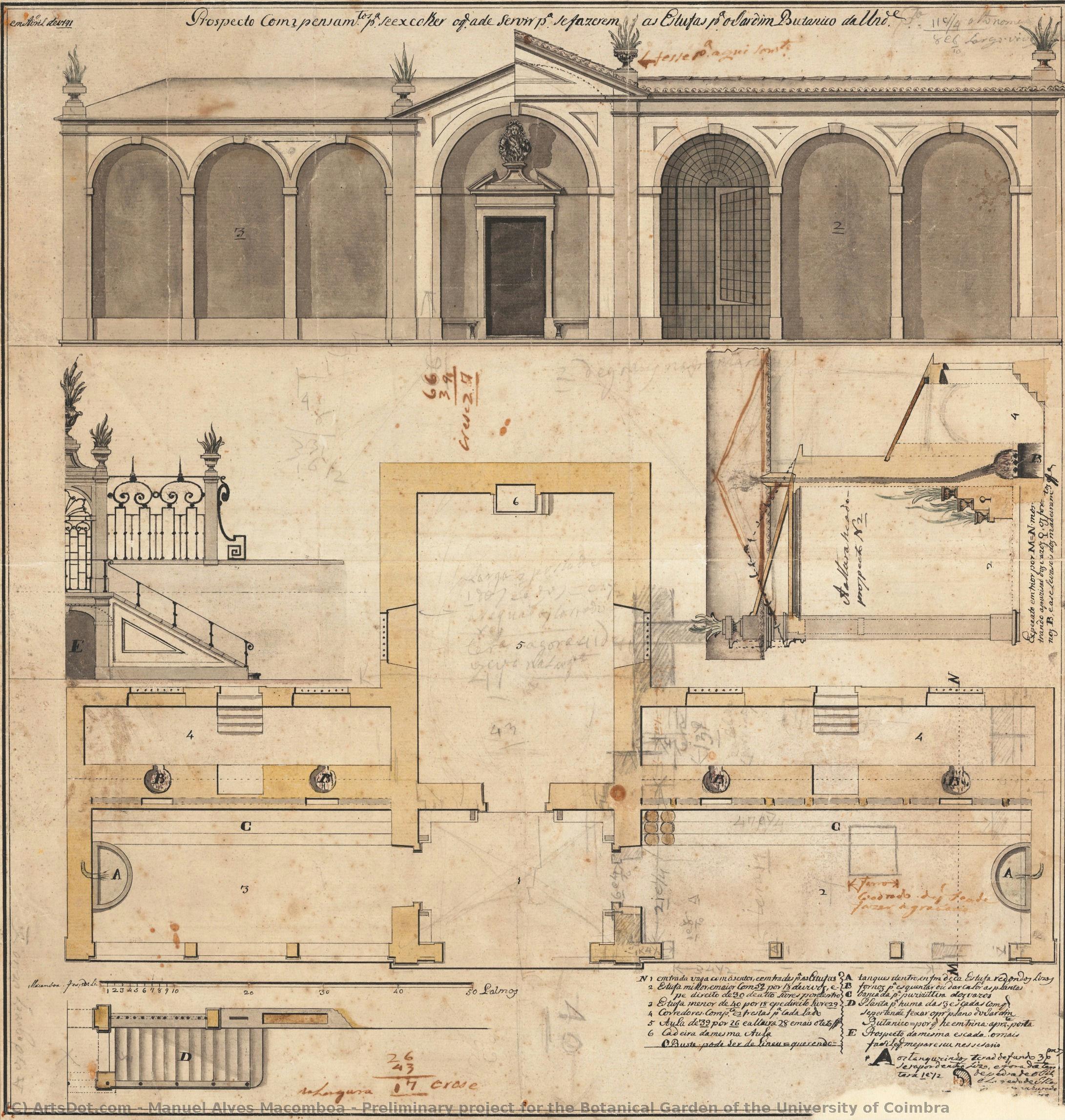
Preliminary project for the Botanical Garden of the University of Coimbra
 1791
1791 51.0 x 48.0 cm
 Machado de Castro National Museum
 Read More
Hand Made Oil Reproduction
Hand-painted oil on canvas in your size and frame, made to order by our artists. ( Buy Print Buy Image)




































Pick from our preset sizes that match the artwork's original proportions.

You may enter your own dimensions to fit a specific frame or space. If your selected size does not match the original image's proportions, we will either crop the artwork or extend the painting with additional hand-painted elements. A digital mockup will be sent for your approval before production begins.
Please note that the on-screen preview does not reflect the actual cropping or extension. Only the mockup will accurately show the final composition.
While custom sizes are available, we recommend selecting a dimension from the predefined list to preserve the original proportions.
After order, ArtsDot.com team will email client for instructions and provide a mockup preview
Worldwide Delivery () in 3/4 weeks instead of standard 5 weeks. (25 August). No compromise on quality.

Free Worldwide Express Shipping

High-Quality Linen Canvas

Full Shipping Insurance

Customs Tax Refund Guarantee

True Color Matching Guarantee

60-Day Return Policy (Defects Only)

100% Money-Back Guarantee

Bulk Discount Offer
 Glass option is only available in size under 110 CM

Preliminary project for the Botanical Garden of the University of Coimbra
Reproduction Medium
Reproduction Size
-


Total Price
$ 263
Artwork Description
Related Artworks









Artist Biography
The Architect of Coimbra’s Vision
Manuel Alves Macomboa remains a figure shrouded in the mists of historical detail, yet his indelible impact on Portuguese architecture and urban planning continues to resonate through the stone and soil of Coimbra. Born during the transformative years of the eighteenth century in Portugal, Macomboa ascended to prominence not merely as a builder, but as a visionary custodian of knowledge. His appointment as the architect tasked with overseeing the University of Coimbra was a defining moment in his career, a role he held with steadfast dedication until his passing in 1815. Through this singular position, he became a pivotal voice, shaping the intellectual and artistic landscape of an era defined by the pursuit of Enlightenment ideals.
While the precise chronicles of his early life are scarce, leaving historians to reconstruct his journey through the enduring legacy of his commissions, Macomboa’s dedication to the craft was unmistakable. His work was characterized by a profound ability to marry engineering necessity with aesthetic grace. This mastery is perhaps most brilliantly captured in his involvement with the Santa Clara Aqueduct, a marvel of hydraulic design that served as a lifeline for the university campus. In this feat of engineering, one sees the intersection of practical utility and architectural elegance, ensuring a reliable water supply while contributing to the structural grandeur of the region.
A Legacy of Science and Enlightenment
Beyond the structural triumphs of stone and mortar, Macomboa’s most enduring legacy resides in his visionary preliminary project for the University Botanical Garden. This undertaking was far more than a mere landscaping endeavor; it was a profound expression of the scientific spirit of his time. By designing a space intended to foster horticultural excellence and rigorous scientific observation, MacomboA sought to establish Coimbra as a premier center for research. His designs for the garden reflected a sophisticated understanding of the natural world, prioritizing an aesthetic harmony that allowed human innovation to coexist beautifully with the environment.
The breadth of his influence extended even to the broader recovery of the Portuguese landscape following the devastating Lisbon earthquake. Macomboa’s involvement in the Pombalina Reform demonstrates a remarkable versatility and resilience. As part of this comprehensive rebuilding effort, he applied his architectural expertise to the challenges of reconstruction, contributing to a period of significant urban evolution. His work during this era highlights a career defined by both local devotion to Coimbra and a larger commitment to the architectural rebirth of Portugal.
To reflect on the life of Manuel Alves Macomboa is to explore the following pillars of his contribution:
- Architectural Stewardship: His long-standing role as the architect for the University of Coimbra, shaping its physical and intellectual identity.
- Engineering Excellence: The creation of vital infrastructure, such as the Santa Clara Aqueduct, which blended hydraulic function with structural beauty.
- Scientific Vision: The pioneering botanical garden project that mirrored the Enlightenment's passion for experimentation and nature.
- Urban Resilience: His participation in the Pombalina Reform, contributing to the architectural reconstruction of a nation in recovery.
Manuel Alves Macomboa
1815 , Portugal
Quick Facts
- Date Of Death: 1815
- Full Name: manuel alves macomboa
- Nationality: Portuguese
- Notable Artworks:
- Preliminary project for the Botanical Garden of Coimbra
- Santa Clara Aqueduct
- Place Of Birth: Portugal