

 Preview
 Send
Send Share
Share
 Details

 Download
 Similars
 X-Ray
X-Ray Diaporama
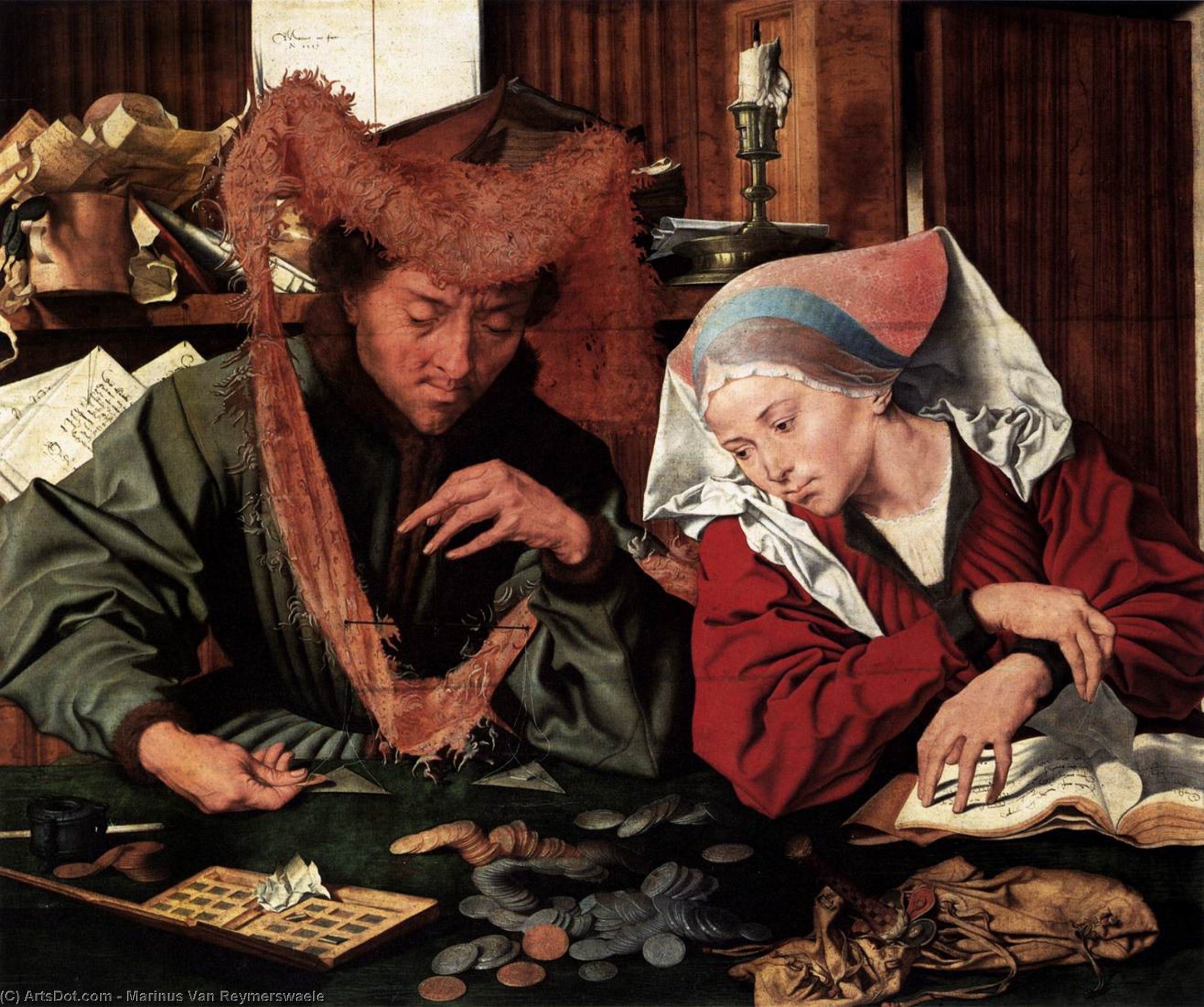
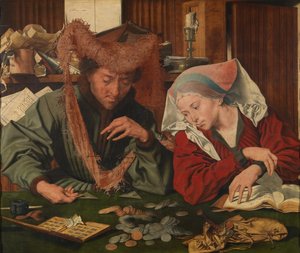
Money-Changer and his Wife
 Oil On Canvas
- WallArt
- Northern Renaissance
 1539
1539 83.0 x 97.0 cm
 Museo del Prado
 Read More
Purchase a high-resolution, enhanced digital image, far superior to the online preview.
Each file is meticulously prepared by our in-house specialists using advanced tools and expert manual retouching. We ensure every image has exceptional clarity, precise color accuracy, and fine detail.
The final file is delivered via email within 72 hours, optimized for immediate use in professional, editorial, and print environments. This is the same quality trusted by top-tier design studios, publishers, and galleries.
Digital Image
Download a high-resolution file for personal display, printing, and creative projects. ( Buy Print Buy Hand Made Painting)
Included in Every Digital Image Order
Expert Digital Delivery, Guaranteed
When you choose ArtsDot.com, you're not just getting an image - you're receiving a professionally enhanced digital artwork, crafted with precision and backed by a satisfaction guarantee. Here's everything that comes with your order, automatically:

Fast Email Delivery
Your high-resolution digital image file will be emailed to you within 72 hours of ordering - ready for immediate use.

AI-Enhanced Digital File
Your artwork is professionally optimized using advanced AI tools and manual editing, ensuring maximum detail, clarity, and color accuracy.

Free Lifetime Re-Delivery
Accidentally deleted or lost your file? No worries - we'll resend it to you anytime, free of charge.

No Import Fees - Ever
Enjoy your artwork instantly with zero customs, duties, or delivery fees - digital downloads are always tax-free.

Color Accuracy Guarantee
We ensure your digital image reflects the original colors as closely as possible using professional tools and color management.

60-Day Satisfaction Guarantee
If you're not satisfied with your digital image, we'll revise it or refund 100% within 60 days - no questions asked.

100% Money-Back Guarantee
Not satisfied? Get a full refund within 60 days of receiving your digital file - no questions asked.

Bulk Order Discounts
Buy 3 images, save 10% - Buy 5, save 15% - Buy 10+, save 20%. Great for creative projects, galleries, and agencies.
Collectible Description
A Glimpse into Domestic Life and Commerce
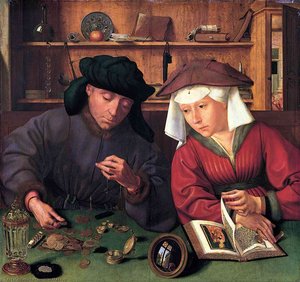
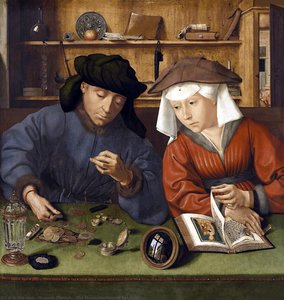
This captivating portrait, titled Money-Changer and his Wife, transports us directly into an intimate moment from the early sixteenth century. The scene unfolds around a sturdy table, suggesting a space of both domestic routine and intellectual pursuit. At the heart of the composition are the two figures: the man, clearly identified by the array of coins before him as a money-changer, and his wife, whose posture—head gently bowed—suggests a moment of quiet repose or deep contemplation. The arrangement is rich with narrative suggestion; scattered books hint at literacy and accumulated knowledge, while the presence of a bowl adds an element of everyday domesticity. It is a tableau vivant, capturing not just likenesses, but the very texture of life in a prosperous mercantile household.
Mastery of Venetian Color and Light
Painted around 1539 by Marinus van Reymerswaele, this work showcases a sophisticated handling of light that seems to emanate from within the scene itself. The artist employs rich, deep tones characteristic of the period, allowing the subtle interplay of highlights on the coins and the soft shadows enveloping the seated figures to give the painting an almost palpable depth. While the biography provided speaks extensively of Titian’s Venetian school, this piece embodies that same commitment to coloristic richness—a hallmark of art emerging from Venice during its golden age. The technique allows the viewer's eye to wander naturally across the surface, drawn first to the figures, then lingering on the intriguing details like the perched bird in the upper corner.
Symbolism Woven into the Everyday
The objects within this painting are not mere props; they are carefully placed symbols. The money itself speaks to the burgeoning economic power of the Renaissance merchant class—a world where commerce was as vital an art form as painting. The books suggest that wealth and learning are intertwined, a common theme in portraiture of the era. Furthermore, the inclusion of the bird often carries symbolic weight, perhaps representing the soul or simply the natural vitality observing the human drama unfolding below. These subtle layers invite deep consideration, transforming what might seem like a simple genre scene into a meditation on status, intellect, and domestic harmony.
An Enduring Connection for Modern Spaces
For those seeking to infuse a room with the gravitas and artistry of the Renaissance, this reproduction offers an unparalleled opportunity. The composition’s balance—the grounded figures contrasted with the airy detail of the bird and the scattered scholarly items—lends itself beautifully to various interior aesthetics, from richly paneled libraries to elegant drawing rooms. Owning or displaying a piece echoing this work connects one's space not just to art history, but to the enduring human narrative of ambition, partnership, and quiet moments found amidst worldly success.
Related Artworks


Artist Biography
Titian: The Sun of Venice
The decade of the 1490s witnessed a burgeoning Renaissance across Europe, and within that vibrant landscape, Titian – born Tiziano Vecellio around 1488/90 in the small Alpine town of Pieve di Cadore – emerged as one of its most dazzling stars. His life, spanning nearly eight decades, coincided with a period of immense artistic transformation, marked by shifts from the more rigid formality of early Renaissance Florence to the richer, more sensual palettes and dynamic compositions that would define Venetian painting for generations. His story is not simply one of technical mastery; it’s a reflection of the evolving cultural currents of his time – a testament to ambition, patronage, and the enduring power of color.
Titian's early training was conventional for an aspiring artist of his era. He began as a pupil in the workshop of Sebastiano Zuccato, a renowned mosaicist in Venice, before briefly joining the studio of Gentile Bellini, one of the city’s most established masters. However, it was through his association with Giorgione – a figure whose influence would ripple throughout Titian's career – that he truly began to forge his own distinctive style. Giorgione’s innovative use of color and atmospheric perspective, coupled with a focus on capturing fleeting moments of beauty, provided a crucial foundation for Titian’s later development. The pair collaborated on the magnificent frescoes adorning the ‘Scuola del Santo’ in Padua, a project that cemented their bond and established Titian as a rising talent.
The Rise to Prominence
Following Giorgione's untimely death in 1510, Titian seized his opportunity. He quickly established himself as an independent artist, attracting the attention of wealthy patrons throughout Italy – from the powerful Medici family in Florence to the dukes and princes of Ferrara, Mantua, and Urbino. His versatility was remarkable; he excelled at a wide range of subjects, including portraits, mythological scenes, religious altarpieces, and landscapes. He wasn’t simply a painter; he was a courtier, a diplomat, and a master of presentation, understanding the importance of cultivating relationships with his clients.
Titian's early works are characterized by a delicate lyricism and a fondness for pastoral settings – scenes of shepherds, nymphs, and idyllic landscapes bathed in soft light. However, as he matured, his style underwent a dramatic transformation. He embraced bolder colors, looser brushwork, and a more dynamic approach to composition. His later paintings are infused with a sensual energy and a profound understanding of human emotion. The ‘Assumption of the Virgin’ (1516-18) for Santa Maria Gloriosa dei Frari in Venice is a prime example of this evolution – a monumental altarpiece that redefined Venetian painting and set a new standard for grandeur and emotional intensity.
Technique and Innovation
Titian's mastery of color was unparalleled. He developed a unique technique known as “color glazing,” applying thin, translucent layers of paint to build up rich, luminous surfaces. This method allowed him to achieve an astonishing range of hues and tones – from the deepest ultramarine blues to the most vibrant reds and yellows. He also experimented extensively with different pigments, constantly seeking new ways to capture the nuances of light and shadow. His use of *chiaroscuro*—the dramatic contrast between light and dark—became a hallmark of his style, adding depth and drama to his compositions.
Beyond color, Titian’s innovations extended to composition and brushwork. He moved away from the rigid formality of earlier Renaissance painting, embracing a more fluid and expressive approach. His brushstrokes were often loose and gestural, conveying a sense of movement and spontaneity. He also pioneered new techniques for depicting drapery and texture, creating fabrics that seemed to shimmer and flow with life.
Legacy and Influence
Titian’s influence on subsequent generations of artists is immeasurable. He was followed by a succession of Venetian painters – including Tintoretto, Veronese, and Bassano – who built upon his innovations and established the Venetian school as one of the most important artistic centers in Europe. His techniques were studied and imitated throughout the 17th century and beyond, shaping the course of Western art history.
Titian’s legacy extends far beyond the canvas. He was a shrewd businessman, a charismatic personality, and a keen observer of human nature. His life embodies the spirit of the Renaissance – a period of unprecedented creativity, innovation, and cultural exchange. He remains one of the most beloved and admired artists in history, celebrated for his dazzling colors, dramatic compositions, and profound understanding of beauty.
marinus van reymerswaele
1490 - 1546 , Netherlands
Quick Facts
- Artistic Movement Or Style: Renaissance painting”
- Artists Or Movements Influenced By This Artist: ['Venetian School”,\n “European painting”']
- Artists Who Influenced This Artist:
- Giorgione
- Giovanni Bellini
- Date Of Birth: c. 1490
- Date Of Death: 1576
- Full Name: Tiziano Vecellio”
- Nationality: Venetian
- Notable Artworks:
- Assumption of the Virgin
- Venus of Urbino
- Bacchus and Ariadne
- Place Of Birth: Pieve di Cadore, Italy

