Menu
PreviewPreview AR previewAR preview Buy Print Buy PrintBuy Image Buy Image SendSend
DetailsDetails Add to favorites Add to favorites DownloadDownload SimilarsSimilars X-RayX-Ray DiaporamaDiaporama

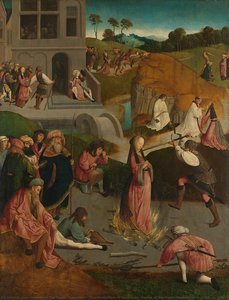
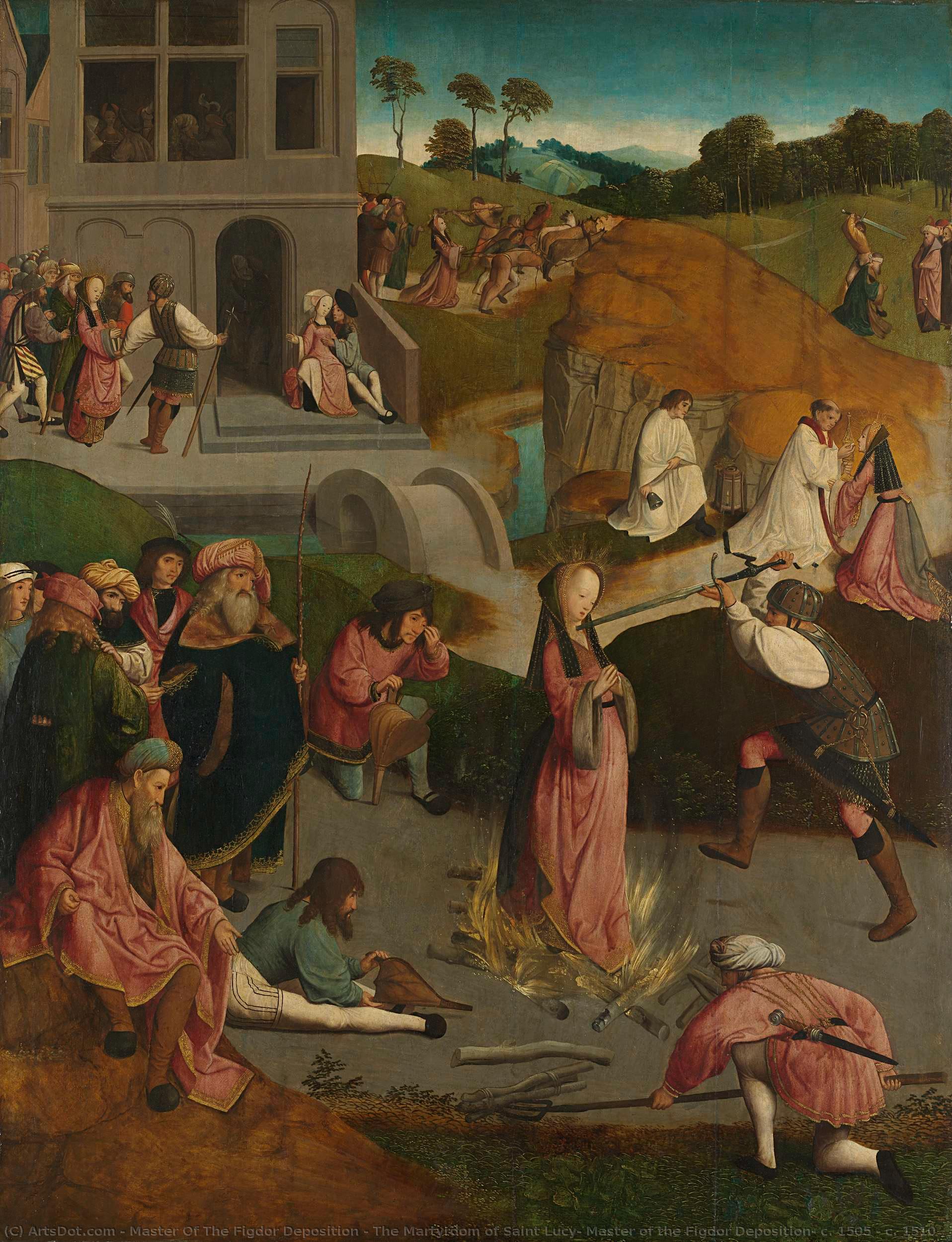
The Martyrdom of Saint Lucy, Master of the Figdor Deposition, c. 1505 - c. 1510

  • Creation date1510
  • Dimensions132.0 x 102.0 cm

Explore the enigmatic Master of the Figdor Deposition (c. 1480-1500), a key Early Netherlandish painter known for rich colors, emotive realism & poignant religious scenes like 'The Martyrdom of St. Lucy.' Discover his legacy on ArtsDot!

Hand Made Oil Reproduction

Hand-painted oil on canvas in your size and frame, made to order by our artists. (Buy Print Buy PrintBuy Image Buy Image)

Standard
custom
CM
INCH

Pick from our preset sizes that match the artwork's original proportions.

width
height

You may enter your own dimensions to fit a specific frame or space. If your selected size does not match the original image's proportions, we will either crop the artwork or extend the painting with additional hand-painted elements. A digital mockup will be sent for your approval before production begins.
Please note that the on-screen preview does not reflect the actual cropping or extension. Only the mockup will accurately show the final composition.
While custom sizes are available, we recommend selecting a dimension from the predefined list to preserve the original proportions.

Examples of what can be changed: Replace face with customer photo; Add pet (e.g., replace cat with dog); Include hidden message in background; Change background landscape or elements.
After order, ArtsDot.com team will email client for instructions and provide a mockup preview

Worldwide Delivery () in 3/4 weeks instead of standard 5 weeks. (7 September). No compromise on quality.

why_choose_icon
Free Worldwide Express Shipping
why_choose_icon
High-Quality Linen Canvas
why_choose_icon
Full Shipping Insurance
why_choose_icon
Customs Tax Refund Guarantee
why_choose_icon
True Color Matching Guarantee
why_choose_icon
100-Day Return Policy (Defects Only)
why_choose_icon
100% Money-Back Guarantee
why_choose_icon
Bulk Discount Offer

Total Price

$ 263

reproduction

The Martyrdom of Saint Lucy, Master of the Figdor Deposition, c. 1505 - c. 1510

Reproduction Medium

Reproduction Size

-

Total Price

$ 263

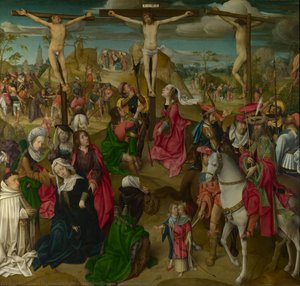
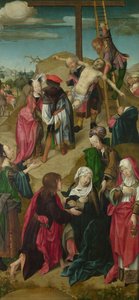
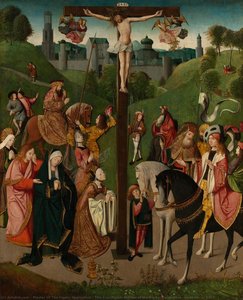
The painting depicts various scenes from the legend and martyrdom of St Lucy as related in the Legenda aurea by Jacobus de Voragine (d. 1298).6 The dimensions, the number of planks making up the panel, stylistic similarities with the painting from which the artist takes his name, and the Viennese provenance show that The Martyrdom of St Lucy once formed a single unit with The Deposition formerly in the collection of Albert Figdor in Vienna, which was lost during the Second World War (fig. a). The scenes originally formed the front (The Deposition) and back (The Martyrdom) of the wing of an altarpiece, of which the centre panel and the other wing are probably lost. Most authors thought that the panel was the right wing of an altarpiece with The Crucifixion as the main subject.7 It can be assumed from the composition of The Martyrdom, in which most of the figures are facing right, that it was in fact the outer left wing.8 If that was the case, The Deposition would have been the inner left wing, which means that the subject of the centre panel, whether painted or sculpted, has to be reassessed. The more likely scenario with a Deposition on the left wing is that the centre panel was a Lamentation and the right wing a Resurrection. The outer right wing could have had other scenes from the life of Lucy or another saint. The triptych or retable may have been intended for the high altar of a church or convent dedicated to St Lucy.9 The scene and composition of The Martyrdom of St Lucy can also be associated with a chasuble of 1507 embroidered with scenes from St Lucy’s life which may have been made in Amsterdam.10 She was not a popular saint in the northern Netherlands, and there was no Luciakerk (Church of St Lucy) near Amsterdam or Haarlem, and only one convent.11 It stood on the site of what is now the Amsterdams Historisch Museum, which may have been where both the panel and the chasuble originated. Stylistically, this painting by the Master of the Figdor Deposition can be placed between the work of Geertgen tot Sint Jans in Haarlem and of Jacob Cornelisz van Oostsanen in Amsterdam. The horizontal arrangement of the composition on several levels is closely related to that of one of Geertgen’s core works, The Burning of the Bones of St John the Baptist in Vienna.12 The two panels also share the manner of depicting the foliage on the trees with short horizontal brushstrokes. In addition, some of the figure types in The Martyrdom are comparable to those in paintings attributed to Geertgen. Paschasius, for example, standing behind St Lucy on the left, is related to Joachim, the figure on the far left of The Holy Kinship attributed to Geertgen (SK-A-500). The points of similarity are the shadow below the cheekbone, the fairly short distance between the bottom of the nose and the lower lip, the fine, reddish brown contour line around the whites of the eyes, and the way in which the light areas in the beard and face are rendered with delicate touches of the brush. The execution of the background figures, with reddish brown contours for the faces and hands, is considered typical of Jacob Cornelisz van Oostsanen.13 The ‘draughtsman-like’ manner of painting, visible in the priest’s face and elsewhere, with various passages being accentuated with painted hatchings, such as the shadow below the cheekbone and the furrows on the forehead, is close to the work of Jacob Cornelisz. On the basis of the assumed original location of the painting, its relationship to the chasuble of 1507, and the stylistic parallels with the work of Jacob Cornelisz, such as his Crucifixion of c. 1507-10, The Martyrdom of St Lucy can be dated around the same time, c. 1505-10. (M. Leeflang)

Artist Biography

a glimpse into the life and artistry of a 15th-century netherlandish painter

in the realm of early netherlandish painting, few names have garnered as much intrigue as master of the figdor deposition, an enigmatic figure active in the netherlands from approximately 1480 to 1500. this artist's existence is shrouded in mystery, with his name being a direct result of his association with a specific altarpiece, now lost to the annals of time.

early life and artistic beginnings

despite the scarcity of information regarding master of the figdor deposition's early life, it is believed that he was active in haarlem or amsterdam. his artistic style, often described as a blend of naturalism and realism, suggests a connection to the early netherlandish movement, which was characterized by its detailed and emotive depictions.

notable works and style

key characteristics:
  • use of rich, warm colorization.
  • sympathetic expressions in his subjects.
  • blend of naturalism and realism.

influence and legacy

though the master of the figdor deposition's influence may not have been as widespread as some of his contemporaries, his unique style has contributed to the rich tapestry of early netherlandish painting. for more on this artist and others like him, explore ArtsDot's extensive collection: master of the figdor deposition's works on ArtsDot wikipedia: master of the figdor deposition
master of the figdor deposition

master of the figdor deposition

1480 - 1500 , Netherlands

Quick Facts

  • Artistic Movement Or Style: High Renaissance
  • Artists Or Movements Influenced By This Artist:
    • Venetian School
    • Mannerism
  • Artists Who Influenced This Artist:
    • Giovanni Bellini
    • Giorgione
  • Date Of Birth: c. 1480
  • Date Of Death: 1556/57
  • Full Name: Lorenzo Lotto
  • Nationality: Italian Renaissance
  • Notable Artworks:
    • Virgin and Child with St. Jerome
    • Allegory of Virtue and Vice
    • Portrait of an Old Man with a Boy
  • Place Of Birth: Venice, Italy
Explore artworks organized by themes, styles, and characteristics.