 Preview
 Send
Send Share
Share
 Details

 Download
 Similars
 X-Ray
X-Ray Diaporama
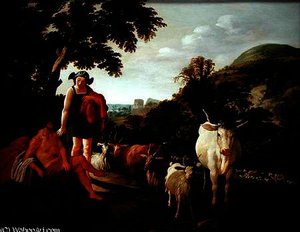
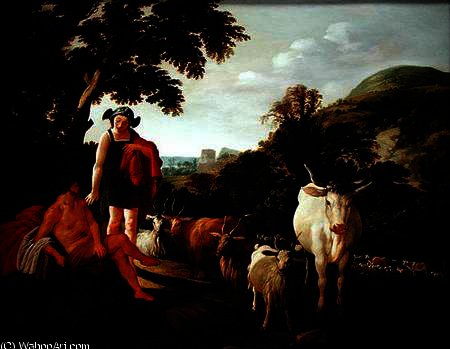
Mercury and Argus
 Read More
Giclée / Art Print
Museum-quality giclée or canvas print with fast production and flexible finish options. ( Buy Hand Made Painting Buy Image)




































Pick from our preset sizes that match the artwork's original proportions.

You may enter your own dimensions to fit a specific frame or space. If your selected size does not match the original image's proportions, we will either crop the artwork or extend the image with a mirrored or solid-fill edge. A digital mockup will be sent for your approval before production begins.
Please note that the on-screen preview does not reflect the actual cropping or extension. Only the mockup will accurately show the final composition.
While custom sizes are available, we recommend selecting a dimension from the predefined list to preserve the original proportions.
Worldwide Delivery () in 2 weeks instead of standard 4/5 weeks. (22 August)

Free Worldwide Express Shipping

High-Quality Linen Canvas

Full Shipping Insurance

Customs Tax Refund Guarantee

True Color Matching Guarantee

60-Day Return Policy (Defects Only)

100% Money-Back Guarantee

Bulk Discount Offer
 Glass option is only available in size under 110 CM

Mercury and Argus
Giclée / Art Print
Reproduction Size
-


Total Price
$ 63
Related Artworks

Artist Biography
The Radiant Legacy of Moyses Matheusz van Uyttenbroeck
In the golden twilight of the seventeenth century, few artists captured the vibrant pulse of life and the dramatic tension of myth with as much grace as Moyses Matheusz van Uyttenbroeck. Born around 1595 in The Hague, Netherlands, Uyttenbroeck emerged from a period of profound cultural transformation. His early years were steeped in the intellectual richness of the Dutch tradition, where he received an education that balanced humanist scholarship with rigorous artistic training. As the younger brother of the painter Jan Matheusz van Uyttenbroeck, Moyses was born into a world where the brush and the etching needle were instruments of both storytelling and social prestige. His formative years in Den Haag provided him with a foundational mastery of light and form, yet it was his migration to the bustling artistic hub of Antwerp around 1620 that would truly ignite his creative spirit.
The move to Antwerp proved to be the defining chapter of his life, placing him at the heart of the Flemish Baroque movement. In this vibrant metropolis, Uyttenbroeck found himself surrounded by the echoes of masters like Rubens and the burgeoning realism of the Pre-Rembrandtists. It was here that he refined a style that was uniquely his own—a sophisticated marriage of meticulous anatomical precision and an almost theatrical sense of movement. His work began to attract the gaze of prestigious patrons, including the influential Van Loon family, who sought his ability to capture not just the physical likeness of their subjects, but the nuanced psychological depths of the human condition. Through his canvases, the boundaries between the mundane and the mythological began to blur, as he breathed life into classical legends with a contemporary vitality.
Mastery of Genre and Mythological Narrative
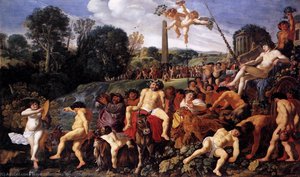
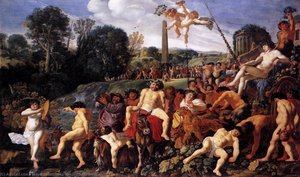
Uyttenbroeck’s oeuvre is a testament to his versatility, ranging from intimate portraits to sweeping, epic compositions. He possessed a rare ability to navigate the complexities of genre painting, finding profound beauty in the everyday rhythms of life while simultaneously elevating mythological themes to new heights of expressive power. His technique was characterized by subtle tonal gradations and a dynamic use of color that could shift from the warm, inviting earth tones of a pastoral scene to the striking, dramatic contrasts typical of the Baroque era. When painting scenes of revelry, such as his celebrated Bacchanal of 1627, he employed a palette rich with splashes of red and blue, creating an atmosphere that felt both festive and intensely alive.
The artist’s skill is perhaps most evident in his treatment of mythological subjects, where he utilized the language of classical antiquity to explore themes of desire, pursuit, and fate. Some of his most enduring achievements include:
- Alpheus Pursuing Arethusa: A work that showcases his command over fluid movement and the tension of a legendary chase.
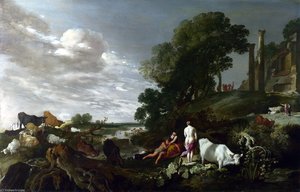
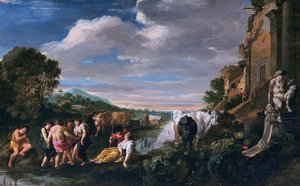
- Mercury and Argus: An exploration of divine intervention and watchful vigilance, rendered with exquisite detail.
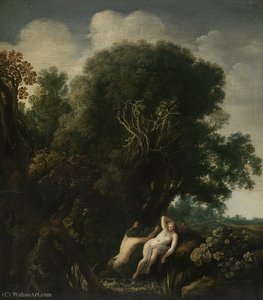
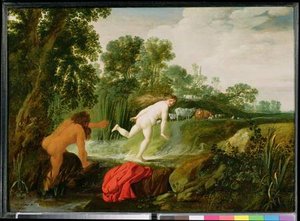
- A Nymph Surprised by a Satyr while Bathing: A piece that exemplifies his ability to blend naturalistic landscapes with the playful, often eroticized themes of classical myth.
Beyond the grand narratives, Uyttenbroeck was a master of the landscape and the portrait, imbuing even his most quiet compositions with an underlying sense of drama. His landscapes often served as more than mere backdrops; they were active participants in the emotional arc of his subjects, featuring lush greenery, winding rivers, and atmospheric light that suggested a world teeming with unseen life.
Historical Significance and Artistic Enduring Spirit
Though his life was relatively short, ending around 1647, the impact of Moyses Matheusz van Uyttenbroeck remains etched in the history of the Dutch Golden Age. He stood at a unique crossroads of artistic influence, bridging the gap between the meticulous realism of the North and the exuberant, emotive energy of the Flemish Baroque. His ability to synthesize these two worlds allowed him to create works that were both intellectually stimulating and visually captivating, making him a significant figure in the evolution of seventeenth-century European art.
Today, his legacy is preserved in some of Europe's most esteemed institutions, such as the Herzog Anton Ulrich-Museum in Germany and the British Museum. Collectors and historians alike continue to admire him for his technical brilliance and his capacity to convey profound emotional depth through a single, well-placed brushstroke. In the annals of art history, Uyttenbroeck remains a master of the human character, an artist who could capture the fleeting moment of a smile or the eternal tension of a myth with equal, breathtaking precision.
moyses matheusz van uyttenbroeck
1595 - 1647 , Netherlands
Quick Facts
- Artistic Movement Or Style: Dutch Golden Age Art
- Artists Or Movements Influenced By This Artist: ['Baroque']
- Artists Who Influenced This Artist:
- Peter Paul Rubens
- Jan Steen
- Date Of Birth: ca. 1595
- Date Of Death: ca. 1647
- Full Name: Moyses Matheusz van Uyttenbroeck
- Nationality: Dutch
- Notable Artworks:
- Alpheus Pursuing Arethusa
- Mercury and Argus
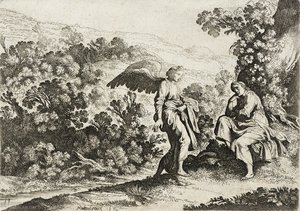
- Angel and Seated Figure in a Landscape
- Place Of Birth: Den Haag, Netherlands