 Preview
 Send
Send Share
Share
 Details

 Download
 Similars
 X-Ray
X-Ray Diaporama
Allegory of Death


 Read More
Hand Made Oil Reproduction
Hand-painted oil on canvas in your size and frame, made to order by our artists. ( Buy Print Buy Image)




P118B $10

P118H $10

P118W $10

P438Z $10

P508JH $12

P508YH $12

P805H $10

P805Z $10

P919BZ $10

P919G $10

P919XJ $10

P959ZH $10

P968JZ $12

W106C $8

W218G $10

W218JH $8

W218Y $10

W307PJ $10

W316G $10

W316PJ $8

W316Y $10

W398PJ $8

W4111J $10

W500HY $15

W500JH $15

W692G $12

W849H $8

W940BG $15

W953PJ $8




Pick from our preset sizes that match the artwork's original proportions.

You may enter your own dimensions to fit a specific frame or space. If your selected size does not match the original image's proportions, we will either crop the artwork or extend the painting with additional hand-painted elements. A digital mockup will be sent for your approval before production begins.
Please note that the on-screen preview does not reflect the actual cropping or extension. Only the mockup will accurately show the final composition.
While custom sizes are available, we recommend selecting a dimension from the predefined list to preserve the original proportions.
After order, ArtsDot.com team will email client for instructions and provide a mockup preview
Worldwide Delivery () in 3/4 weeks instead of standard 5 weeks. (17 August). No compromise on quality.

Free Worldwide Express Shipping

High-Quality Linen Canvas

Full Shipping Insurance

Customs Tax Refund Guarantee

True Color Matching Guarantee

60-Day Return Policy (Defects Only)

100% Money-Back Guarantee

Bulk Discount Offer
 Glass option is only available in size under 110 CM

Allegory of Death
Reproduction Medium
Reproduction Size
-


Total Price
$ 263
Artwork Description
The Weight of Time: An Allegory of Mortality
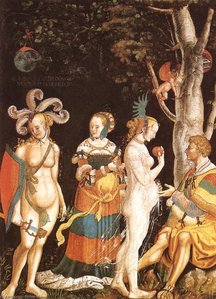
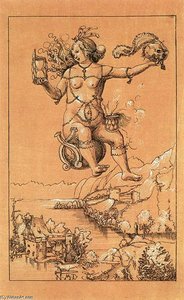
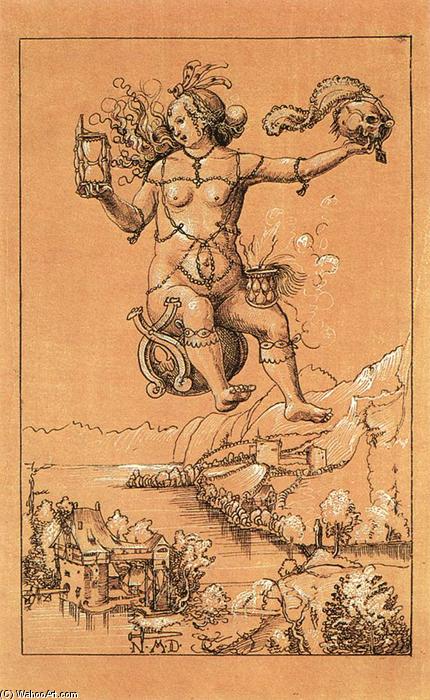
To gaze upon this drawing is to confront one of humanity's most enduring philosophical quandaries: the passage of time and the inevitability of decay. This piece, an arresting study in Renaissance allegory, presents a figure caught in a profound moment of transition. The central nude woman, rendered with exquisite detail, embodies more than just human form; she becomes a living meditation on beauty’s ephemeral nature. Her flowing hair seems to capture the very breath of passing moments, while her posture suggests both grace and a quiet resignation to fate.
Symbolism Woven in Line and Shadow
The objects held by the figure are not mere props; they are potent symbols speaking volumes without uttering a word. In one hand rests the stark, undeniable presence of a skull—the universal memento mori, a chilling reminder that earthly glories fade. Counterbalancing this gravity is the object in her other hand, perhaps a mirror, which catches and refracts light, symbolizing vanity or the deceptive gleam of fleeting beauty. Adorned with jewelry and a feathered headdress, she carries the trappings of status—the accoutrements of life lived richly. Yet, these symbols are juxtaposed against the backdrop of an active, populated landscape, suggesting that even amidst the bustle of daily existence, the ultimate reckoning remains.
Mastery in Renaissance Technique
The technical execution speaks to a high level of draughtsmanship characteristic of the period's finest minds. The artist has employed fine lines and masterful shading to imbue the drawing with an almost startling three-dimensionality. One can trace the delicate interplay between the smooth skin, the texture of the feathers, and the solidity of the background architecture. This careful rendering elevates the piece beyond a simple sketch; it is a meticulously constructed visual argument. The inclusion of intricate decorative borders further frames this narrative, suggesting that the allegory itself is contained within a rich tapestry of cultural meaning.
A Dialogue for the Modern Collector
Whether viewed as a profound moral lesson or a celebration of classical humanism, this work resonates deeply with contemporary sensibilities. For the collector or designer seeking an object imbued with intellectual weight and artistic pedigree, this reproduction offers unparalleled depth. It invites contemplation in any room—a sophisticated piece that whispers tales of *vanitas* while simultaneously celebrating the enduring power of art itself. To own this is to possess a conversation starter, a visual anchor for thoughtful interiors.
Related Artworks
Artist Biography
The Renaissance Visionary of Bern: The Life and Legacy of Niklaus Manuel
In the vibrant tapestry of the sixteenth-century Northern Renaissance, few figures loom as large or as multifaceted as Niklaus Manuel. Born in Berlin around 1484, this extraordinary individual was far more than a mere painter; he was a mercenary soldier, a writer, and a pivotal figure in the civic life of Bern. His life was a whirlwind of movement and intellect, bridging the gap between the brutal realities of European warfare and the refined humanist ideals of the Renaissance. As a central character in the artistic landscape of Switzerland, Manuel’s work serves as a profound window into an era defined by spiritual struggle, political upheaval, and a burgeoning fascination with the human condition.
The foundation of Manuel’s technical mastery can be traced back to his formative years in Basel, where he underwent rigorous training under the legendary Hans Holbein the Younger. This apprenticeship was transformative, instilling in him a meticulous devotion to realism and a sophisticated command of chiaroscuro. From Holbein, Manuel inherited an eye for the minute details of nature and the human form, as well as the ability to use light and shadow to imbue his subjects with psychological depth. This connection to the humanist tradition allowed him to move beyond simple ornamentation, instead creating works that prioritized observation and an accurate, almost visceral, representation of the world around him.
A Mastery of Symbolism and Narrative
Manuel’s artistic output is characterized by a remarkable versatility, ranging from deeply religious altarpieces to biting satirical compositions. His ability to weave complex theological narratives with humanist symbolism allowed him to capture the dualities of his age—the sacred and the profane, the eternal and the mortal. One of his most hauntingly beautiful themes was the exploration of mortality, often expressed through intricate landscapes and symbolic figures. In works such as his Allegory of Death, he utilizes the image of a nude woman holding a skull to evoke profound meditations on transformation and the inevitability of the end, set against an intricately detailed backdrop that showcases his command over environmental storytelling.
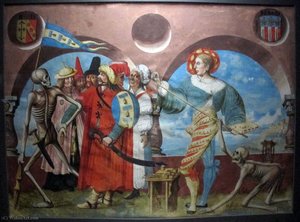
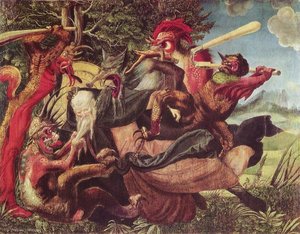
Beyond the contemplative, Manuel possessed a talent for depicting intense, dynamic struggle. His Temptation of Saint Anthony stands as a testament to his ability to utilize the emerging Mannerist style, employing rich colors and intense detail to portray demonic temptation and spiritual warfare. This capacity for drama was perhaps most famously realized in his monumental mural, the Danse Macabre, at the Dominican Abbey in Bern. Although this masterpiece was tragically lost to history in 1660, its influence lived on through contemporary copies, reminding viewers of his ability to command large-scale compositions that spoke to the collective consciousness of the Bernese people.
Historical Significance and Artistic Endurance
The significance of Niklaus Manuel extends far beyond the borders of Switzerland. He represented a unique breed of Renaissance man—an artist whose brush was as active in the halls of governance and the battlefields of Europe as it was in the quiet studios of Basel. His portraits, such as those found in the Historisches Museum Bern, reveal a master capable of capturing the dignity and symbolic weight of the nobility, using dramatic lighting to elevate his subjects into icons of their era.
Ultimately, Manuel’s legacy is defined by his role as a bridge. He bridged the gap between the late Gothic traditions and the burgeoning Renaissance; he bridged the distance between the soldier's grit and the scholar's grace; and most importantly, he bridged the human experience with the divine through his art. His works remain essential touchstones for understanding the cultural metamorphosis of the sixteenth century, offering a glimpse into a world where art, politics, and spirituality were inextricably entwined.
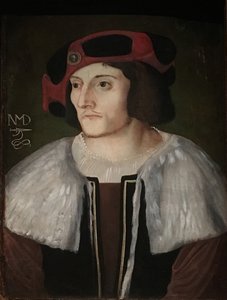
niklaus manuel
1484 - 1530 , Germany
Quick Facts
- Artistic Movement Or Style: Renaissance Painting
- Artists Or Movements Influenced By This Artist: ['Renaissance Switzerland']
- Artists Who Influenced This Artist: ['Holbein']
- Date Of Birth: c. 1484
- Date Of Death: 28 April 1530
- Full Name: Niklaus Manuel Deutsch
- Nationality: Swiss
- Notable Artworks:
- Danse Macabre
- Temptation of Saint Anthony
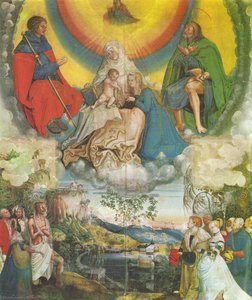
- Anna selbdritt and the Holy Jacobus and Rochus as intercessors for mankind bothered by the plague humanity
- Place Of Birth: Berlin, Germany
Related Articles
Unveiling Hidden Meanings: Allegory in Western Art History
Explore the rich history of allegory in Western art! Discover hidden meanings in masterpieces from Giotto to Bosch & beyond. Expert insights for collectors and enthusiasts at ArtsDot.

Illuminating Faith: Biblical Narrative & Artistic Expression Through the Ages
Explore the rich history of biblical art from Giotto to the Renaissance masters with ArtsDot. Discover symbolism, techniques & enduring legacies. Museum-quality reproductions & expert insights.
Illuminating Faith: Biblical Scenes & Their Enduring Legacy in Art History
Explore the profound history of biblical art! Discover Renaissance masterpieces by Giotto & more. Uncover symbolism, artistic techniques, and lasting influence. Expert insights at ArtsDot.
Hieronymus Bosch's Masterpieces: 25 Visions of Art & Morality | ArtsDot
Delve into the enigmatic world of Hieronymus Bosch! Explore 25 iconic paintings – from 'The Garden of Earthly Delusions' to his haunting triptychs. Discover the symbolism, history & artistry behind these Renaissance masterpieces. Find museum-quality art reproductions at ArtsDot.com.
Sacred Narratives on Canvas: Exploring Biblical Art Across Centuries
Explore the rich history of biblical art from Giotto to the Renaissance masters. Discover symbolism, techniques & enduring legacies with ArtsDot – your source for museum-quality reproductions and expert art insights.