 Preview
 Send
Send Share
Share
 Details

 Download
 Similars
 X-Ray
X-Ray Diaporama
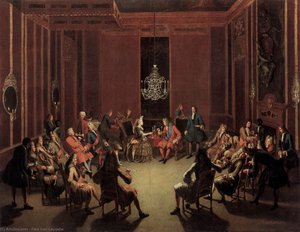
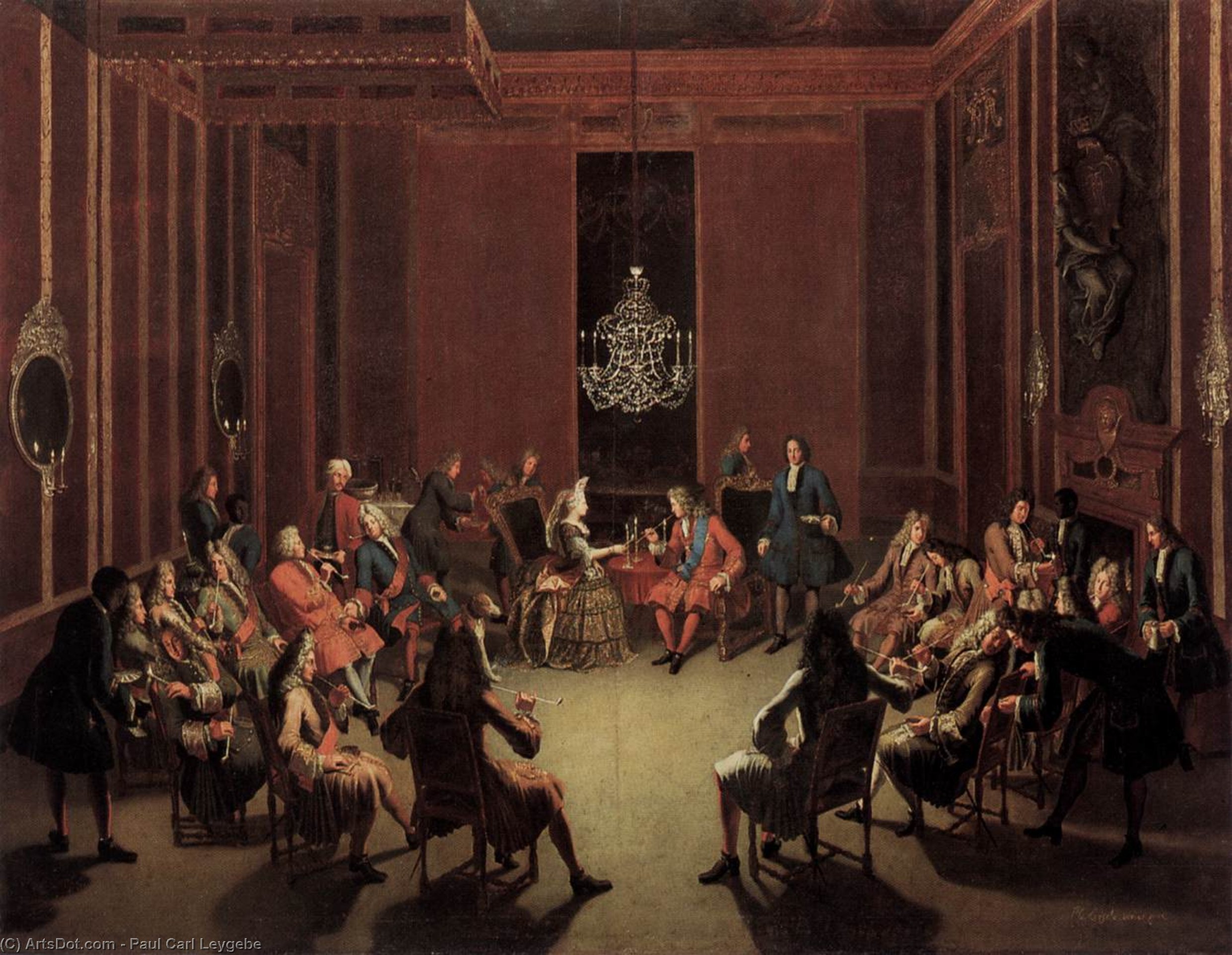
Tabakskollegium of Frederick I
 1709
1709 130.0 x 166.0 cm
 Neues Palais
 Read More
Giclée / Art Print
Museum-quality giclée or canvas print with fast production and flexible finish options. ( Buy Hand Made Painting Buy Image)




































Pick from our preset sizes that match the artwork's original proportions.

You may enter your own dimensions to fit a specific frame or space. If your selected size does not match the original image's proportions, we will either crop the artwork or extend the image with a mirrored or solid-fill edge. A digital mockup will be sent for your approval before production begins.
Please note that the on-screen preview does not reflect the actual cropping or extension. Only the mockup will accurately show the final composition.
While custom sizes are available, we recommend selecting a dimension from the predefined list to preserve the original proportions.
Worldwide Delivery () in 2 weeks instead of standard 4/5 weeks. (24 August)

Free Worldwide Express Shipping

High-Quality Linen Canvas

Full Shipping Insurance

Customs Tax Refund Guarantee

True Color Matching Guarantee

60-Day Return Policy (Defects Only)

100% Money-Back Guarantee

Bulk Discount Offer
 Glass option is only available in size under 110 CM

Tabakskollegium of Frederick I
Giclée / Art Print
Reproduction Size
-


Total Price
$ 63
Related Artworks






Artist Biography
The Anatomist of the Baroque: The Life and Legacy of Paul Carl Leygebe
In the grand, sweeping tapestry of the Prussian Baroque, few figures possess a legacy as intellectually profound and visually intricate as Paul Carl Leyge.gebe. Born in Nuremberg in 1664, Leygebe emerged from a lineage of craftsmanship; his father, Gottfried Christian Leygebe, was a skilled sculptor and medallist. This early exposure to the precision of metalwork and form likely planted the seeds for what would become a dual mastery of both the brush and the scalpel. As the family moved to Berlin in 1668, the young artist found himself at the heart of a burgeoning European power, an environment that would eventually see him rise to the prestigious position of official court painter and professor of anatomy at the Prussian Academy of Arts.
Leygebe’s artistic development was far from a singular pursuit of aesthetics; it was a deeply scholarly endeavor. His education at the Jesuit Collegium Carolinum infused his work with a humanist spirit, blending classical ideals with a rigorous scientific curiosity. This unique intersection of disciplines allowed him to approach the canvas not merely as a surface for decoration, but as a window into the structural truth of the human form. His appointment as a professor of anatomy in 1715 was not a departure from his painting, but rather its ultimate refinement. By understanding the underlying musculature and skeletal architecture, Leygebe brought an unprecedented level of anatomical accuracy to the monumental decorative cycles that would define his career.
A Vision in Gold and Glory: The Tabakskollegium Murals
The true zenith of Leygebe’s creative output lies within the halls of Berlin’s Prussian Academy of Arts, specifically in his celebrated Tabakskollegium murals. These ambitious decorative panels were more than mere ornamentation; they were grand narratives designed to celebrate the prestige and cultural vitality of the Prussian court. Working under the architectural guidance of masters like Andreas Schlüter, Leygebe transformed ceilings and walls into theatrical stages of light and shadow. His ability to weave complex allegories—such as his celestial plafond in the "Roten Samtkammer," which depicted the constellations of King Frederick’s coronation—demonstrates a profound command over the Baroque language of movement and cosmic order.
Beyond these monumental cycles, Leygebe served as a chronicler of royalty. His canvases captured the very essence of Prussian power, depicting the triumphs of Frederick William, the Great Elector, and the regal presence of King Frederick William I. One of his most striking early achievements was the Triumphal Entry of the Great Elector, a work that utilized scale and dramatic composition to immortalize a moment of political splendor. Through these works, Leygebe did not just paint history; he sculpted it with light, ensuring that the grandeur of the Hohenzollern dynasty was etched into the visual memory of the era.
The Fragile Endurance of a Masterpiece
Despite the monumental scale of his contributions, the historical footprint of Paul Carl Leygebe has faced the ravages of time and conflict. Much of his magnificent oeuvre was tragically lost or damaged during the devastation of World War II and the subsequent political shifts in Germany. This loss adds a layer of poignant melancholy to his biography; we view his surviving fragments as precious echoes of a vanished splendor. Yet, the significance of his work remains undiminished for historians and art lovers alike.
Leygebe’s importance transcends simple portraiture or decoration. He represents a rare moment in art history where the scientific revolution and the Baroque aesthetic converged. His legacy is found in the meticulous detail of a muscle's tension, the precise alignment of a celestial body, and the enduring spirit of an artist who saw no boundary between the beauty of the visible world and the complex truth of the biological one. He remains a cornerstone of German Baroque art, a master whose name continues to resonate with the precision of an anatomist and the soul of a poet.
paul carl leygebe
1664 - 1756 , Germany
Quick Facts
- Artistic Movement Or Style: Baroque
- Artists Who Influenced This Artist:
- Johann Georg Muffat
- Andreas Schlüter
- Date Of Birth: 1664
- Date Of Death: 1756
- Full Name: Paul Carl Leygebe
- Nationality: German
- Notable Artworks:
- Tabakskollegium murals
- Portraits
- Place Of Birth: Nuremberg, Germany