

 Preview
 Send
Send Share
Share
 Details

 Download
 Similars
 X-Ray
X-Ray Diaporama
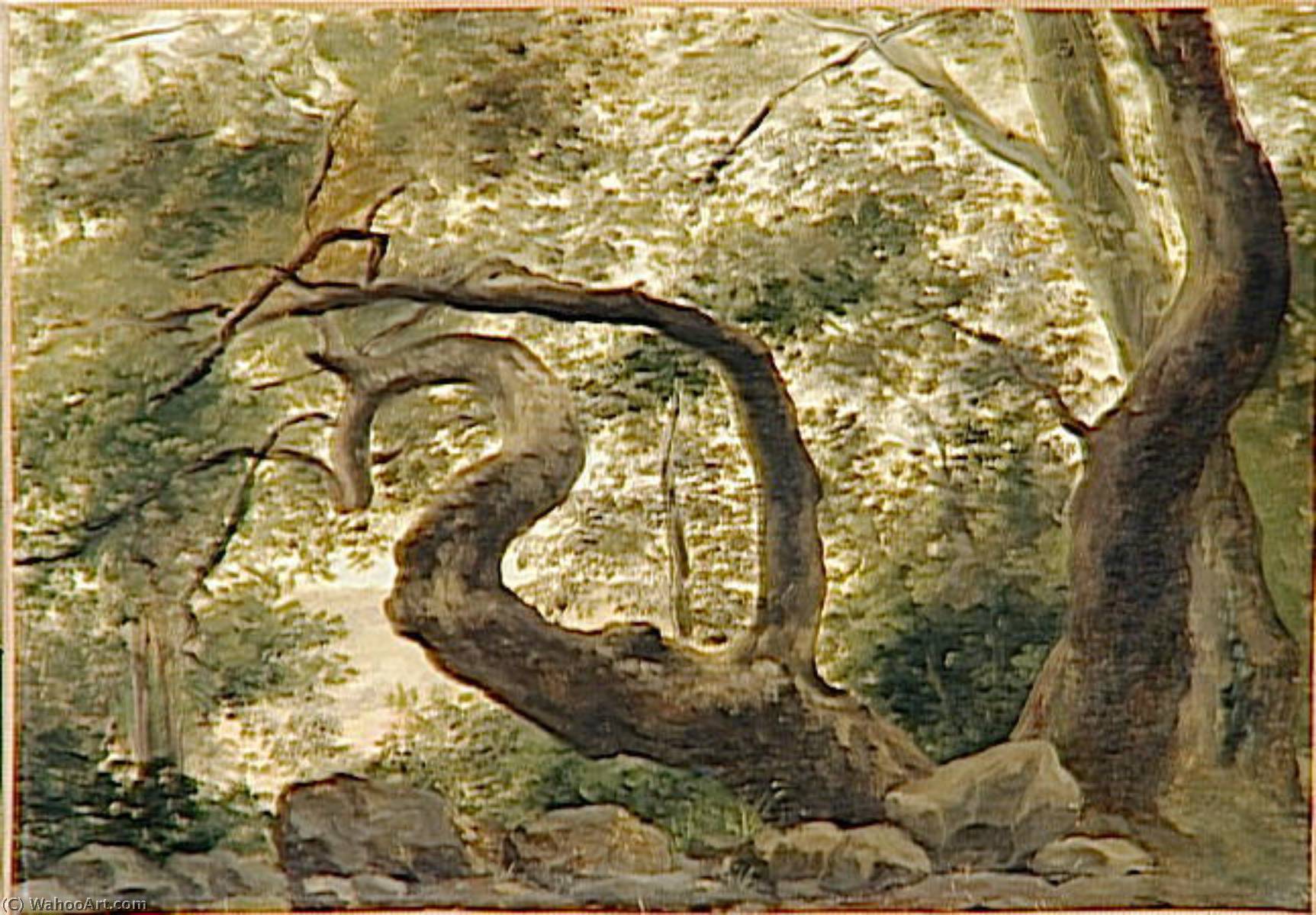
SOUS BOIS, ARBRES AUX BRANCHES TORTUEUSES


 Read More
Purchase a high-resolution, enhanced digital image, far superior to the online preview.
Each file is meticulously prepared by our in-house specialists using advanced tools and expert manual retouching. We ensure every image has exceptional clarity, precise color accuracy, and fine detail.
The final file is delivered via email within 72 hours, optimized for immediate use in professional, editorial, and print environments. This is the same quality trusted by top-tier design studios, publishers, and galleries.
Digital Image
Download a high-resolution file for personal display, printing, and creative projects. ( Buy Print Buy Hand Made Painting)
Included in Every Digital Image Order
Expert Digital Delivery, Guaranteed
When you choose ArtsDot.com, you're not just getting an image - you're receiving a professionally enhanced digital artwork, crafted with precision and backed by a satisfaction guarantee. Here's everything that comes with your order, automatically:

Fast Email Delivery
Your high-resolution digital image file will be emailed to you within 72 hours of ordering - ready for immediate use.

AI-Enhanced Digital File
Your artwork is professionally optimized using advanced AI tools and manual editing, ensuring maximum detail, clarity, and color accuracy.

Free Lifetime Re-Delivery
Accidentally deleted or lost your file? No worries - we'll resend it to you anytime, free of charge.

No Import Fees - Ever
Enjoy your artwork instantly with zero customs, duties, or delivery fees - digital downloads are always tax-free.

Color Accuracy Guarantee
We ensure your digital image reflects the original colors as closely as possible using professional tools and color management.

60-Day Satisfaction Guarantee
If you're not satisfied with your digital image, we'll revise it or refund 100% within 60 days - no questions asked.

100% Money-Back Guarantee
Not satisfied? Get a full refund within 60 days of receiving your digital file - no questions asked.

Bulk Order Discounts
Buy 3 images, save 10% - Buy 5, save 15% - Buy 10+, save 20%. Great for creative projects, galleries, and agencies.
Collectible Description
The Labyrinthine Embrace of Nature: An Exploration of Valenciennes' Woodland Scene
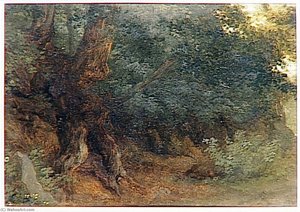
To gaze upon Pierre de Valenciennes’s "Sous Bois, Arbres aux Branches Tortueuses" is to step through a veil and into the hushed, verdant heart of an ancient wood. This watercolor painting is not merely a depiction of trees; it is an immersive study in organic form, light, and the enduring mystery of nature. The composition immediately draws the eye deep into the undergrowth, where a cluster of trees presents their most dramatic feature: branches that twist, writhe, and serpentine like sleeping beasts. Valenciennes captures this botanical drama with an almost palpable sense of life, inviting the viewer to lose themselves within its leafy embrace.
Mastery in Watercolor Technique
The sheer technical brilliance evident in this piece is breathtaking. Valenciennes employs watercolor not just as a medium, but as an atmospheric agent. The artist’s handling of pigment suggests a profound understanding of light diffusion. Observe how the dappled sunlight struggles to penetrate the dense canopy; it breaks through in soft, ethereal patches, illuminating pockets of moss and shadow. This effect is achieved through delicate washes and masterful layering—a technique that lends the entire scene an unparalleled sense of depth despite the somewhat flattened perspective typical of the genre. The texture itself seems audible: one can almost feel the rough bark against the velvety softness of the undergrowth, all rendered with loose, fluid brushstrokes characteristic of a painter deeply connected to his subject.
Historical Echoes and Artistic Context
Positioned at the cusp between the Enlightenment’s rationalism and the burgeoning emotional fervor of Romanticism, this work speaks volumes about its time. Valenciennes himself was a pioneer in championing “landscape portraits,” elevating nature from mere backdrop to primary subject matter. In an era where art was increasingly turning inward toward feeling and sublime experience, this woodland scene embodies that shift. It reflects a cultural moment when the wildness of the natural world—its untamed complexity—became a profound source of artistic inspiration and philosophical contemplation.
Symbolism of the Twisted Form
The title itself, referencing "tortuous branches," hints at deeper meanings woven into the foliage. These winding limbs are more than just botanical curiosities; they become potent symbols. They suggest resilience—the way life finds a path even when obstructed by time or circumstance. They might whisper tales of endurance, adaptation, and the slow, inevitable passage of years etched into wood and leaf. For the modern collector or designer, this piece offers not just decoration, but a contemplation point: a visual meditation on complexity and survival.
Bringing Woodland Serenity Home
To reproduce this artwork is to invite a pocket of profound tranquility into any interior space. Whether displayed in a formal drawing-room seeking classical depth or in a sunlit study needing an infusion of organic calm, the muted palette of greens and browns offers grounding sophistication. Owning a reproduction allows one to connect with the historical genius of Valenciennes while enjoying the timeless, emotional resonance of nature’s most intricate artistry.
Related Artworks
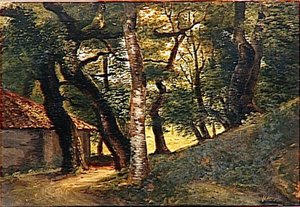
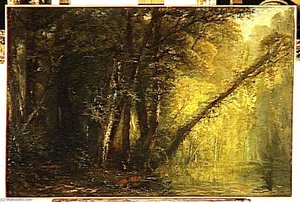
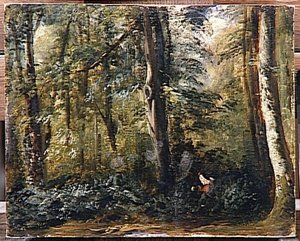
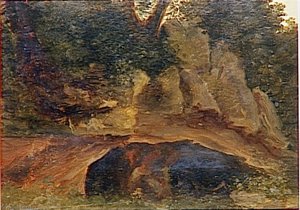
Artist Biography
The Pioneer of the Open Air: The Life and Vision of Pierre de Valenciennes
In the grand tapestry of art history, certain figures act as quiet architects of revolution, laying the foundations for movements that would later define entire eras. Pierre Henri de Valenciennes (1750–1819) was precisely such a pioneer. Born in Toulouse, his journey from the classical traditions of France to the sun-drenched landscapes of Italy represents a profound shift in the Western artistic consciousness. While many of his contemporaries remained tethered to the controlled environments of the studio, Valenciennes sought a more visceral connection with the natural world. He was not merely interested in depicting scenery; he sought to capture the very breath of the earth through what he termed "landscape portraits," a concept that would eventually pave the way for the Impressionist revolution.
His formative years were marked by a rigorous pursuit of mastery, beginning under the guidance of the history painter Gabriel-François Doyen. This early training in traditional subject matter provided him with a robust technical foundation, yet his soul yearned for something more immediate. His travels to Rome in the late 1770s proved to be the transformative catalyst of his career. Immersed in the Roman Campagna and the serene environs of Lake Nemi, Valenciennes began to move away from the grand, idealized panoramas favored by the Academy. Instead, he turned his gaze toward the humble and the ephemeral: a moss-covered stone wall, the way light filters through a thicket of trees, or the melancholic beauty of overgrown ruins. This period of direct observation allowed him to develop an acute sensitivity to atmosphere and light, treating the landscape not as a backdrop for historical drama, but as the protagonist itself.
Technique, Theory, and the Mastery of Perspective
Valenciennes’s artistic evolution was uniquely driven by a marriage of scientific precision and poetic intuition. His time in Italy was not solely spent sketching; he dedicated himself to the study of perspective under mathematical professors, an endeavor that would later inform his most significant intellectual contribution to art. In 1800, he published his influential treatise, Elémens de perspective pratique à l’usage des artistes. This work was far more than a technical manual; it was a manifesto for a new way of seeing. He argued passionately that the landscape painter must become an expert observer of nature, urging artists to move their easels outdoors to capture the true essence of light and shadow.
This theoretical rigor was matched by a breathtakingly nuanced technique. Influenced by the dramatic chiaroscuro of masters like Caravaggio and Rembrandt, Valenciens mastered the art of tonal gradation. His works often feature a delicate balance of light and dark, where shadows are not merely absences of light but rich, textured spaces that hold depth and mystery. Whether he was painting the misty, cloud-shrouded mountains of La Rocca di Papa or the tranquil, sun-dappled paths near Nemi, his brushwork possessed an ability to evoke the tactile qualities of nature—the roughness of bark, the dampness of moss, and the ethereal quality of morning mist. His ability to blend these mathematical certainties with emotional resonance earned him the respect of the French Academy and solidified his reputation as a master of paysage historique.
Legacy: The Bridge to Modernity
The historical significance of Pierre de Valenciennes lies in his role as a bridge between the structured classicism of the 18th century and the emotive, sensory-driven art of the 19th century. Though he was celebrated at the Paris Salon for his large-scale historical landscapes—works that often integrated mythological or classical themes into natural settings—it is his smaller, more intimate studies that resonate most powerfully with the modern eye. These "landscape portraits" served as a vital precursor to the plein air movement, influencing generations of artists who would later seek to dissolve the boundaries between the canvas and the living world.
To look upon a Valenciennes landscape is to witness the birth of a new way of perceiving reality. His legacy can be summarized through several key contributions:
- The Introduction of Direct Observation: He championed the practice of painting outdoors, moving beyond studio-bound imagination to capture authentic environmental truths.
- Theoretical Innovation: Through his writings on perspective, he provided the technical vocabulary necessary for artists to translate complex three-dimensional spaces onto a two-dimensional surface.
- The Elevation of the Mundane: By finding profound beauty in ruins, woods, and simple lakeside scenes, he shifted the focus of landscape painting from the monumental to the intimate.
- A Foundation for Impressionism: His obsession with the ephemeral qualities of light and atmosphere laid the essential groundwork for the later explorations of Monet and his contemporaries.
Ultimately, Pierre de Valenciennes remains a figure of immense quiet power. He did not seek to destroy the traditions of the past, but rather to expand them, infusing the rigid structures of classical painting with the vibrant, unpredictable spirit of the natural world.
pierre de valenciennes
1750 - 1819
Quick Facts
- Artistic Movement Or Style: Romantic Landscape Painting
- Artists Or Movements Influenced By This Artist: ['Romantic Landscape Painting']
- Artists Who Influenced This Artist:
- Hubert Robert
- Pierre-Athanaise Chauvin
- Achille Etna Michallon
- Date Of Death: 1819
- Full Name: Pierre Henri de Valenciennes
- Nationality: French
- Notable Artworks:
- Le Lac de Nemi et Genzano
- L’Escalier de Pierres Recouvert de Mousse
- Les Envirs de Genzano
- Place Of Birth: Toulouse

