 Preview
 Send
Send Share
Share
 Details

 Download
 Similars
 X-Ray
X-Ray Diaporama
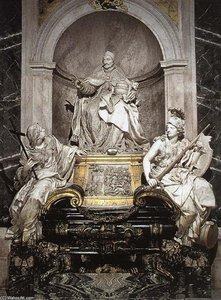
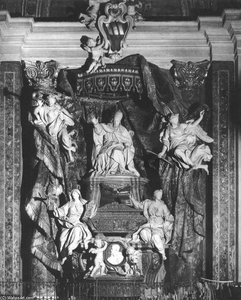
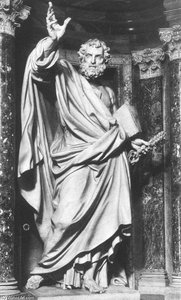
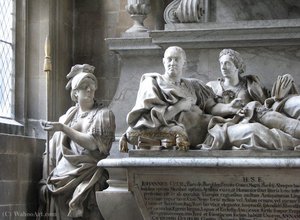
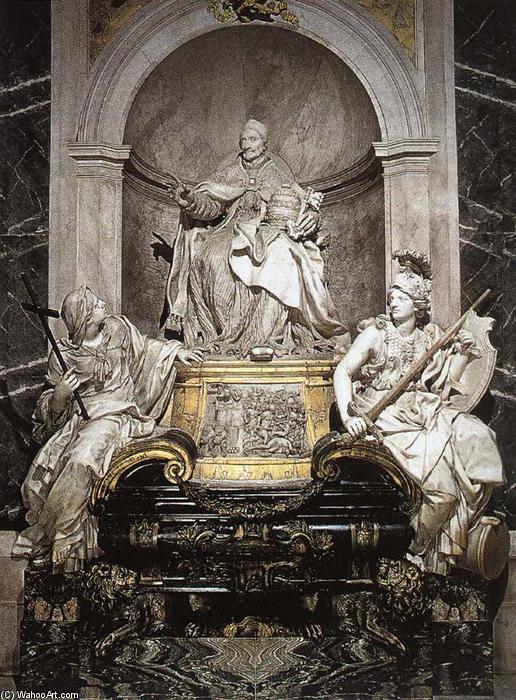
Tomb of Pope Innocent XI


 Read More
Hand Made Oil Reproduction
Hand-painted oil on canvas in your size and frame, made to order by our artists. ( Buy Print Buy Image)




P118B $10

P118H $10

P118W $10

P438Z $10

P508JH $12

P508YH $12

P805H $10

P805Z $10

P919BZ $10

P919G $10

P919XJ $10

P959ZH $10

P968JZ $12

W106C $8

W218G $10

W218JH $8

W218Y $10

W307PJ $10

W316G $10

W316PJ $8

W316Y $10

W398PJ $8

W4111J $10

W500HY $15

W500JH $15

W692G $12

W849H $8

W940BG $15

W953PJ $8




Pick from our preset sizes that match the artwork's original proportions.

You may enter your own dimensions to fit a specific frame or space. If your selected size does not match the original image's proportions, we will either crop the artwork or extend the painting with additional hand-painted elements. A digital mockup will be sent for your approval before production begins.
Please note that the on-screen preview does not reflect the actual cropping or extension. Only the mockup will accurately show the final composition.
While custom sizes are available, we recommend selecting a dimension from the predefined list to preserve the original proportions.
After order, ArtsDot.com team will email client for instructions and provide a mockup preview
Worldwide Delivery () in 3/4 weeks instead of standard 5 weeks. (24 August). No compromise on quality.

Free Worldwide Express Shipping

High-Quality Linen Canvas

Full Shipping Insurance

Customs Tax Refund Guarantee

True Color Matching Guarantee

60-Day Return Policy (Defects Only)

100% Money-Back Guarantee

Bulk Discount Offer
 Glass option is only available in size under 110 CM

Tomb of Pope Innocent XI
Reproduction Medium
Reproduction Size
-


Total Price
$ 288
Artwork Description
The Weight of Faith: Pierre-Étienne Monnot’s Tomb of Pope Clement VIII
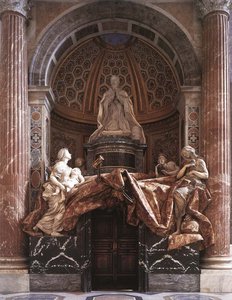
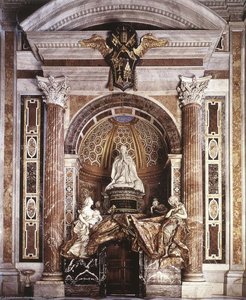
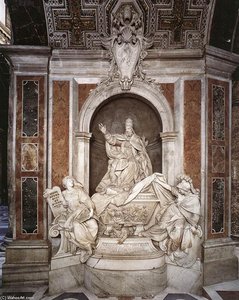
Within the echoing grandeur of St. Peter's Basilica resides a monument not merely to mortality, but to an era of profound spiritual and political power – Pierre-Étienne Monnot’s magnificent Tomb of Pope Clement VIII. Completed in 1697, this colossal sculpture is more than just a funerary tribute; it’s a meticulously crafted embodiment of papal authority, a testament to the Baroque mastery of French sculptor Monnot, and a poignant reflection on the complexities of faith and legacy. The sheer scale of the piece – nearly twelve feet tall and spanning over twenty-five feet in length – immediately commands attention, drawing the viewer into a world of intricate detail and dramatic emotion.
Monnot, having established himself as a leading figure in Rome’s artistic community after arriving from his native Franche-Comté, was entrusted with this monumental commission by Cardinal Giovan Battista Velamen, Clement VIII's private secretary. The design itself was rooted in the earlier, more restrained tomb of Pope Innocent XI, but Monnot elevated it to an unprecedented level of opulence and theatricality. He skillfully revived Bernini’s original polychrome scheme – a vibrant palette of reds, blues, and golds – which had been largely obscured over time, restoring the tomb to its intended splendor. This restoration wasn't simply cosmetic; it was a deliberate act of honoring Clement VIII’s reign and reaffirming his importance within the Catholic Church.
A Symphony of Marble: Technique and Artistic Style
Monnot’s genius lies not only in his ambitious scale but also in his masterful command of marble. The sculpture is executed entirely in white marble, a material he expertly manipulated to achieve an astonishing level of realism and luminosity. Notice the subtle gradations of tone – from the smooth, polished surfaces of the papal robes to the rougher texture of the drapery – each meticulously carved to mimic the appearance of natural fabric. This painstaking attention to detail extends to every facet of the composition, including the intricate folds of the papal garments, the muscular anatomy of the allegorical figures, and the delicate features of Clement VIII himself.
The work is firmly rooted in the late Baroque style, characterized by dramatic contrasts of light and shadow (chiaroscuro), dynamic movement, and a heightened sense of emotion. Monnot employs strong diagonals to create a sense of depth and perspective, drawing the viewer’s eye towards the central figure of the Pope. The composition is carefully balanced, with each element contributing to the overall impression of power and solemnity. The use of contrapposto – where the figure's weight is shifted onto one leg – imbues Clement VIII with a sense of dignified repose, reinforcing his image as a steadfast leader.
Symbolism and Spiritual Narrative
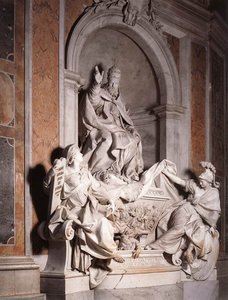
Beyond its technical brilliance, the Tomb of Pope Clement VIII is rich in symbolic meaning. The central figure of the Pope is depicted seated on an elaborate throne, flanked by two allegorical figures: Religion, holding a book and a cross, and Justice, bearing scales and a sword. These symbols represent the core tenets of Clement VIII’s papacy – his dedication to faith and his commitment to upholding the law. The inclusion of Saint Peter's keys, prominently displayed on the throne, underscores the Pope’s authority as the successor of Saint Peter and the guardian of the Church.
Further enhancing the narrative is a relief panel depicting the “Raising of the Siege of Vienna in 1683,” a pivotal event during Clement VIII's reign. This scene commemorates his crucial role in rallying European forces against the Ottoman Empire, solidifying his reputation as a courageous and effective leader. The inclusion of this specific event highlights not only his military prowess but also his dedication to defending Christendom from external threats. The overall composition speaks volumes about the Pope’s legacy – a blend of spiritual guidance, political acumen, and unwavering faith.
A Legacy in Stone: Emotional Impact and Enduring Beauty
Standing before the Tomb of Pope Clement VIII is an undeniably powerful experience. The sheer scale of the sculpture, combined with its intricate detail and dramatic lighting, evokes a sense of awe and reverence. It’s not simply a portrait of a deceased pope; it's a meditation on power, faith, and mortality. Monnot masterfully captures the solemnity of death while simultaneously celebrating the enduring legacy of Clement VIII.
Today, this magnificent monument continues to inspire admiration for its artistic merit and historical significance. Reproductions offer an accessible way to bring this extraordinary work into any space, allowing viewers to appreciate the skill and vision of Pierre-Étienne Monnot – a sculptor who left an indelible mark on the art and architecture of Rome.
Related Artworks
Artist Biography
The Sculptural Legacy of Pierre-Étienne Monnot
In the grand, sweeping era of the Late Baroque, few artists captured the divine drama and physical grace of marble as effectively as Pierre-Étienne Monnot. Born in 1657 in the rugged beauty of Doubs, France, Monnot’s journey from a provincial woodcarver's apprentice to a celebrated sculptor in the heart of Rome is a testament to the era's interconnected artistic landscape. Trained initially by his father, he honed his foundational skills in the workshops of Dijon, but it was his move to Italy that would ultimately define his destiny. By 1687, Monnot had settled in Rome, where he became a vital figure within a vibrant community of Burgundian expatriates, breathing life into stone through a style that blended French precision with Italian grandeur.
Monnot’s artistic evolution was deeply shaped by the masters who preceded him and the monumental atmosphere of the Eternal City. Often referred to in Italian records as Pietro Stefano Monnot, he navigated the complex social and religious hierarchies of Rome with remarkable success. His early works in Italy reflected the influence of Domenico Guidi, particularly evident in his exquisite marble reliefs for the church of Santa Maria della Vittoria. In these pieces, such as the Nativity and the Flight into Egypt, one can observe a delicate balance between narrative movement and classical stability—a hallmark of the transition from the high Baroque to a more refined, late-Baroque idiom.
Mastery of Marble and Divine Commission
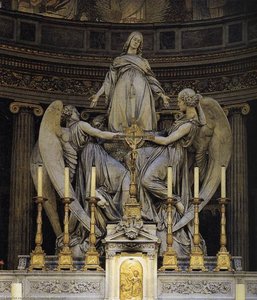
The true significance of Monnot’s career lies in his ability to secure commissions that placed him at the very center of Catholic iconography. His talent for translating spiritual fervor into tangible form made him a preferred choice for the most prestigious religious institutions in Europe. One of his most profound achievements was his contribution to the Saint Ignatius altar in the Church of the Gesù, where he sculpted a pair of angels holding the IHS monogram. This work placed him alongside other titans of the era, such as Pierre Le Gros the Younger, cementing his status within the elite circle of sculptors shaping the visual identity of the Counter-Reformation.
Beyond the altars of Rome, Monnot’s reach extended to the highest echelons of the papacy and international nobility. His work on the tomb of Pope Innocent XI in St. Peter's Basilica, executed under the design of the legendary Carlo Maratta, stands as a pinnacle of his technical prowess. In this monumental undertaking, Monnot demonstrated an unparalleled ability to handle the weight of history and the solemnity of death, using marble to evoke both the permanence of the Church and the fleeting nature of mortal life. His skill was not limited to the sacred; he was equally adept at capturing the human spirit in portrait busts and mythological scenes, catering to a sophisticated clientele that sought to immortalize their own legacies through his chisel.
A Lasting Impression on Baroque Art
The historical significance of Pierre-Étienne Monnot transcends the mere execution of beautiful objects. He served as a cultural bridge, bringing the meticulousness of French training to the emotive power of Italian sculpture. His career represents the zenith of an international artistic movement where borders were fluid and talent was the primary currency. Through his works, we see the late Baroque period not just as a style of excess, but as a sophisticated language of devotion, power, and human emotion.
To reflect on Monnot's enduring impact, one might consider these defining elements of his career:
- Technical Versatility: His ability to transition seamlessly from the intimate detail of relief carvings to the monumental scale of papal tombs.
- Cultural Synthesis: The unique fusion of French structural clarity with the dramatic, swirling energy characteristic of Roman Baroque sculpture.
- Ecclesiastical Influence: A profound role in decorating the most sacred spaces of Rome, contributing to the visual splendor of the Jesuit order and the Papacy.
- International Reach: His success in establishing a lasting reputation that resonated far beyond his native Franche-Comté, reaching the courts and cathedrals of Europe.
pierre etienne monnot
1657 - 1733 , France
Quick Facts
- Artistic Movement Or Style: Late Baroque
- Artists Who Influenced This Artist:
- Domenico Guidi
- Alessandro Algardi
- Carlo Maratta
- Date Of Birth: 1657
- Date Of Death: 1733
- Full Name: Pierre-Étienne Monnot
- Nationality: French
- Notable Artworks:
- Nativity relief
- Flight into Egypt relief
- Tomb of Pope Innocent XI
- Angels with IHS monogram
- Place Of Birth: Doubs, France
Related Articles

Bronze Sculptures That Defined Art History | ArtsDot
Journey through art history with our Top 10 bronze sculptures! Explore masterpieces by Rodin, Michelangelo & more. Discover stories behind iconic statues and find museum-quality reproductions for your home decor at ArtsDot.com.

The Enduring Allure of Marble in Art History: From Classical Sculpture to Modern Abstraction
Explore the captivating history of marble sculpture from ancient Greece to modern art. Discover renowned artists like Canova & Michelangelo, carving techniques, and investment insights at ArtsDot.

The Enduring Form: Exploring Themes & Techniques in Sculpture Across Historical Periods
Explore the rich history of sculpture from ancient masterpieces to contemporary innovations. Discover key techniques, influential artists & investment potential for discerning art collectors.
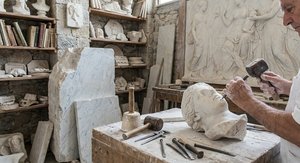
The Enduring Legacy of Marble: A Comprehensive Exploration of Technique, Symbolism & Artistic Expression
Explore the rich history of marble sculpture from antiquity to the Renaissance! Discover key techniques, influential artists & enduring themes in classical art. Expert insights for collectors and enthusiasts at ArtsDot.

The Enduring Form: Sculpture Across History, Technique & Emotional Resonance
Explore the rich history of sculpture with ArtsDot. Discover key techniques, influential artists & investment potential for discerning collectors. Expert insights into valuing and collecting timeless masterpieces.