 Preview
 Send
Send Share
Share
 Details

 Download
 Similars
 X-Ray
X-Ray Diaporama
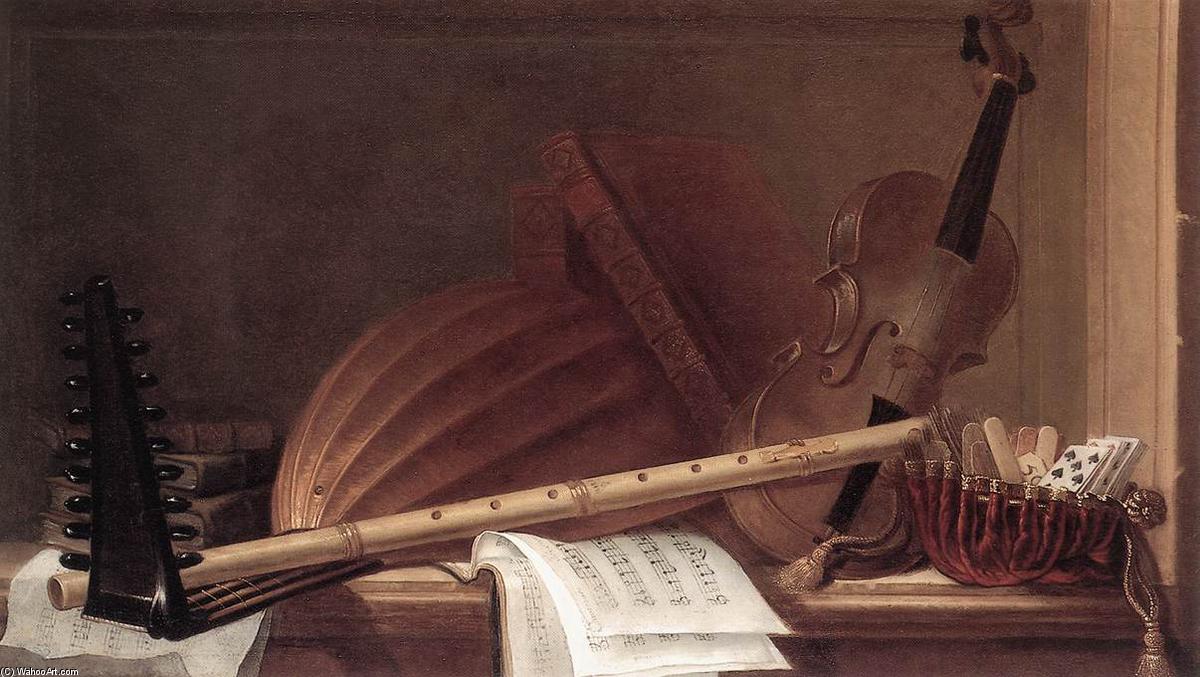
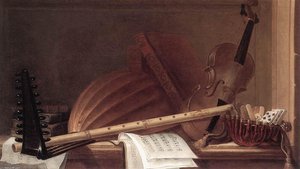
Still-Life of Musical Instruments
 52.0 x 88.0 cm
 Residenzgalerie
 Read More
Hand Made Oil Reproduction
Hand-painted oil on canvas in your size and frame, made to order by our artists. ( Buy Print Buy Image)




































Pick from our preset sizes that match the artwork's original proportions.

You may enter your own dimensions to fit a specific frame or space. If your selected size does not match the original image's proportions, we will either crop the artwork or extend the painting with additional hand-painted elements. A digital mockup will be sent for your approval before production begins.
Please note that the on-screen preview does not reflect the actual cropping or extension. Only the mockup will accurately show the final composition.
While custom sizes are available, we recommend selecting a dimension from the predefined list to preserve the original proportions.
After order, ArtsDot.com team will email client for instructions and provide a mockup preview
Worldwide Delivery () in 3/4 weeks instead of standard 5 weeks. (23 August). No compromise on quality.

Free Worldwide Express Shipping

High-Quality Linen Canvas

Full Shipping Insurance

Customs Tax Refund Guarantee

True Color Matching Guarantee

60-Day Return Policy (Defects Only)

100% Money-Back Guarantee

Bulk Discount Offer
 Glass option is only available in size under 110 CM

Still-Life of Musical Instruments
Reproduction Medium
Reproduction Size
-


Total Price
$ 263
Related Artworks








Artist Biography
A Legacy of Light: The Life and Art of Pierre Nicolas Huilliot
In the golden age of French Baroque painting, few artists possessed the ability to breathe life into the inanimate as profoundly as Pierre Nicolas Huilliot. Born in Paris in 1674, Huilliot was not merely a painter but a custodian of a rich artistic lineage. He emerged from a family of renowned Parisian painters, most notably as the son of the celebrated still-life master Claude Huilliot. This heritage provided him with more than just technical instruction; it offered an immersion into a world where the subtle interplay of light upon a petal or the reflective sheen on a silver vase was treated with religious devotion. Growing up in the shadow of his father’s success, Pierre Nicolas inherited a profound commitment to capturing the tactile reality of the physical world, a trait that would eventually lead him to the prestigious Académie Royale de peinture et de sculpture.
The foundations of Huilliot's mastery were laid within the intimate confines of his father’s studio and further refined through an apprenticeship under Robert Levrac-Tournieres. His early training was steeped in the traditions of the French Baroque, a period defined by drama, movement, and an almost theatrical use of chiaroscuro. This era demanded an artist who could manipulate shadow to create depth and light to evoke emotion. By the time he entered the Academy in 1721, Huilliot had already begun to distinguish himself through his ability to present complex compositions, such as his notable early work featuring a buffet adorned with flowers and fruits. His formal reception into the Academy as a specialist in still lifes in 1722 marked the beginning of a career defined by precision and royal recognition.
The Mastery of Stillness and Symbolism
Huilliot’s oeuvre is a testament to the beauty found in the quiet moments of existence. While many of his contemporaries sought glory in grand historical or mythological narratives, Huilliot found transcendence in the meticulous rendering of objects. He specialized in flower still lifes and interior paintings, works that required an extraordinary level of patience and an eye for the infinitesimal. His technique allowed him to capture the velvety texture of a rose petal, the translucent quality of dew, and the cold, hard brilliance of metallic vessels with equal virtuosity. This mastery of texture served a higher purpose than mere imitation; it invited the viewer into a sensory experience where the boundaries between the canvas and reality seemed to dissolve.
Beyond the technical brilliance, his work often carried a layer of symbolic resonance common to the Baroque period. His depictions of musical instruments, such as his celebrated Still-Life of Musical Instruments, were not merely studies in form but evocations of harmony and the ephemeral nature of sound. Through his brush, a lute or a flute became symbols of the fleeting beauty of life, much like the blooming flowers that often accompanied them in his compositions. This ability to weave meaning into the very fabric of his subjects elevated his work from decorative ornament to profound meditation.
Royal Patronage and Historical Significance
The true measure of Huilliot’s success can be seen in the illustrious circles in which he moved. His talent earned him the patronage of the French Royal family, a distinction that placed him at the very heart of European cultural life. One of his most significant achievements was his commission in 1739 to decorate the petit appartement de la reine at the magnificent Palace of Versailles. To contribute to the visual splendor of such a legendary site is a testament to his standing among the elite painters of his age. His works were not confined to the halls of royalty alone; they found homes in the great châteaux of France, including Trianon and Fontainebleau, ensuring that his aesthetic vision became part of the architectural soul of the nation.
As the decades progressed, Huilliot continued to exhibit at the Academy’s Salon, maintaining his relevance and influence until the twilight of his life in 1751. His historical significance lies in his role as a bridge between the heavy, dramatic Baroque style of the late 17th century and the more refined, delicate sensibilities that would emerge in the following era. He left behind a legacy of excellence that continues to inspire appreciation for the quiet majesty of the still life. Today, his paintings remain vital windows into a lost world of elegance, reminding us that there is an infinite universe of beauty to be discovered in the smallest, most overlooked corners of our existence.
pierre nicolas huilliot
1674 - 1751 , France
Quick Facts
- Artistic Movement Or Style: Baroque
- Artists Or Movements Influenced By This Artist: ['Classical French Art']
- Artists Who Influenced This Artist: ['Claude Huilliot']
- Date Of Birth: Paris, France (1674)
- Date Of Death: 1751
- Full Name: Pierre Nicolas Huilliot
- Nationality: French
- Notable Artworks: ['Still Life with Musical Instruments']
- Place Of Birth: Paris