 Preview
 Send
Send Share
Share
 Details

 Download
 Similars
 X-Ray
X-Ray Diaporama
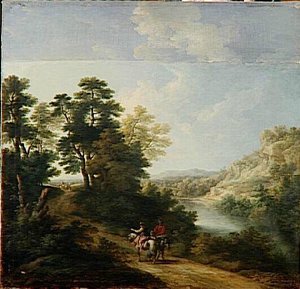
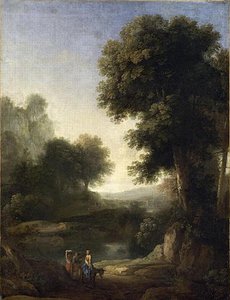
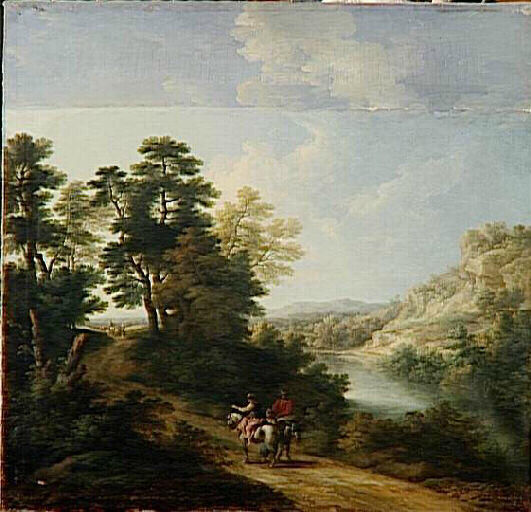
Paysage (avec deux cavaliers)
 Read More
Hand Made Oil Reproduction
Hand-painted oil on canvas in your size and frame, made to order by our artists. ( Buy Print Buy Image)




































Pick from our preset sizes that match the artwork's original proportions.

You may enter your own dimensions to fit a specific frame or space. If your selected size does not match the original image's proportions, we will either crop the artwork or extend the painting with additional hand-painted elements. A digital mockup will be sent for your approval before production begins.
Please note that the on-screen preview does not reflect the actual cropping or extension. Only the mockup will accurately show the final composition.
While custom sizes are available, we recommend selecting a dimension from the predefined list to preserve the original proportions.
After order, ArtsDot.com team will email client for instructions and provide a mockup preview
Worldwide Delivery () in 3/4 weeks instead of standard 5 weeks. (27 August). No compromise on quality.

Free Worldwide Express Shipping

High-Quality Linen Canvas

Full Shipping Insurance

Customs Tax Refund Guarantee

True Color Matching Guarantee

60-Day Return Policy (Defects Only)

100% Money-Back Guarantee

Bulk Discount Offer
 Glass option is only available in size under 110 CM

Paysage (avec deux cavaliers)
Reproduction Medium
Reproduction Size
-


Total Price
$ 288
Related Artworks








Artist Biography
The Serene Vision of Pierre Salomon Domenchin de Chavanne
In the golden twilight of the Baroque era, a period often defined by its dramatic tension and theatrical movement, there emerged a voice of profound stillness. Pierre Salomon Domenchin de Chavanne, born in Paris around 1673, carved out a unique niche within the French landscape tradition. While his contemporaries often sought to overwhelm the viewer with grandiosity, Chavanne turned his gaze toward the quietude of the pastoral world. His canvases serve as windows into an idealized realm where time seems to suspend itself, inviting the observer into a state of contemplative grace. Through his mastery of light and atmosphere, he captured not just the physical reality of the countryside, but the very essence of tranquility.
The foundations of Chavanne’s artistry were laid under the tutelage of the esteemed Jean-Baptiste Oudry. This apprenticeship was pivotal, as Oudry, a master of Flemish-influenced landscape and animal painting, provided Chavanne with the technical vocabulary necessary to render the natural world with precision. From Oudry, Chavanne inherited a sophisticated understanding of tonal painting and an acute sensitivity to atmospheric effects. He learned how to manipulate the subtle gradations of light to breathe life into foliage and skin, a skill that would later become the hallmark of his mature style. This training allowed him to move beyond mere topographical representation, enabling him to infuse his landscapes with a poetic, almost dreamlike quality.
A Symphony of Light and Classical Echoes
Chavanne’s technique is a testament to the power of restraint. He was a master of chiaroscuro, yet he eschewed the harsh, jarring contrasts found in much of the Baroque movement. Instead, his work relies on soft, rhythmic transitions between light and shadow, creating a sense of depth that feels organic rather than forced. His brushwork, though deliberate and controlled, possesses a certain grace that mirrors the gentle undulations of the hills he so frequently depicted. This careful application of paint allowed him to achieve a remarkable tonal harmony, where every element—from the distant mountains to the foregrounded livestock—exists in a state of balanced equilibrium.
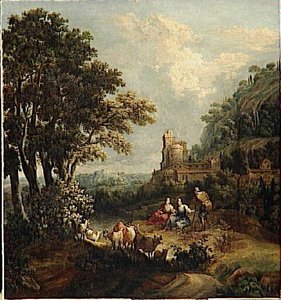
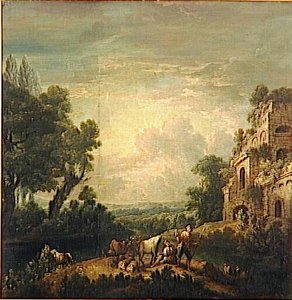
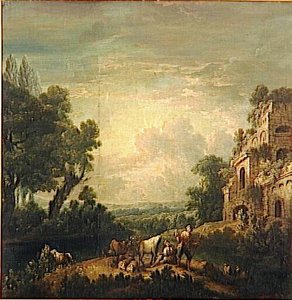
A recurring motif in his oeuvre is the presence of classical antiquity, specifically the evocative imagery of Roman ruins. By integrating crumbling temples and weathered monuments into his pastoral scenes, Chavanne tapped into the profound intellectual currents of his time. These architectural remnants served as more than mere decorative elements; they were symbols of the passage of time and the enduring legacy of human civilization amidst the eternal cycle of nature. In works such as “Paysage (avec bergers et ruines antiques),” the juxtaposition of the ephemeral life of shepherds with the decaying grandeur of stone creates a poignant dialogue between the mortal and the monumental.
Legacy of the Pastoral Ideal
The historical significance of Pierre Salomon Domenchin de Chavanne lies in his ability to bridge the gap between the decorative landscape traditions of the late 17th century and the more emotive, atmospheric sensibilities that would emerge in the following decades. His paintings do not merely document a scene; they evoke a mood. Whether depicting a sun-drenched hillside populated by livestock or a quiet evening vista, his work remains anchored in a sense of peace that is rare in the often turbulent history of European art.
Though biographical records regarding his later years are sparse, ending with his death in Paris in 1744, his artistic footprint remains indelible. He contributed to a lineage of French landscape painters who sought beauty in the quiet corners of the world, influencing the way subsequent generations would perceive the relationship between humanity and the natural environment. Today, his works stand as enduring monuments to the beauty of the pastoral ideal, reminding us that there is profound depth to be found in the simplest of landscapes.
pierre salomon domenchin de chavanne
1673 - 1744
Quick Facts
- Artistic Movement Or Style: Rococo
- Date Of Birth: 1673
- Date Of Death: 1744
- Full Name: Pierre Salomon Domenchin de Chavanne
- Nationality: French
- Notable Artworks:
- Pastorale
- Paysage (avec bergers et ruines antiques)
- Place Of Birth: Paris, France