Preview
 Send
Send Share
Share
 Details

 Download
 Similars
 X-Ray
X-Ray Diaporama
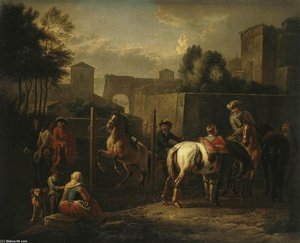
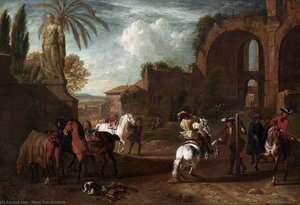
Open-Air Manege
 Oil On Canvas
- WallArt
- Baroque Landscape
 1712
1712 53.0 x 65.0 cm
 Hermitage Museum
 Read More
Hand Made Oil Reproduction
Hand-painted oil on canvas in your size and frame, made to order by our artists. ( Buy Print Buy Image)




P118B $10

P118H $10

P118W $10

P438Z $10

P508JH $12

P508YH $12

P805H $10

P805Z $10

P919BZ $10

P919G $10

P919XJ $10

P959ZH $10

P968JZ $12

W106C $8

W218G $10

W218JH $8

W218Y $10

W307PJ $10

W316G $10

W316PJ $8

W316Y $10

W398PJ $8

W4111J $10

W500HY $15

W500JH $15

W692G $12

W849H $8

W940BG $15

W953PJ $8




Pick from our preset sizes that match the artwork's original proportions.

You may enter your own dimensions to fit a specific frame or space. If your selected size does not match the original image's proportions, we will either crop the artwork or extend the painting with additional hand-painted elements. A digital mockup will be sent for your approval before production begins.
Please note that the on-screen preview does not reflect the actual cropping or extension. Only the mockup will accurately show the final composition.
While custom sizes are available, we recommend selecting a dimension from the predefined list to preserve the original proportions.
After order, ArtsDot.com team will email client for instructions and provide a mockup preview
Worldwide Delivery () in 3/4 weeks instead of standard 5 weeks. (16 August). No compromise on quality.

Free Worldwide Express Shipping

High-Quality Linen Canvas

Full Shipping Insurance

Customs Tax Refund Guarantee

True Color Matching Guarantee

60-Day Return Policy (Defects Only)

100% Money-Back Guarantee

Bulk Discount Offer
 Glass option is only available in size under 110 CM

Open-Air Manege
Reproduction Medium
Reproduction Size
-


Total Price
$ 263
Artwork Description
A Glimpse into 18th-Century Leisure
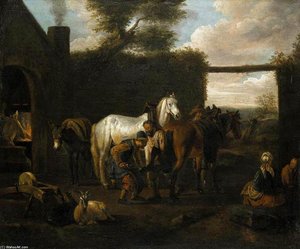
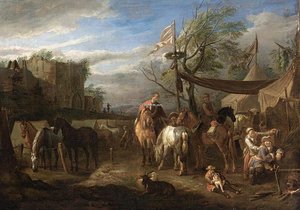
Pieter van Bloemen’s “Open-Air Manege,” painted in 1712, isn't merely a depiction of a scene; it’s a vibrant snapshot of social life during the Baroque era. Housed within the walls of The Hermitage Museum in St. Petersburg, this oil on canvas transports us to an open courtyard bustling with activity – a rare and precious glimpse into the leisure pursuits of the wealthy elite. The painting captures a moment of orchestrated chaos: horses rearing playfully, riders preparing for a spirited gallop, and individuals engaged in various interactions within the lively setting. It’s a scene brimming with energy, suggesting a celebration, a tournament, or perhaps simply an afternoon of refined entertainment.

(Image source: Web Gallery of Art)
The Painter’s Masterstroke: Technique and Composition
Van Bloemen's skill lies not just in capturing a scene, but in rendering it with remarkable dynamism. He employs a technique known as “pittura di tocco,” characterized by small, precise brushstrokes that create an illusion of texture and movement – particularly evident in the horses’ manes and coats. The artist masterfully uses light and shadow to sculpt forms, emphasizing the three-dimensionality of the figures and animals. Notice how the warm glow illuminates the foreground, drawing our eye into the heart of the action, while cooler tones recede into the background, establishing a sense of depth. The composition itself is carefully balanced; the energetic movement of the horses is counterpointed by the more static postures of the onlookers, creating a harmonious visual flow.
A Window to the 18th Century: Pieter van Bloemen and His Context
Pieter van Bloemen (1657-1720) was a prominent Flemish painter who thrived in the cosmopolitan environment of Rome. Born in Antwerp, he honed his skills under Simon Johannes van Douw and later benefited from collaborations with artists like Adriaen van der Cabel and Gillis Weenix in Lyon. His travels exposed him to diverse artistic influences, particularly Italian landscape painting, which profoundly shaped his style. Van Bloemen’s work reflects the prevailing trends of the time – a fascination with classical themes, an appreciation for natural beauty, and a desire to capture fleeting moments of everyday life. He was part of the Bentvueghels, a society of artists who exchanged drawings and prints, further expanding his artistic horizons.
Symbolism and Emotional Resonance
Beyond its technical brilliance, “Open-Air Manege” resonates with deeper symbolic meaning. The scene embodies the pursuit of pleasure and social interaction – values highly prized in 18th-century aristocratic society. The horses represent power, grace, and status, while the riders symbolize control and mastery. The gathering itself speaks to a desire for community and shared experience. Looking at this painting, one can almost feel the excitement of the moment, the anticipation of the race, and the camaraderie among those present. It’s a reminder that even amidst the grandeur of courtly life, there was always room for simple joys and spirited entertainment.
Related Artworks
Artist Biography
Pieter van Bloemen (1657-1720): A Flemish Painter of Animals, Landscapes, and Roman Scenes
Early Life and Training
- Born: Antwerp, Belgium, January 17, 1657
- Died: Antwerp, Belgium, March 6, 1720
- Apprenticed to Simon Johannes van Douw from a young age (possibly as early as age 10), receiving foundational training in artistic techniques.
- Became a master of the Guild of Saint Luke in Antwerp in 1674, demonstrating his proficiency and acceptance within the established art community.
- Family Background: Pieter came from an artistic family; both his younger brothers, Jan Frans and Norbert, were also painters.
Travels and Artistic Development
- Early Travels (1674 & 1689): Initial journeys to Rome likely influenced his later style, exposing him to Italian landscapes and artistic trends.
- Lyon Period (1684): Collaboration with Dutch painters Adriaen van der Cabel and Gillis Weenix in Lyon broadened his exposure to different painting styles and techniques. His brother Jan Frans joined him during this time.
- Rome & the Bentvueghels (1688-1694): A significant period spent in Rome, registered with the parish of Sant’Andrea delle Fratte alongside his brothers. Became a member of the *Bentvueghels*, an association of foreign artists in Rome, earning the nickname "Standaart" likely referencing banners depicted in his military scenes.
- Travels within Italy: Explored Naples, Sicily, and Malta, further enriching his understanding of Italian landscapes and culture.
- Collaboration with Jan Frans: A fruitful partnership where Pieter focused on figures while Jan Frans specialized in landscape (vedute) painting.
Artistic Style and Major Works
- Subject Matter: Known for dynamic depictions of animals, equestrian scenes, market life, military encampments, and genre paintings set within Italianate landscapes.
- Italianizing Landscapes: Adopted the tradition of representing the Roman Campagna with inns, ruins, and animals, creating a distinctive "Roman" atmosphere.
- Bamboccianti Influence: Incorporated elements of the *bamboccianti* style, depicting everyday scenes and trivial subjects, often with meticulous detail.
- Distinctive Features: Characterized by lively coloring in figures' costumes contrasting with the more subdued tones of animals and ruins; a focus on groups of animals presented as "still-lifes" within landscapes.
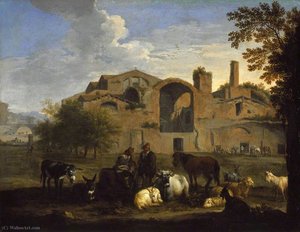
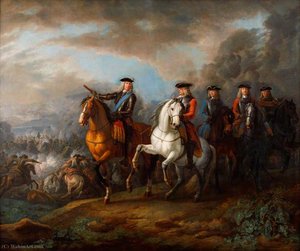
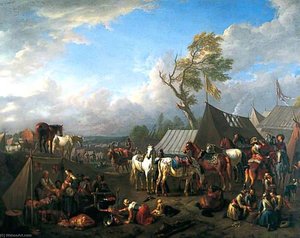
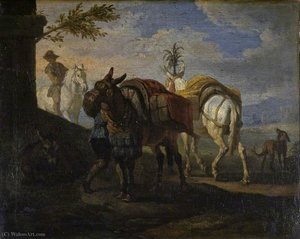
- Notable Works: The Duke of Marlborough and the Earl of Cadogan at Blenheim (Hochstadt) (where he painted the horses), *Military Encampment*, *At the Forge*, *Mules Halting by the Wayside*, and *Landscape with Herdsmen and Animals in front of the Baths of Diocletian, Rome*.
- Drawing Practice: Produced numerous drawings depicting landscapes, figure studies, and animal observations from life.
Legacy and Historical Significance
- Prolific Output: A highly productive artist with a diverse body of work spanning various genres.
- Dean of the Guild of Saint Luke (1699): Held a prestigious position within the Antwerp art community, demonstrating his respect and influence.
- Teacher: Mentored his younger brothers Jan Frans and Norbert, as well as other artists like Peeter van Aken and Frans van Alter.
- Collaboration & Recognition: Frequently sought after for his skill in painting horses, collaborating with prominent artists like Balthasar van den Bossche.
- Contribution to Baroque Art: Van Bloemen’s work exemplifies the dynamism and detail characteristic of Baroque art, particularly within the Flemish tradition. His Italian experiences infused his paintings with a unique blend of Northern European realism and Southern European landscape aesthetics.
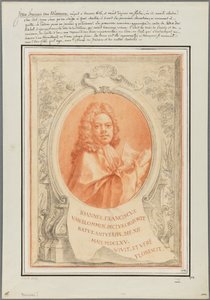
Pieter van Bloemen
1657 - 1720 , Belgium
Quick Facts
- Artistic Movement Or Style: Baroque
- Artists Who Influenced This Artist: ['Simon Johannes van Douw']
- Date Of Birth: January 17, 1657
- Date Of Death: March 6, 1720
- Full Name: Pieter van Bloemen
- Nationality: Flemish
- Notable Artworks:
- Military Encampment
- At the Forge
- Mules Halting by the Wayside
- Landscape with Herdsmen and Animals
- Place Of Birth: Antwerp, Belgium
Related Articles
Van Gogh's Masterpieces: Explore 25 Iconic Paintings & Art for Your Home
Journey through Vincent van Gogh's 25 most iconic paintings! Explore 'Starry Night', 'Sunflowers,' and more—discover the stories, techniques & emotions behind these Post-Impressionist masterpieces. Find museum-quality art reproductions for your home at ArtsDot.com.

Rembrandt's Masterpieces: Explore 25 Iconic Paintings & Prints | ArtsDot
Journey through Rembrandt van Rijn's 25 most iconic paintings & etchings. Explore Dutch Golden Age masterpieces, dramatic chiaroscuro, and timeless portraits. Find museum-quality art reproductions to elevate your home decor on ArtsDot.com.
Early Netherlandish Masters: 10 Paintings That Revolutionized Art & Decor
Journey into the world of Early Netherlandish painting! Explore 10 masterpieces by Jan van Eyck, Rogier van der Weyden & more. Discover stunning detail, symbolism & Renaissance art for your home decor. Find museum-quality reproductions on ArtsDot.com
Sir Anthony van Dyck: Courtly Portraiture & the Shaping of Baroque Identity
Explore the life & legacy of Sir Anthony van Dyck, the leading court painter of his era. Discover his innovative portraiture, Baroque masterpieces, and investment potential for discerning collectors. Learn more at ArtsDot.
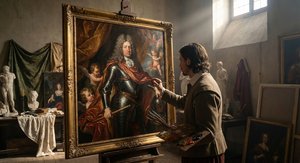
The Grandeur of Baroque Portraiture: Power, Emotion & Artistic Innovation
Explore the grandeur of Baroque portraiture! Discover Rubens, Van Dyck & the masters of 17th-century art. Uncover symbolism, techniques & lasting influence. Expert insights for collectors and enthusiasts.