 Preview
 Send
Send Share
Share
 Details

 Download
 Similars
 X-Ray
X-Ray Diaporama
Village Life
 Pigment
- Contemporary Folk Art
 2015
2015- Contemporary
 112.0 x 255.0 cm
 Queensland Art Gallery | Gallery of Modern Art
 Read More
Hand Made Oil Reproduction
Hand-painted oil on canvas in your size and frame, made to order by our artists. ( Buy Print Buy Image)




P118B $10

P118H $10

P118W $10

P438Z $10

P508JH $12

P508YH $12

P805H $10

P805Z $10

P919BZ $10

P919G $10

P919XJ $10

P959ZH $10

P968JZ $12

W106C $8

W218G $10

W218JH $8

W218Y $10

W307PJ $10

W316G $10

W316PJ $8

W316Y $10

W398PJ $8

W4111J $10

W500HY $15

W500JH $15

W692G $12

W849H $8

W940BG $15

W953PJ $8




Pick from our preset sizes that match the artwork's original proportions.

You may enter your own dimensions to fit a specific frame or space. If your selected size does not match the original image's proportions, we will either crop the artwork or extend the painting with additional hand-painted elements. A digital mockup will be sent for your approval before production begins.
Please note that the on-screen preview does not reflect the actual cropping or extension. Only the mockup will accurately show the final composition.
While custom sizes are available, we recommend selecting a dimension from the predefined list to preserve the original proportions.
After order, ArtsDot.com team will email client for instructions and provide a mockup preview
Worldwide Delivery () in 3/4 weeks instead of standard 5 weeks. (22 August). No compromise on quality.

Free Worldwide Express Shipping

High-Quality Linen Canvas

Full Shipping Insurance

Customs Tax Refund Guarantee

True Color Matching Guarantee

60-Day Return Policy (Defects Only)

100% Money-Back Guarantee

Bulk Discount Offer
 Glass option is only available in size under 110 CM

Village Life
Reproduction Medium
Reproduction Size
-


Total Price
$ 413
Artwork Description
A Tapestry of Tradition: The Vibrant World of Village Life
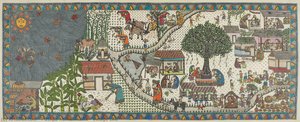
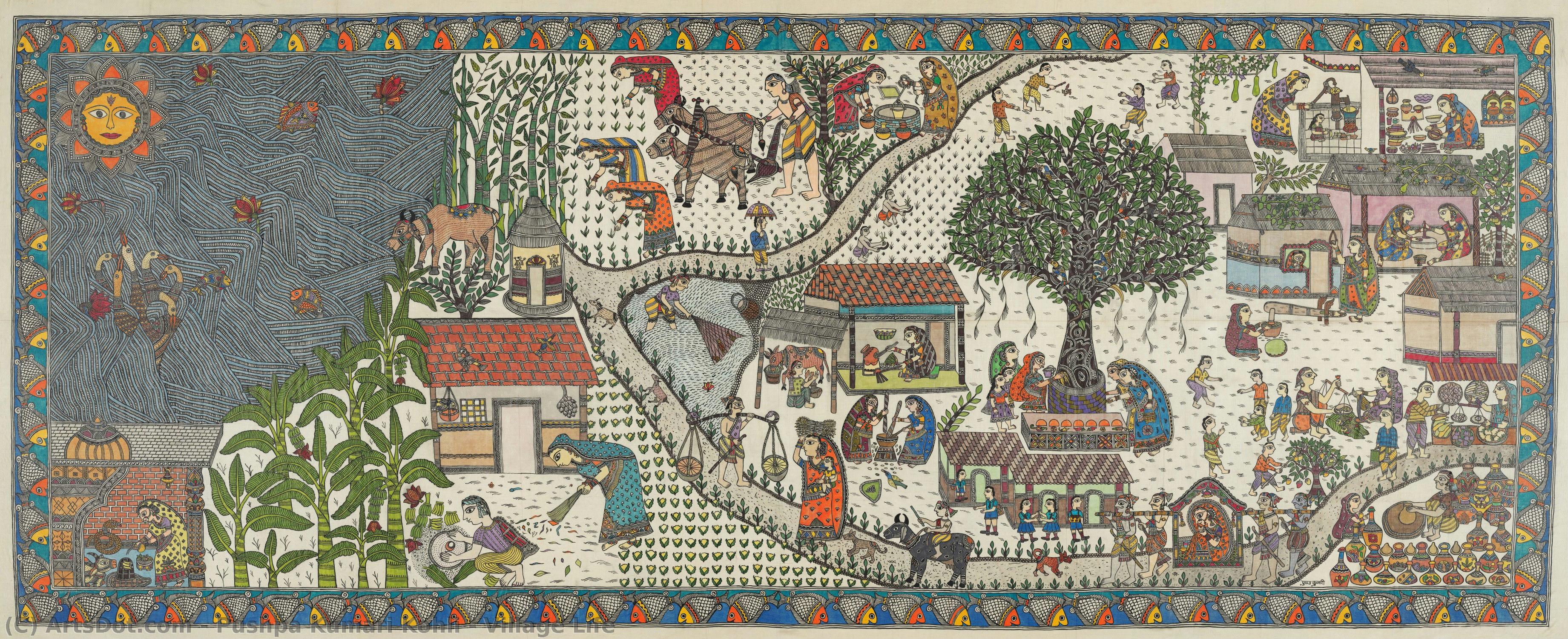
In the sweeping expanse of Pushpa Kumari Kohli’s masterpiece, Village Life, the viewer is not merely observing a painting but is instead invited to step into a living, breathing ecosystem of communal harmony. This large-scale work, measuring an impressive 112 x 255 cm, serves as a breathtaking window into the heart of the Mithila region of Bihar, India. As a premier example of Madhubani art, the composition functions as a dense, rhythmic tapestry where every inch of the surface is alive with movement. The painting captures the essence of rural existence through a layered narrative, depicting a bustling landscape where farming, religious devotion, and social rituals intertwine seamlessly. It is a work that demands attention, pulling the observer into a kaleidoscopic dance of figures engaged in the timeless rhythms of daily life.
The artistry of Kohli and her collaborator Pradyumna Kumar is rooted in an ancient lineage, a tradition passed down through generations of women in the Mithila region. This piece exemplifies the characteristic Madhubani style, where the concept of "horror vacui"—the fear of empty space—is embraced to create a sense of infinite abundance. The composition is masterfully organized into horizontal bands that guide the eye across different vignettes of village activity. A central, majestic tree stands as a focal point, anchoring the swirling energy around it, while a stylized sun with a radiant, watchful face illuminates the scene from the left. To the right, the presence of a waterway introduces a sense of fluidity, balancing the structured geometric patterns with organic grace. The flattened perspective, typical of this folk tradition, prioritizes the emotional and symbolic weight of the story over realistic spatial depth, creating a dreamlike, iconic atmosphere.
Symbolism and the Language of Color
Beyond its visual splendor, Village Life is a profound lexicon of cultural symbols. In the world of Mithila painting, nothing is purely decorative; every motif carries a spiritual or social weight. The artists utilize a highly developed symbolic language where animals and natural elements act as messengers of meaning. Within this intricate web, one might find fish representing fertility, peacocks embodying love, and serpents signifying divinity. Even the sun, depicted with bold, radiating lines, serves as a potent emblem of prosperity and life-giving energy. For collectors and enthusiasts, understanding these layers adds a spiritual dimension to the viewing experience, transforming the artwork from a beautiful object into a sacred text of communal values.
The palette used in this work is nothing short of celebratory. The artists employ a rich variety of hues that create a visually stimulating effect, ranging from deep, earthy tones in the foreground to lighter, ethereal shades in the background. This strategic use of color creates a sense of atmospheric depth despite the flattened style. The application of pigments—traditionally derived from natural sources like turmeric yellow, indigo blue, and red ochre—lends the piece an organic warmth that feels deeply connected to the earth itself. The interplay between bold, expressive lines and intricate geometric patterns creates a texture that feels both ancient and remarkably modern.
An Essential Addition for Discerning Interiors
For interior designers and art collectors, Village Life offers a rare opportunity to introduce a piece of profound cultural heritage into a contemporary space. Its grand scale and horizontal orientation make it an ideal centerpiece for a focal wall in a sophisticated living room, a serene study, or a curated gallery setting. The artwork’s ability to command a room through its vibrant energy and intricate detail ensures that it remains a conversation starter for years to come.
Whether you are drawn to the piece for its historical significance as a continuation of the Madhubani legacy or for its ability to inject warmth and narrative depth into a modern interior, this reproduction stands as a testament to the enduring power of folk art. It is more than a decoration; it is an invitation to celebrate the interconnectedness of community, nature, and tradition. Owning a piece of this caliber allows one to preserve the echoes of a centuries-old tradition while adding a layer of soulful, rhythmic beauty to the modern home.
Related Artworks
![Indian Tobacco Shop Sign [reverse, Indian Facing Right] — Winslow Homer, Contemporary Realism](/media/artworks/images-thumb/74/22/7422432cafc295265ef3b7f7fa62d35d.jpg)
Artist Biography
The Ancestral Echoes of Mithila
Pushpa Kumari Kohli’s artistic journey began amidst the fertile landscapes of Bihar, India, rooted deeply in the ancestral traditions of her village and profoundly shaped by the legacy of her maternal grandmother—a master practitioner of Madhubani art. Born in 1969, Kohli's upbringing witnessed firsthand the captivating beauty and spiritual significance of Mithila paintings, an art form passed down through generations within her family. This formative experience ignited a lifelong passion for preserving and reimagining this ancient artistic heritage, transforming a domestic tradition into a profound medium of personal expression.
Her work serves as a vibrant bridge between the past and the present, carrying the weight of centuries-old customs into the contemporary art world. By drawing from the rhythms of rural life in Bihar, Kohli does more than merely paint; she archives a way of life that is as much about community and spirituality as it is about pigment and paper.
Technique and the Alchemy of Nature
Kohli’s distinctive style embodies the very essence of Madhubani painting, characterized by its meticulous execution and an organic connection to the earth. Her process is a deliberate act of honoring tradition, utilizing natural pigments derived from plant extracts that lend her work an incomparable warmth and depth. She primarily employs turmeric yellow, indigo blue, and red ochre, applying these hues with tamarind paste onto handmade coarse cotton paper. This method ensures that each piece possesses a tactile, historical quality.
Unlike Western techniques that prioritize linear perspective and anatomical realism, Kohli embraces the stylized representations inherent to Mithilaism. Her compositions are rich with:
- Intricate Geometric Patterns: These are not merely decorative but serve as auspicious symbols intended to ward off evil spirits.
- Symbolic Motifs: Every line and shape is woven into a larger narrative of cosmic balance.
- Bold Outlines: A signature element that defines the figures and separates them from the dense, patterned backgrounds.
Divine Narratives and Cosmic Symbolism
The heart of Kohli's oeuvre lies in its exploration of themes such as fertility, prosperity, and divine protection—elements central to Mithila cosmology. Her canvases frequently become stages for Hindu mythology and folklore, where the boundaries between the human and the divine blur. A profound example of her mastery can be found in works like “Surya and Sangya,” which showcases her ability to blend complex storytelling with sacred iconography.
Through the depiction of deities such as Surya, the Sun God, Kohli communicates a worldview rooted in the harmony of nature. The recurring presence of flora and fauna within her paintings reflects the interconnectedness of all living things, making her art a meditative experience for the viewer. Each stroke carries a palpable connection to the spiritual pulse of rural India, ensuring that the mythological narratives remain vibrant and relevant.
Legacy and International Recognition
Pushpa Kumari Kohli's dedication to Madhubani art has garnered international recognition, elevating a regional folk tradition to the global stage. Her ability to infuse traditional motifs with personal vision and social commentary has allowed her work to resonate far beyond the borders of Bihar. As she continues to evolve, her commitment remains steadfast: to preserve the sanctity of her heritage while ensuring that the voices of the Mithila masters continue to be heard in the modern era.

pushpa kumari kohli
1969 - , India
Quick Facts
- Artistic Movement Or Style: Madhubani Art
- Artists Or Movements Influenced By This Artist: ['Hubaneswar School']
- Artists Who Influenced This Artist: ['Traditional Madhubani Artists']
- Date Of Birth: 1969
- Full Name: Pushpa Kumari Kohli
- Nationality: Indian
- Notable Artworks:
- Surya and Sangya
- Village Life
- Place Of Birth: Rantambore, India
Related Articles
Raja Ravi Varma: Bridging Tradition & Modernity in 19th-Century Indian Art
Explore the life & art of Raja Ravi Varma, a pioneer who fused European techniques with Indian iconography. Discover his iconic paintings, lasting legacy, and influence on modern Indian art at ArtsDot.

Echoes of Tradition: Exploring the Enduring Legacy of Folk Art Movements
Explore the rich history of folk art movements worldwide! Discover definitions, notable artists, and the enduring legacy of this captivating tradition. Expert insights & high-quality reproductions at ArtsDot.
Maria Primachenko: A Legacy of Ukrainian Folk Art & Naive Expression
Discover the captivating world of Maria Primachenko, Ukraine's celebrated naive artist. Explore her vibrant paintings, unique style, and enduring legacy with ArtsDot – your source for authentic art insights & reproductions.
Edward Hicks’ ‘Peaceable Kingdom’: American Folk Art & the Shaping of a National Identity
Explore the profound symbolism & historical context of Edward Hicks’ ‘Peaceable Kingdom.’ Discover how this iconic American folk art masterpiece reflects Quaker values and shaped a nation's identity. Learn more at ArtsDot.

Echoes of Heritage: Continuity & Innovation in Traditional Art Forms
Explore the rich history of cultural heritage & folk art traditions worldwide! Discover inspiring artists, preservation efforts, and museum collections. Find handmade oil paintings & expert insights at ArtsDot.