Early Life & Artistic Foundations: A Royal Upbringing
When we think of iconic Indian art, certain images instantly come to mind: serene Saraswati with her veena, Lakshmi seated on a lotus, and soulful heroines from the epics. Behind many of these images stands Raja Ravi Varma (1848–1906), a visionary whose work continues to influence art, religion, and popular culture in India today. More than a painter, Varma was—uniquely—a bridge between eras, techniques, and sensibilities. His story begins not in an artist’s studio, but within the walls of Kilimanoor Palace in Travancore (present-day Kerala). Born on April 29th, 1848, into a family steeped in intellectual and cultural pursuits, young Ravi Varma's artistic talent was recognized early. Anecdotes speak of a childhood filled with sketching on palace walls using natural pigments and charcoals – an instinctive urge to create that foreshadowed his future mastery.
His upbringing was far from accidental; it was nurtured by a lineage deeply connected to the arts. His mother, Uma Ambabayi Thampuratty, belonged to a family of scholars, poets, and artists, instilling in him an appreciation for beauty and storytelling. His uncle, Raja Raja Varma, became his first formal teacher, guiding his hand through traditional techniques of drawing and mural painting. Later, the arrival of court artist Rama Swamy Naidu introduced him to watercolors—a relatively new medium in India at that time. However, it was a pivotal meeting with Theodor Jenson, a Dutch portraitist visiting the royal court, that truly altered the course of his artistic journey. Jenson exposed Varma to oil painting, imparting the technical foundations of European realism, perspective, and chiaroscuro—skills that would become integral to his monumental contribution to Indian art.
The Fusion of Styles: European Realism Meets Indian Sensibility
 Wikipedia: Raja Ravi Varma
Raja Ravi Varma (Malayalam: [rajaː ravi varma(ː)ɐ]) (29 April 1848 – 2 October 1906) was an Indian painter. His works are one of the best examples of the fusion of European academic art with a purely Indian sensibility and iconography. He greatly enh...
Before Raja Ravi Varma, much of Indian art, particularly in the South, adhered to the flat forms and bright lines of mural and miniature traditions. Varma, captivated by the realism of European academic painting, began experimenting with oils, anatomical studies, and three-dimensional modeling of the body. He absorbed techniques such as perspective, naturalistic light and shadow, and detailed portraiture from European masters. He devoured art books, studying Raphael and Rembrandt through prints, closely observing visiting colonial artists, declaring his ambition to emulate European realism but use it to serve Indian stories.
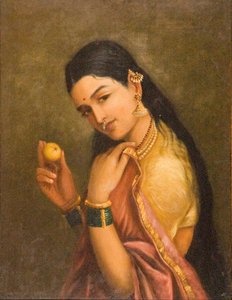
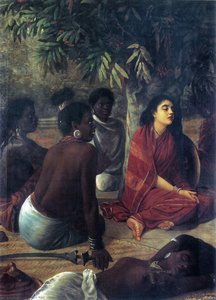
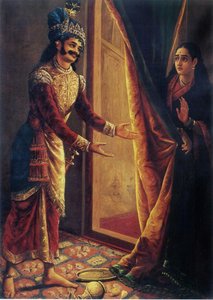
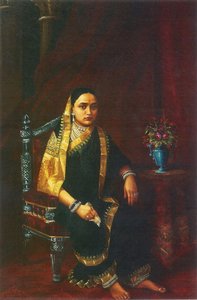
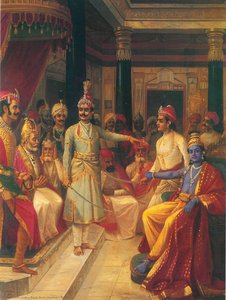
What sets Varma apart is that despite these Western influences, his subjects remained profoundly Indian—mythological figures, melodramatic heroines from the Mahabharata and Ramayana, and recognizable types from Kerala and Maharashtra. The fabrics, jewelry, settings, and gestures are all deeply rooted in Indian culture. He once famously stated: “My paintings may be in the European style, but they will tell Indian stories.” This wasn’t merely a technical exercise; it was a conscious effort to elevate Indian narratives through a universally understood language of realism. He pioneered what we now call indigenized realism—a style that resonated deeply with audiences accustomed to traditional forms while simultaneously introducing a new level of detail and emotional depth.
Iconic Works & The Birth of Indian Calendar Art
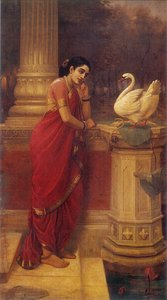 Damayanti And Hamsam
Discover Raja Ravi Varma’s ‘Damayanti And Hamsam,’ a stunning 1899 oil painting blending Romanticism & Orientalism. Explore Indian mythology, rich textures & serene beauty.
Varma’s artistic output was prolific, but certain works stand out as testaments to his unique vision. Shakuntala (1898) is perhaps one of his most celebrated paintings, depicting the poignant moment from the Mahabharata where Shakuntala feigns removing a thorn to steal a glance at her beloved Dushyanta. The painting masterfully conveys emotion—melancholy, love, yearning—through subtle body language and expressive facial features. Similarly, Damayanti Talking to the Swan (1899) captures the delicacy of hope and anxiety as Damayanti listens for news from her lover, Nala. Varma’s use of a luminous palette and intricate detailing further enhances the serene beauty of the scene.
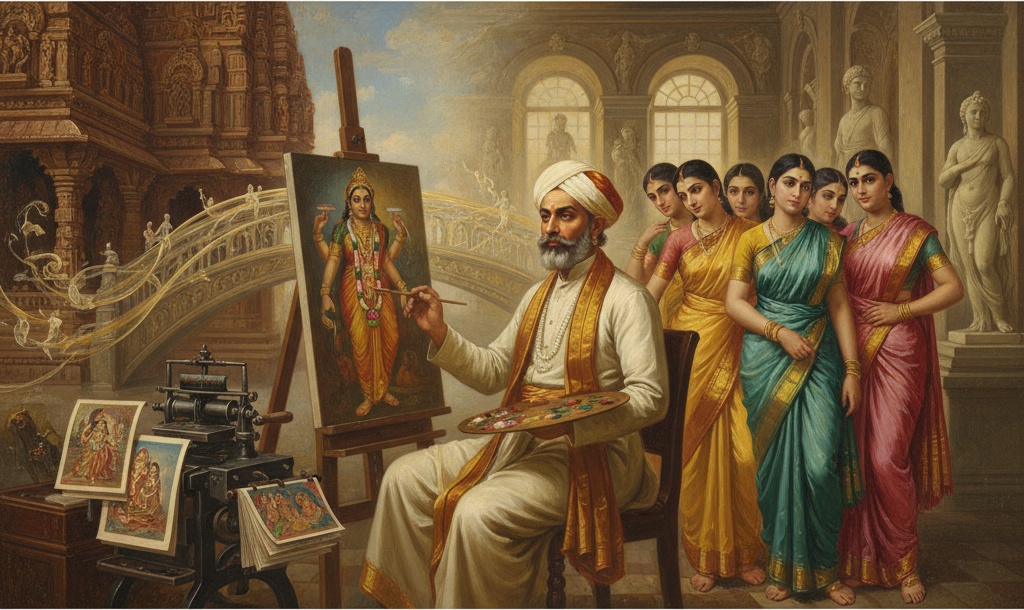
However, perhaps his most lasting contribution lies in his depictions of Hindu goddesses. His Saraswati—draped in a vibrant red sari, seated on a white lotus with her veena—became an instantly recognizable image across India. His Lakshmi, similarly, embodied prosperity and grace. But Varma didn’t stop at creating these masterpieces; he understood the power of accessibility. He commissioned lithographs of his paintings, making them affordable to a wider audience. This was revolutionary. Before this, fine art was largely confined to royal courts and wealthy patrons. Varma's lithographs democratized art, increasing its involvement in common people’s lives and profoundly shaping artistic tastes—effectively laying the foundation for the Indian calendar art industry.
Varma's Influence on Religious Depiction and Mythology
The impact of Raja Ravi Varma’s religious depictions cannot be overstated. Prior to his work, representations of Hindu deities were often stylized and symbolic, adhering to established iconographic conventions. Varma brought a new level of realism and human emotion to these figures. His goddesses weren't distant, ethereal beings; they were beautiful women with relatable expressions and tangible presence. This resonated deeply with the public, fostering a more personal connection to their faith.
His paintings weren’t simply artistic renderings; they became objects of worship in many households. The accessibility afforded by lithographs meant that even those who couldn't afford original paintings could have images of their favorite deities adorning their homes. This widespread dissemination of his work profoundly influenced the visual culture of India, shaping how people perceived and interacted with religious imagery. Furthermore, Varma’s depictions drew heavily from Indian epic poetry and Puranas, bringing these ancient stories to life in a way that was both visually stunning and emotionally engaging.
Controversies, Legacy & the Enduring Appeal of a Master Painter
Varma's work wasn’t without its critics. Some traditionalists questioned his use of Western techniques, arguing it diluted the purity of Indian art. Others raised concerns about the perceived sensuality in his depictions of goddesses. However, these criticisms were largely overshadowed by the overwhelming public appreciation for his paintings and their accessibility. He faced challenges navigating the complexities of colonial India, balancing artistic innovation with cultural expectations.
Despite these hurdles, Raja Ravi Varma’s legacy remains undeniable. He bridged tradition and modernity, East and West, creating a unique style that continues to inspire artists today. His paintings are not merely historical artifacts; they are windows into a bygone era, reflecting the social, religious, and artistic sensibilities of 19th-century India. His influence can be seen in countless reproductions, calendar art, and popular culture references. Museums like The Raja Ravi Varma Heritage Foundation in Bangalore and The Ganesh Shivaswamy Foundation continue to preserve his legacy through authentic paintings, sketches, and archival material. Raja Ravi Varma’s story is a testament to the power of art to transcend boundaries, connect cultures, and leave an enduring mark on the world.