

 Preview
 Send
Send Share
Share
 Details

 Download
 Similars
 X-Ray
X-Ray Diaporama
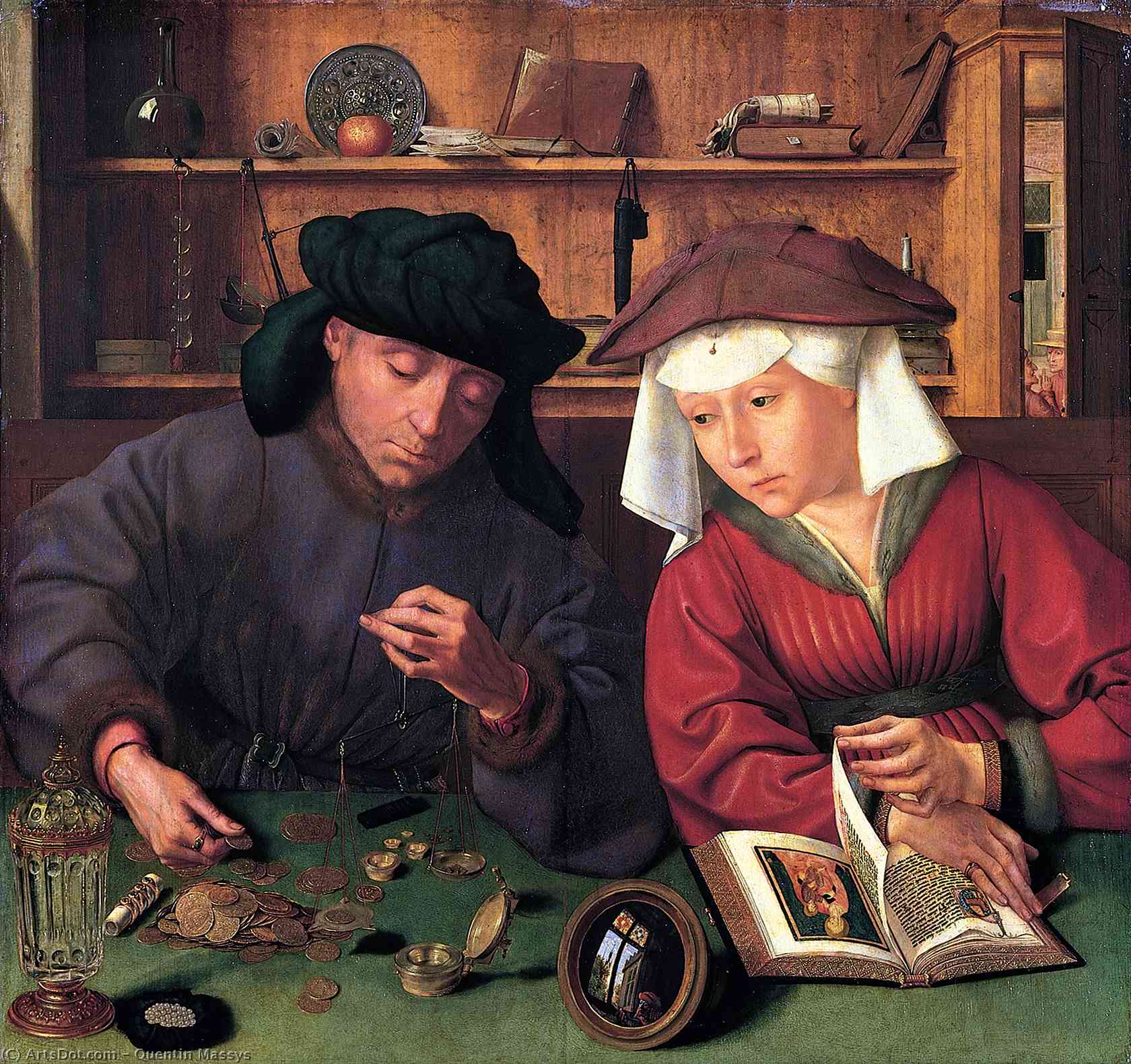
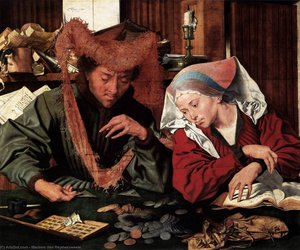
The Moneylender and his Wife
 Oil On Canvas
- WallArt
- Baroque Renaissance
 1514
1514 71.0 x 68.0 cm
 The Louvre
 Read More
Purchase a high-resolution, enhanced digital image, far superior to the online preview.
Each file is meticulously prepared by our in-house specialists using advanced tools and expert manual retouching. We ensure every image has exceptional clarity, precise color accuracy, and fine detail.
The final file is delivered via email within 72 hours, optimized for immediate use in professional, editorial, and print environments. This is the same quality trusted by top-tier design studios, publishers, and galleries.
Digital Image
Download a high-resolution file for personal display, printing, and creative projects. ( Buy Print Buy Hand Made Painting)
Included in Every Digital Image Order
Expert Digital Delivery, Guaranteed
When you choose ArtsDot.com, you're not just getting an image - you're receiving a professionally enhanced digital artwork, crafted with precision and backed by a satisfaction guarantee. Here's everything that comes with your order, automatically:

Fast Email Delivery
Your high-resolution digital image file will be emailed to you within 72 hours of ordering - ready for immediate use.

AI-Enhanced Digital File
Your artwork is professionally optimized using advanced AI tools and manual editing, ensuring maximum detail, clarity, and color accuracy.

Free Lifetime Re-Delivery
Accidentally deleted or lost your file? No worries - we'll resend it to you anytime, free of charge.

No Import Fees - Ever
Enjoy your artwork instantly with zero customs, duties, or delivery fees - digital downloads are always tax-free.

Color Accuracy Guarantee
We ensure your digital image reflects the original colors as closely as possible using professional tools and color management.

60-Day Satisfaction Guarantee
If you're not satisfied with your digital image, we'll revise it or refund 100% within 60 days - no questions asked.

100% Money-Back Guarantee
Not satisfied? Get a full refund within 60 days of receiving your digital file - no questions asked.

Bulk Order Discounts
Buy 3 images, save 10% - Buy 5, save 15% - Buy 10+, save 20%. Great for creative projects, galleries, and agencies.
Collectible Description
The Moneylender and His Wife: A Window Into Antwerp Renaissance Ambivalence
Quentin Massys’s *The Moneylender and His Wife*, painted in 1514, stands as a pivotal work within the burgeoning Antwerp School—a movement that decisively reshaped Northern European painting during the High Renaissance. More than just a portrait of a wealthy merchant family, it embodies a complex interplay of observation, satire, and humanist ideals, reflecting the anxieties and aspirations of its time.
- Subject Matter: The scene depicts a moneylender and his wife seated at a table laden with coins, books, apples, and a bowl—a commonplace tableau that nonetheless served as a springboard for Massys’s artistic exploration. This depiction wasn't merely realistic; it deliberately positioned the figures within the social landscape of Antwerp, a city undergoing rapid transformation under Habsburg rule.
- Style & Technique: Massys employed meticulous detail and chiaroscuro—the dramatic interplay of light and shadow—characteristic of Venetian painting but adapted to Northern European sensibilities. The artist’s masterful use of perspective creates an illusionistic depth that draws the viewer into the intimate space of the domestic interior.
- Historical Context: Antwerp was experiencing a surge in international trade, attracting merchants from across Europe, including Italians fleeing the Inquisition. This influx fueled economic prosperity but also engendered tensions regarding taxation and financial stability—themes subtly conveyed through Massys’s depiction of the couple’s demeanor and surroundings.
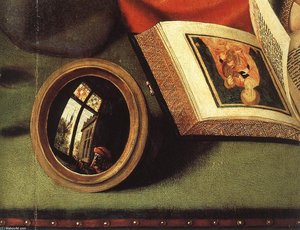
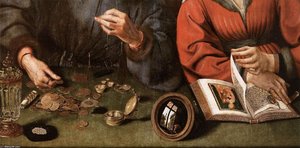
- Symbolism: The inclusion of objects like the illuminated codex symbolizes piety and erudition, contrasting with the avarice implied by the coins on the table. The mirror reflects not only the physical world but also the psychological state of the subjects—their preoccupation with appearances and their awareness of being observed.
- Emotional Impact: Despite its seemingly calm surface, *The Moneylender and His Wife* communicates a profound sense of melancholy and contemplation. Massys’s subtle rendering of facial expressions invites viewers to ponder questions of morality, wealth, and the human condition—a testament to his ability to infuse art with psychological depth.
Massys's innovative approach distinguishes him from earlier Northern Renaissance artists who favored idealized representations. Instead, he confronted viewers with a portrait that captures the complexities of everyday life, mirroring the spirit of Antwerp’s vibrant cultural milieu. The painting’s enduring appeal lies in its ability to resonate across centuries—a captivating glimpse into a moment of artistic brilliance and intellectual curiosity.
The meticulous attention to detail—particularly the subtle shading on skin tones and the reflective surface of the mirror—demonstrates Massys's mastery of technique. These elements elevate the artwork beyond mere visual representation, transforming it into an immersive experience that engages the viewer’s senses and intellect. It exemplifies the Antwerp School’s commitment to realism while simultaneously exploring profound philosophical ideas.
Furthermore, *The Moneylender and His Wife* serves as a compelling reminder of Massys's artistic legacy—a pioneer who established a new aesthetic standard for Northern European painting. Its influence can be traced in subsequent works by artists like Jan van Hemessen and Rembrandt, solidifying Massys’s position as one of the most important figures in shaping Renaissance art.
Related Artworks

Artist Biography
The Architect of the Antwerp School
In the vibrant, burgeoning landscape of the sixteenth-century Low Countries, few names resonate with as much foundational importance as Quentin Massys. Often heralded as the pioneer of the Antwerp School, Massys was a painter who bridged the gap between the meticulous, spiritual devotion of the Early Netherlandish tradition and the burgeoning humanism of the Northern Renaissance. Born around 1466 in Leuven, Belgium, his early life remains a tapestry of legend and historical fragments. It is widely whispered in art history that before he ever grasped a fine brush, he was trained as an ironsmith—a detail that lends a profound, tactile weight to his later mastery of texture and material. This background in metalworking likely instilled in him a unique reverence for the physical world, allowing him to render the sheen of silk, the cold glint of coin, and the weathered skin of humanity with unparalleled precision.
As he transitioned from the academic atmosphere of Leuven to the bustling commercial hub of Antwerp around 1490, Massys began to weave his own distinct thread into the fabric of Flemish art. His early training, potentially under the guidance of Dirk Bouts, connected him to the lineage of masters like Hans Memling and Rogier van der Weyden. From these predecessors, he inherited a devotion to verisimilitude—the pursuit of truth in representation. Yet, Massys was far from a mere imitator. While he maintained the exquisite detail characteristic of his ancestors, he infused his work with a new, burgeoning vitality and a willingness to explore the complexities of the human condition through both religious solemnity and biting social commentary.
A Mastery of Devotion and Satire
The brilliance of Massys lies in his remarkable ability to navigate two seemingly disparate worlds: the sacred and the profane. On one hand, his religious compositions serve as profound meditations on faith. In works such as Christ on the Cross with Donors, he captures the raw, emotional gravity of the crucifixion, utilizing a High Renaissance sensibility to present a scene that is both deeply moving and technically flawless. His ability to depict the divine through the lens of human suffering allowed his religious subjects to resonate with a visceral intimacy, making the spiritual palpable to the viewer.
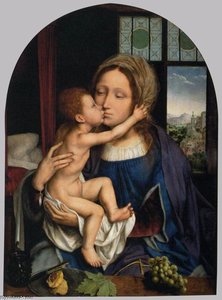
Conversely, Massys was a master of the satirical genre, using his brush to hold a mirror up to the shifting social morals of his era. He possessed a keen eye for the foibles of humanity, often creating scenes that blended realism with a subtle, mocking wit. This duality is perhaps most evident in his approach to portraiture and genre painting, where he could pivot from the serene beauty of a Virgin and Child to the more complex, morally layered depictions of contemporary life. His work often explored themes of greed, vanity, and the tension between material wealth and spiritual purity, making him a precursor to the great genre painters who would follow in the centuries to come.
Legacy and Artistic Significance
The historical significance of Quentin Massys cannot be overstated; he was the catalyst for an artistic revolution in Antwerp. By introducing new motifs and techniques while remaining anchored in the rich traditions of his homeland, he provided the blueprint for a school of painting that would dominate Flanders throughout the sixteenth century. His influence can be traced through the evolution of Northern European art, as he paved the way for a more expressive, observational style that embraced the complexities of the modernizing world.
Today, we remember Massys not just as a craftsman, but as a storyteller who captured the soul of an era. His legacy is preserved in the enduring power of his imagery:
- Technical Innovation: The seamless integration of metalworking-inspired precision with the fluid grace of Renaissance oil painting.
- The Antwerp School: Establishing a lasting artistic movement that prioritized both realism and moral narrative.
- Humanist Perspective: A unique ability to blend the profound sanctity of religious icons with the sharp, observational wit of social satire.
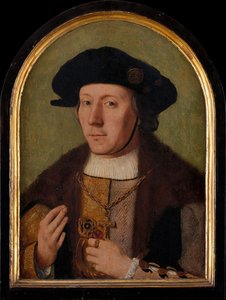
Quentin Massys
1466 - 1530 , Belgium
Quick Facts
- Artistic Movement Or Style: Antwerp School
- Artists Or Movements Influenced By This Artist: ['Hans Memling']
- Artists Who Influenced This Artist: ['Dirk Bouts']
- Date Of Birth: Leuven, Belgium (c. 1466)
- Date Of Death: 1530
- Full Name: Quentin Massys
- Nationality: Flemish
- Notable Artworks:
- St Anne Altarpiece
- The Moneylender and His Wife
- Place Of Birth: Leuven

