 Preview
 Send
Send Share
Share
 Details

 Download
 Similars
 X-Ray
X-Ray Diaporama
Baptismal font


 Read More
Hand Made Oil Reproduction
Hand-painted oil on canvas in your size and frame, made to order by our artists. ( Buy Print Buy Image)




































Pick from our preset sizes that match the artwork's original proportions.

You may enter your own dimensions to fit a specific frame or space. If your selected size does not match the original image's proportions, we will either crop the artwork or extend the painting with additional hand-painted elements. A digital mockup will be sent for your approval before production begins.
Please note that the on-screen preview does not reflect the actual cropping or extension. Only the mockup will accurately show the final composition.
While custom sizes are available, we recommend selecting a dimension from the predefined list to preserve the original proportions.
After order, ArtsDot.com team will email client for instructions and provide a mockup preview
Worldwide Delivery () in 3/4 weeks instead of standard 5 weeks. (17 August). No compromise on quality.

Free Worldwide Express Shipping

High-Quality Linen Canvas

Full Shipping Insurance

Customs Tax Refund Guarantee

True Color Matching Guarantee

60-Day Return Policy (Defects Only)

100% Money-Back Guarantee

Bulk Discount Offer
 Glass option is only available in size under 110 CM

Baptismal font
Reproduction Medium
Reproduction Size
-


Total Price
$ 263
Related Artworks
Artist Biography
The Enigmatic Master of Mosan Bronze: Reiner de Huy
Reiner de Huy, a name whispered through the annals of medieval art history, remains an elusive figure despite being credited with one of the most significant achievements of Romanesque sculpture – the magnificent baptismal font at St Bartholomew’s Church in Liège. Born sometime before 1125 and likely passing around 1150, Reiner's life is shrouded in mystery, known primarily through a single mention in a charter from the Bishopric of Liège identifying him as “Renerus aurifaber,” or Rainer the goldsmith. This scant detail, however, belies the profound impact his artistry had on the artistic landscape of 12th-century Europe.
A Flourishing Artistic Center: The Mosan Valley
To understand Reiner de Huy is to understand the vibrant cultural milieu of the Mosan Valley. Situated along the Meuse River, encompassing parts of modern Belgium and France, this region was a crucible of artistic innovation during the Romanesque period. The Prince-Bishopric of Liège fostered a thriving community of metalworkers, sculptors, and goldsmiths, with bronze casting holding particular prestige. This wasn’t merely a technical skill; it was an art form deeply intertwined with religious devotion and aristocratic patronage. The valley's strategic location facilitated trade and the exchange of ideas, drawing influences from Byzantine traditions, classical antiquity, and Ottonian artistry. Reiner emerged from this fertile ground, embodying the synthesis of these diverse elements.
The Baptismal Font: A Narrative in Bronze
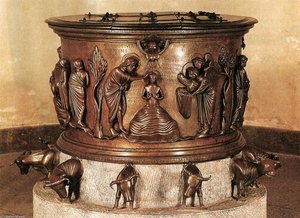
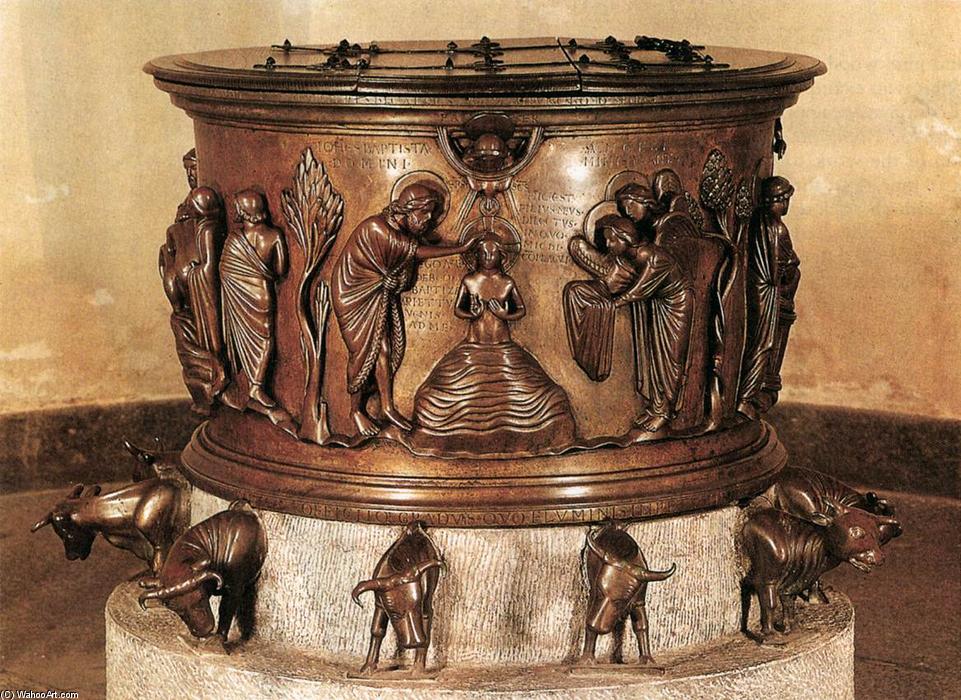
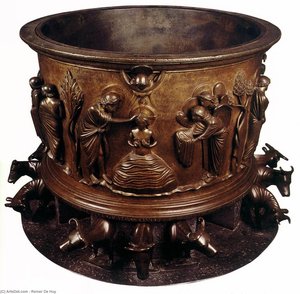
Reiner’s enduring legacy rests upon the extraordinary baptismal font created between 1107 and 1118 for St Bartholomew's Church. This monumental work, cast in bronze, is not simply a vessel for ritual purification; it is a complex narrative unfolding in sculpted relief. The basin itself depicts five scenes central to the sacrament of baptism: John the Baptist preaching, the Baptism of Christ, and episodes involving the apostles Peter and John the Evangelist. These reliefs are remarkable for their dynamic composition, graceful figures, and a nascent sense of spatial depth – qualities that set them apart from earlier Romanesque sculpture. The original cover, adorned with depictions of the Twelve Apostles and prophets (sadly lost during the French Revolution), further enhanced the font’s symbolic richness.
Style and Influences
The style of the baptismal font reveals a sophisticated understanding of classical forms blended with Byzantine elegance. Figures possess a flowing, rhythmic quality reminiscent of antique sculpture, yet they are imbued with a distinctly medieval spirituality. The intricate detailing, particularly in the drapery and facial expressions, demonstrates Reiner’s mastery of metalworking techniques. While direct influences remain debated, scholars point to connections with Ottonian bronze casting and Byzantine reliquaries. The font's narrative approach also reflects a growing emphasis on storytelling within religious art, anticipating developments in Gothic sculpture. A small bronze crucifix figure housed in the Schnütgen Museum in Cologne is often attributed to Reiner’s hand, offering further insight into his artistic vocabulary. Other works found in Brussels and Dublin are believed to have originated from his workshop, showcasing the breadth of his creative enterprise.
Historical Significance and Legacy
Reiner de Huy stands as a pivotal figure in the transition from Ottonian to Romanesque art. His baptismal font not only exemplifies the artistic achievements of the Mosan school but also profoundly influenced subsequent generations of sculptors and metalworkers. The work’s classical elegance, dynamic composition, and narrative power set a new standard for religious imagery. Though little is known about his personal life, Reiner de Huy's enduring masterpiece continues to inspire awe and admiration, solidifying his place as one of the most important artists of the medieval period. His work serves as a testament to the artistic flourishing that occurred in the Meuse Valley during the 12th century—a region often hailed as the “Athens of the North” for its intellectual and creative vitality.
reiner de huy
1150
Quick Facts
- Artistic Movement Or Style: Romanesque art
- Date Of Death: 1150
- Full Name: Reiner de Huy
- Nationality: Netherlandish
- Notable Artworks: ['Baptismal Font']
- Place Of Birth: Huy, Belgium
Related Articles

Bronze Age to Modern Masters: 10 Sculptures That Redefined Art | ArtsDot
Journey through art history with 10 legendary bronze sculptures – from Michelangelo's David to Rodin’s Thinker. Explore the stories, techniques & timeless beauty of these masterpieces. Find museum-quality reproductions & elevate your home decor on ArtsDot.com.

Bronze Sculptures That Defined Art History | ArtsDot
Journey through art history with our Top 10 bronze sculptures! Explore masterpieces by Rodin, Michelangelo & more. Discover stories behind iconic statues and find museum-quality reproductions for your home decor at ArtsDot.com.

The Enduring Legacy of Bronze: A Historical & Artistic Exploration for the Collector
Explore the rich history & enduring appeal of bronze sculpture with expert insights for collectors at ArtsDot. Learn about casting techniques, iconic artists, collecting tips & contemporary interpretations.
The Enduring Legacy of Bronze: History, Technique & Artistic Expression for the Collector
Explore the rich history & enduring appeal of bronze sculpture with expert insights for collectors at ArtsDot. Learn about casting techniques, iconic artists, and collecting tips.
The Enduring Legacy of Bronze Sculpture: A Collector's Guide to Form & Cultural Significance
Explore the rich history & enduring appeal of bronze sculpture with expert insights for collectors at ArtsDot. Learn about casting techniques, iconic artists, and collecting tips to build a discerning art collection.