 Preview
 Send
Send Share
Share
 Details

 Download
 Similars
 X-Ray
X-Ray Diaporama
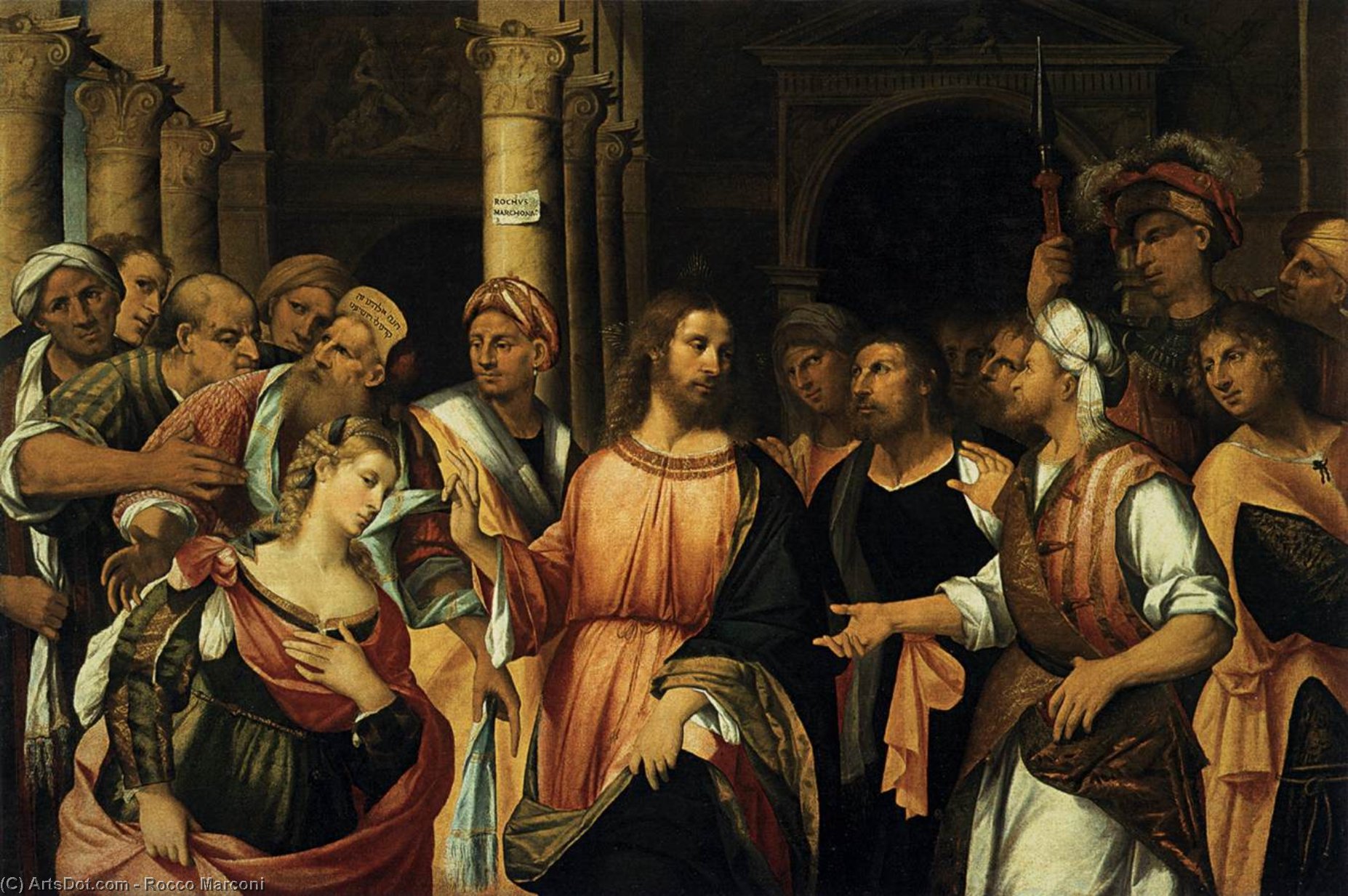
Christ and the Adulteress
 Oil On Canvas
- WallArt
- Venetian Renaissance
 1525
1525- Renaissance
 131.0 x 197.0 cm
 Gallerie dell'Accademia
 Read More
Giclée / Art Print
Museum-quality giclée or canvas print with fast production and flexible finish options. ( Buy Hand Made Painting Buy Image)




P118B $10

P118H $10

P118W $10

P438Z $10

P508JH $12

P508YH $12

P805H $10

P805Z $10

P919BZ $10

P919G $10

P919XJ $10

P959ZH $10

P968JZ $12

W106C $8

W218G $10

W218JH $8

W218Y $10

W307PJ $10

W316G $10

W316PJ $8

W316Y $10

W398PJ $8

W4111J $10

W500HY $15

W500JH $15

W692G $12

W849H $8

W940BG $15

W953PJ $8




Pick from our preset sizes that match the artwork's original proportions.

You may enter your own dimensions to fit a specific frame or space. If your selected size does not match the original image's proportions, we will either crop the artwork or extend the image with a mirrored or solid-fill edge. A digital mockup will be sent for your approval before production begins.
Please note that the on-screen preview does not reflect the actual cropping or extension. Only the mockup will accurately show the final composition.
While custom sizes are available, we recommend selecting a dimension from the predefined list to preserve the original proportions.
Worldwide Delivery () in 2 weeks instead of standard 4/5 weeks. (25 August)

Free Worldwide Express Shipping

High-Quality Linen Canvas

Full Shipping Insurance

Customs Tax Refund Guarantee

True Color Matching Guarantee

60-Day Return Policy (Defects Only)

100% Money-Back Guarantee

Bulk Discount Offer
 Glass option is only available in size under 110 CM

Christ and the Adulteress
Giclée / Art Print
Reproduction Size
-


Total Price
$ 63
Collectible Description
A Moment of Divine Grace in the Venetian Renaissance
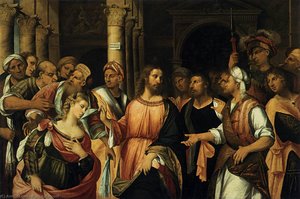
In the heart of the bustling Venetian Renaissance, where light and shadow danced through the canals, Rocco Marconi captured a profound moment of spiritual tension in his masterpiece, Christ and the Adulteress. Painted around 1525, this large-scale oil on canvas serves as a breathtaking window into a period of intense religious devotion and artistic experimentation. The scene unfolds with a dramatic intensity, placing the viewer directly within a crowded assembly of figures gathered around Jesus Christ. Marconi masterfully orchestrates a composition that feels both monumental and intimate, drawing the eye toward the central figure of Christ, whose presence acts as the calm, moral anchor amidst a sea of human emotion and whispered judgment.
The painting is a triumph of narrative depth, depicting the biblical encounter where Christ challenges those ready to cast stones at a woman caught in sin. As one gazes upon the canvas, the sheer scale of 131 x 197 cm envelops the room, making it an extraordinary centerpiece for any sophisticated collection or a commanding focal point in a grand interior design scheme. The artist utilizes the rich, layered techniques characteristic of the Venetian school to breathe life into the diverse cast of characters. From the man draped in an intricate turban to the subtle presence of a figure holding a drum-like object, every detail contributes to a sense of a living, breathing world—a tapestry of humanity caught in a singular, transformative moment of grace.
Technique and the Mastery of Light
Marconi’s brushwork reflects the profound influence of his mentor, the legendary Giovanni Bellini, yet it possesses a unique sensitivity that hints at the burgeoning drama of the later Renaissance. The technique employed in Christ and the Adulteress relies on a sophisticated interplay of light and shadow, often referred to as chiaroscuro, which lends a sculptural quality to the figures. The way light falls across the faces of the onlookers—some etched with suspicion, others with contemplative awe—creates a psychological depth that is rare even among his contemporaries. This mastery of oil paint allows for subtle gradations in skin tones and the luxurious textures of period clothing, making the artwork feel remarkably tactile.
For the discerning collector or interior designer, this piece offers more than mere decoration; it offers an atmosphere. The color palette, rooted in the earthy yet vibrant tones of the Veneto region, provides a sense of warmth and historical weight. When placed in a curated space, such as a library, a formal dining hall, or a contemporary gallery setting, the painting acts as a conversational anchor. It invites contemplation, prompting viewers to reflect on themes of mercy, judgment, and the complexities of the human condition. Owning a high-quality reproduction of this work means bringing a piece of the 16th century's soul into the modern era, preserving the legacy of Rocco Marconi’s brief but brilliant artistic journey.
Related Artworks



Artist Biography
A Venetian Voice Amidst the Shadows of Tintoretto
Rocco Marconi (c. 1490 – 1529) stands as a singular figure within the vibrant tapestry of Venetian Renaissance painting, a talent whose brilliance shone briefly but powerfully amidst the towering presence of masters like Tintoretto and Veronese. While often overshadowed by his more prolific contemporaries in the annals of art history, Marconi’s contribution to the Venetian school is undeniable—a testament to artistic sensitivity and an exploration of religious iconography that reveals a deeply distinctive stylistic voice. His life, though relatively short, captured the essence of a period defined by intense spiritual fervor and the transformative power of light.
Born in Treviso, Marconi’s formative years were steeped in the rich artistic traditions of the Veneto region. He entered the prestigious workshop of the legendary Giovanni Bellini, spending over twenty-five years absorbing the master's profound understanding of perspective, chiaroscuro, and the expressive potential of color. Alongside fellow pupils such as Vittore Belliniano and Girolamo Santacroce, Marconi internalized the humanist ideals that characterized Bellini’s oeuvre. This rigorous tutelage instilled in him a technical foundation that allowed him to navigate the complexities of the Venetian style, yet he would eventually move beyond mere imitation to find his own rhythmic grace.
The Mastery of Light and Devotion
Marconi’s artistic style is distinguished by a remarkable subtlety and emotional depth, qualities that often provided a serene counterpoint to the more dramatic, turbulent canvases produced during the later Venetian Renaissance. Unlike the aggressive shadows found in Tintoretto’s work, Marconi favored a more restrained palette and luminous brushwork, prioritizing atmospheric perspective and nuanced tonal gradations. His compositions frequently centered on biblical narratives, particularly depictions of Christ, which served as a mirror to the spiritual preoccupations of his era.
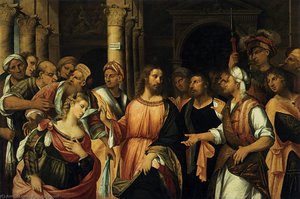
One of his most breathtaking achievements, Christ and the Adulteress (c. 1525), exemplifies this mastery. In this large-scale oil on canvas, Marconi orchestrates a scene of profound spiritual tension. The painting serves as a window into a crowded assembly, where the central figure of Christ acts as a calm, moral anchor amidst a sea of human emotion and whispered judgment. Through a sophisticated interplay of light and shadow, he lends a sculptural quality to his figures, breathing life into a diverse cast of characters—from men draped in intricate turbans to subtle, peripheral observers. This ability to balance the monumental with the intimate is what defines his unique legacy.
Legacy and Historical Significance
Though his career was cut short by his death in 1529, Marconi’s integration into the professional fabric of Venice was significant. His membership in the Venetian painters' guild (fraglia) in 1517 and his later involvement with the Scuola di Sant’Anna in 1526 demonstrate his standing within the prestigious artistic community of the time. His work remains a vital link in the evolution of the Venetian school, representing the transition from the balanced classicism of Bellini to the more emotive, atmospheric explorations of the mid-sixteenth century.
Today, the significance of Rocco Marconi lies in his ability to capture the human condition through a lens of divine grace. His paintings do not merely recount religious stories; they invite the viewer into a living, breathing world caught in transformative moments of sanctity and struggle. For collectors and historians alike, his oeuvre offers a precious glimpse into a period where the brushstroke was used not just to depict form, but to illuminate the very soul of the Renaissance.
rocco marconi
1490 - 1529
Quick Facts
- Artistic Movement Or Style: Renaissance Painting
- Artists Or Movements Influenced By This Artist: ['Tintoretto']
- Artists Who Influenced This Artist: ['Giovanni Bellini']
- Date Of Death: 1529
- Full Name: Rocco Marconi
- Nationality: Italian
- Notable Artworks: ['Christ Paintings']
- Place Of Birth: Venice
Related Articles

Jacopo Tintoretto's Masterpieces: 25 Paintings That Define Venetian Drama | ArtsDot
Explore 25 breathtaking masterpieces by Jacopo Tintoretto, the Venetian master of drama and light. Discover the stories behind iconic Renaissance paintings & find museum-quality art reproductions to elevate your home decor on ArtsDot.com.

The Enduring Legacy of Oil on Canvas: Technique, History & Aesthetic Impact
Explore the rich history & techniques of oil painting – from Renaissance masters to Impressionism. Discover pigments, layering methods, and why this timeless medium endures. Expert insights for artists & art enthusiasts.

The Enduring Power of Painting: A Historical & Contemporary Exploration of Form and Emotion
Explore the rich history & enduring techniques of oil painting with ArtsDot. Discover masterpieces, learn about art collecting, and find authentic handmade reproductions crafted by skilled artists.

Oil on Canvas: A Historical & Technical Exploration of a Timeless Artistic Medium
Explore the rich history & enduring techniques of oil painting on canvas. Discover the science behind its longevity, conservation practices, and contemporary relevance. Expert insights for art enthusiasts.
The Golden Light of Innovation: Exploring the Venetian Renaissance Art Movement (1430–1580)
Explore the Golden Age of Venetian art (1430–1580). Discover Giorgione, Titian & Tintoretto's techniques, the 'colorito' revolution, and lasting influence. Expert insights for collectors & enthusiasts.