 Preview
 Send
Send Share
Share
 Details

 Download
 Similars
 X-Ray
X-Ray Diaporama
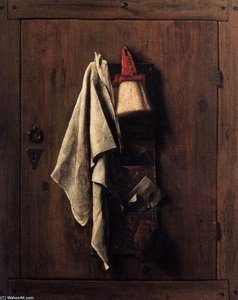
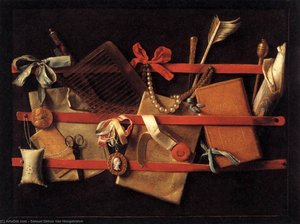
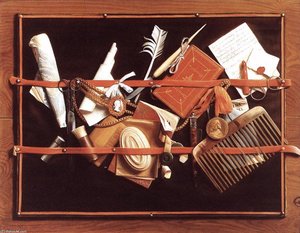
Trompe-l'oeil Still-Life
 Acrylic On Canvas
- WallArt
- Baroque Style
 1655
1655 92.0 x 72.0 cm
 Academy of Fine Arts Vienna
 Read More
Hand Made Oil Reproduction
Hand-painted oil on canvas in your size and frame, made to order by our artists. ( Buy Print Buy Image)




P118B $10

P118H $10

P118W $10

P438Z $10

P508JH $12

P508YH $12

P805H $10

P805Z $10

P919BZ $10

P919G $10

P919XJ $10

P959ZH $10

P968JZ $12

W106C $8

W218G $10

W218JH $8

W218Y $10

W307PJ $10

W316G $10

W316PJ $8

W316Y $10

W398PJ $8

W4111J $10

W500HY $15

W500JH $15

W692G $12

W849H $8

W940BG $15

W953PJ $8




Pick from our preset sizes that match the artwork's original proportions.

You may enter your own dimensions to fit a specific frame or space. If your selected size does not match the original image's proportions, we will either crop the artwork or extend the painting with additional hand-painted elements. A digital mockup will be sent for your approval before production begins.
Please note that the on-screen preview does not reflect the actual cropping or extension. Only the mockup will accurately show the final composition.
While custom sizes are available, we recommend selecting a dimension from the predefined list to preserve the original proportions.
After order, ArtsDot.com team will email client for instructions and provide a mockup preview
Worldwide Delivery () in 3/4 weeks instead of standard 5 weeks. (17 August). No compromise on quality.

Free Worldwide Express Shipping

High-Quality Linen Canvas

Full Shipping Insurance

Customs Tax Refund Guarantee

True Color Matching Guarantee

60-Day Return Policy (Defects Only)

100% Money-Back Guarantee

Bulk Discount Offer
 Glass option is only available in size under 110 CM

Trompe-l'oeil Still-Life
Reproduction Medium
Reproduction Size
-


Total Price
$ 263
Artwork Description
A Masterstroke of Illusion: Examining Samuel Dirksz van Hoogstraten’s Trompe-l'oeil Still Life
Samuel Dirksz van Hoogstraten (1627 – 1678), a luminary of the Dutch Golden Age, stands as an unparalleled innovator in artistic representation. More than merely capturing visual likeness, he wrestled with perception itself—a feat achieved through his masterful command of trompe-l'oeil technique and underpinned by a profound understanding of Baroque aesthetics. Born in Dordrecht, Van Hoogstraten’s formative years were spent within the influential workshop of his father, Dirk van Hoogstraten, fostering an early appreciation for artistic principles that would propel him to prominence in Amsterdam – the epicenter of Dutch artistic fervor during this transformative period. His career wasn't simply about producing beautiful images; it was about elevating art beyond mere imitation, transforming it into a conduit for intellectual contemplation and emotional resonance.The Illusion of Reality: Trompe-l’Oeil Technique
Van Hoogstraten’s signature style—trompe-l'oeil—was revolutionary for its time. Literally translating to “fool the eye,” this technique deliberately deceived the viewer into perceiving objects as existing beyond the confines of the painted surface. He achieved this astonishing effect through meticulous attention to detail, exploiting principles of perspective and chiaroscuro – dramatic contrasts between light and dark – to create an illusion of depth and dimensionality. The artist skillfully manipulated tonal gradations and subtle shading to mimic the textures and reflections of real-world objects, blurring the boundaries between painting and reality. This wasn’t simply skillful craftsmanship; it was a deliberate challenge to accepted artistic conventions.A Study in Baroque Ornamentation
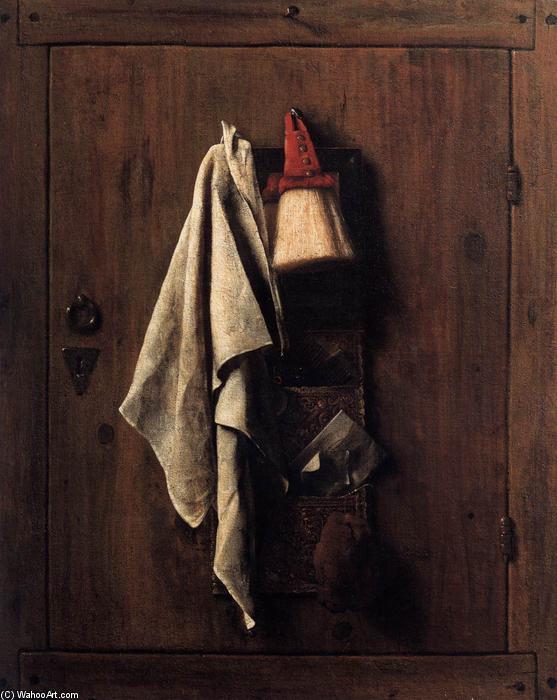
The “Trompe L'oeil Still Life,” completed around 1655, exemplifies the grandeur and sophistication characteristic of Baroque art. The composition is dominated by a richly ornamented wooden cabinet—a symbol of wealth and status prevalent during the period—upon which rests an assortment of meticulously rendered items: a towel draped elegantly over the drawer’s edge, a brass lamp casting warm light onto its surface, and stacks of papers bearing handwritten annotations. Two bottles flank the scene, one positioned prominently at the upper left corner and another nestled near the lower right, further enhancing the illusionistic depth. The muted palette—primarily browns and golds—reflects the Baroque preference for opulent color schemes designed to evoke emotion and grandeur.Symbolism Within Illusion
Beyond its technical brilliance, the painting resonates with symbolic meaning. The cabinet itself represents domestic tranquility and prosperity – values highly esteemed in Dutch society during Van Hoogstraten’s era. The lamp symbolizes enlightenment and knowledge, mirroring the artist's own intellectual pursuits. Furthermore, the papers hint at scholarly activity and contemplation—underscoring Van Hoogstraten’s belief that art should engage both intellect and emotion. These elements intertwine seamlessly within the trompe-l'oeil framework, amplifying their impact on the viewer and inviting them to contemplate deeper themes of beauty, order, and human experience.Emotional Resonance: Capturing a Moment in Time
Ultimately, “Trompe L’Oeil Still Life” transcends mere visual representation; it aspires to capture a fleeting moment imbued with atmosphere and emotion. Van Hoogstraten's masterful use of light and shadow creates an immersive experience for the observer, drawing them into the scene and prompting reflection on its underlying symbolism. It stands as a testament to his ability to transform pigment onto canvas into something far more profound—a window into the mind of a brilliant artist and a captivating exemplar of Baroque artistry.Related Artworks
Artist Biography
A Master of Illusion and Intellect: The World of Samuel Dirksz van Hoogstraten
Samuel Dirksz van Hoogstraten, a name resonating with the ingenuity of the Dutch Golden Age, was far more than simply a painter. Born in Dordrecht in 1627 and passing away there in 1678, he embodied the era’s spirit of intellectual curiosity, artistic innovation, and burgeoning mercantile power. He wasn't merely recording reality on canvas; he was dissecting it, playing with perception, and exploring the very nature of representation itself. Van Hoogstraten distinguished himself not only through his skillful brushwork but also as a poet and a profound art theorist, leaving behind a legacy that extends beyond the visual realm into the world of ideas. His journey began within the family workshop of his father, Dirk van Hoogstraten, laying a foundational understanding of artistic principles before venturing to Amsterdam – the beating heart of Dutch artistry in the 17th century. It was there he entered the esteemed studio of Rembrandt van Rijn, an experience that would indelibly shape his early style and approach to light and shadow.From Rembrandt’s Shadow to Independent Vision
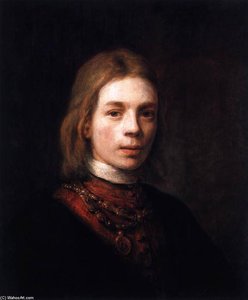
The influence of Rembrandt is undeniably present in Van Hoogstraten's initial works. A portrait from 1645, now residing in the Liechtenstein collection in Vienna, serves as a clear testament to this apprenticeship. However, unlike many students who remained tethered to their master’s style, Van Hoogstraten possessed an insatiable desire for experimentation and a restless spirit that propelled him beyond imitation. He wasn't content to simply replicate Rembrandt’s chiaroscuro; he sought to deconstruct it, analyze its effects, and ultimately forge his own unique artistic voice. This pursuit led him on extensive travels throughout Europe – to Vienna, Rome, and London – exposing him to diverse artistic traditions and fueling his intellectual growth. These journeys weren't merely sightseeing expeditions; they were immersive studies in architecture, perspective, and the prevailing aesthetic sensibilities of each locale. Upon returning to Dordrecht, he married in 1656 and assumed a civic role as provost of the mint, demonstrating a multifaceted talent that extended beyond the artistic sphere. This period saw him further refine his skills, moving towards an increasingly sophisticated understanding of illusionism and spatial representation.Trompe-l’œil, Perspective Boxes, and the Art of Deception
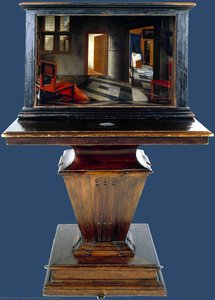
Van Hoogstraten's artistic prowess truly blossomed in his mastery of trompe-l’œil, a technique that translates to “deceive the eye.” His still lifes weren’t simply arrangements of objects; they were meticulously crafted illusions designed to blur the boundaries between reality and representation. He imbued seemingly haphazard collections with deeper symbolic meanings, inviting viewers to contemplate the transient nature of life and the deceptive allure of material possessions. Simultaneously, he became renowned for his creation of “peepshows” or "perspective boxes"—ingenious devices that offered immersive three-dimensional views into miniature worlds. One such box, currently housed at the National Gallery in London, recreates the interior of a typical Dutch house with astonishing realism when viewed through strategically placed peepholes. These weren’t mere novelties; they were sophisticated explorations of perspective and spatial illusion, demonstrating Van Hoogstraten's profound understanding of how the human eye perceives depth and dimension. His architectural paintings, such as his 1652 view of the Vienna Hofburg, further showcased his technical skill and attention to detail.A Theorist’s Legacy: ‘Inleyding tot de hooge schoole der schilderkonst’
However, Samuel van Hoogstraten's contribution extends far beyond his paintings and perspective boxes. He was a dedicated art theorist who sought to codify the principles of painting in his magnum opus, Inleyding tot de hooge schoole der schilderkonst: anders de zichtbaere werelt (Introduction to the Academy of Painting, or The Visible World), published in 1678. This ambitious treatise stands as one of the most comprehensive and intellectually rigorous explorations of art theory produced in the Dutch Republic during the 17th century. Van Hoogstraten delved into issues of pictorial persuasion, illusionism, the moral responsibilities of the artist, and the relationship between painting and philosophy, drawing upon a vast range of ancient and modern sources. He built upon the foundations laid by Karel van Mander in his earlier work, *Het Schilder-Boeck*, seeking to create a systematic framework for understanding and practicing the art of painting. His writings reflect both international influences gleaned from his travels and contemporary debates within Dutch artistic circles. It was this dedication to articulating the principles behind his craft that cemented his place as a pivotal figure in the history of art theory.A Lasting Influence
Van Hoogstraten’s influence resonated through subsequent generations of artists, notably through his pupils – including his brother Jan van Hoogstraten, Aert de Gelder, Cornelis van der Meulen, and Godfried Schalcken. His legacy is further preserved in the writings of Arnold Houbraken, one of his students who penned a biography of the artist that serves as a primary source of information about his life and work. Samuel Dirksz van Hoogstraten was not simply a painter; he was a polymath—an artist, poet, theorist, and administrator—who embodied the intellectual ferment of the Dutch Golden Age. His innovative techniques, profound insights into perception, and dedication to articulating the principles of art continue to captivate and inspire audiences today, solidifying his position as a master of illusion and intellect whose work transcends time.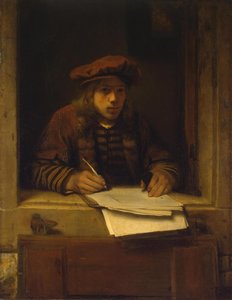
Samuel Dirksz van Hoogstraten
1627 - 1678 , Netherlands
Quick Facts
- Artistic Movement Or Style: Dutch Golden Age, Baroque
- Artists Or Movements Influenced By This Artist:
- Aert de Gelder
- Cornelis van der Meulen
- Godfried Schalcken
- Artists Who Influenced This Artist:
- Rembrandt
- Dirk van Hoogstraten
- Date Of Birth: August 2, 1627
- Date Of Death: October 19, 1678
- Full Name: Samuel Dirksz van Hoogstraten
- Nationality: Dutch
- Notable Artworks:
- Portrait of Mathys van den Brouck
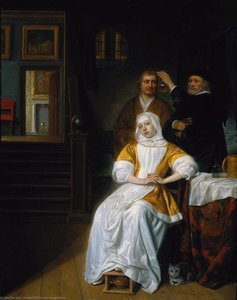
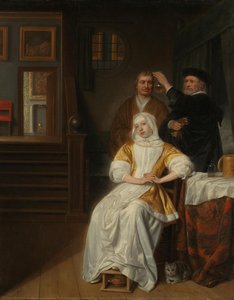
- The Anemic Lady
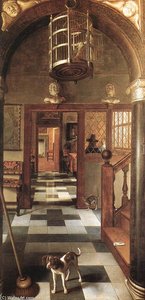
- View of a Corridor
- Man at a Window
- Vanitas
- Place Of Birth: Dordrecht, Netherlands
Related Articles

Dutch Masters: 10 Golden Age Paintings That Still Inspire |
Journey into the Dutch Golden Age! Explore 10 iconic paintings by Rembrandt, Vermeer & Hals. Discover the stories behind these Baroque masterpieces and find museum-quality art reproductions to elevate your home decor on .

Golden Age Reflections: Dutch Baroque Painting & Cultural Innovation
Explore the Dutch Golden Age of painting! Discover key artists like Vermeer & ter Borch, their innovative techniques, and the rich cultural context behind these Baroque masterpieces. Learn about collecting & appreciating this iconic art period.

Illuminating Innovation: Exploring the Dutch Golden Age of Painting
Explore the Dutch Golden Age of painting with ArtsDot. Discover Rembrandt, Vermeer & other Masters. Learn about key characteristics, iconic artworks, and lasting influence. Expert insights for collectors & enthusiasts.
Abraham Hendricksz van Beyeren: Pioneering Dutch Still Life & the Banquet Tradition
Explore the captivating world of Dutch Golden Age still life with Abraham van Beyeren. Discover his innovative techniques, symbolic banquet scenes & lasting influence on art history. Learn about collecting these masterpieces.
Jan Jansz Wijnants: A Study in Dutch Golden Age Still Life & Floral Transience
Explore the captivating world of Jan Wijnants and Dutch Golden Age still life painting. Discover symbolism, masterful techniques & lasting influence on floral art history. Learn more!