 Preview
 Send
Send Share
Share
 Details

 Download
 Similars
 X-Ray
X-Ray Diaporama
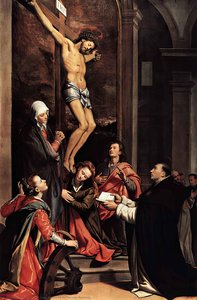
Vision of St Thomas Aquinas
 Oil On Canvas
- WallArt
- Italian Baroque
 1593
1593 362.0 x 233.0 cm
 Convent of San Marco
 Read More
Hand Made Oil Reproduction
Hand-painted oil on canvas in your size and frame, made to order by our artists. ( Buy Print Buy Image)




P118B $10

P118H $10

P118W $10

P438Z $10

P508JH $12

P508YH $12

P805H $10

P805Z $10

P919BZ $10

P919G $10

P919XJ $10

P959ZH $10

P968JZ $12

W106C $8

W218G $10

W218JH $8

W218Y $10

W307PJ $10

W316G $10

W316PJ $8

W316Y $10

W398PJ $8

W4111J $10

W500HY $15

W500JH $15

W692G $12

W849H $8

W940BG $15

W953PJ $8




Pick from our preset sizes that match the artwork's original proportions.

You may enter your own dimensions to fit a specific frame or space. If your selected size does not match the original image's proportions, we will either crop the artwork or extend the painting with additional hand-painted elements. A digital mockup will be sent for your approval before production begins.
Please note that the on-screen preview does not reflect the actual cropping or extension. Only the mockup will accurately show the final composition.
While custom sizes are available, we recommend selecting a dimension from the predefined list to preserve the original proportions.
After order, ArtsDot.com team will email client for instructions and provide a mockup preview
Worldwide Delivery () in 3/4 weeks instead of standard 5 weeks. (17 August). No compromise on quality.

Free Worldwide Express Shipping

High-Quality Linen Canvas

Full Shipping Insurance

Customs Tax Refund Guarantee

True Color Matching Guarantee

60-Day Return Policy (Defects Only)

100% Money-Back Guarantee

Bulk Discount Offer
 Glass option is only available in size under 110 CM

Vision of St Thomas Aquinas
Reproduction Medium
Reproduction Size
-


Total Price
$ 263
Artwork Description
A Vision Steeped in Faith and Intellectual Contemplation
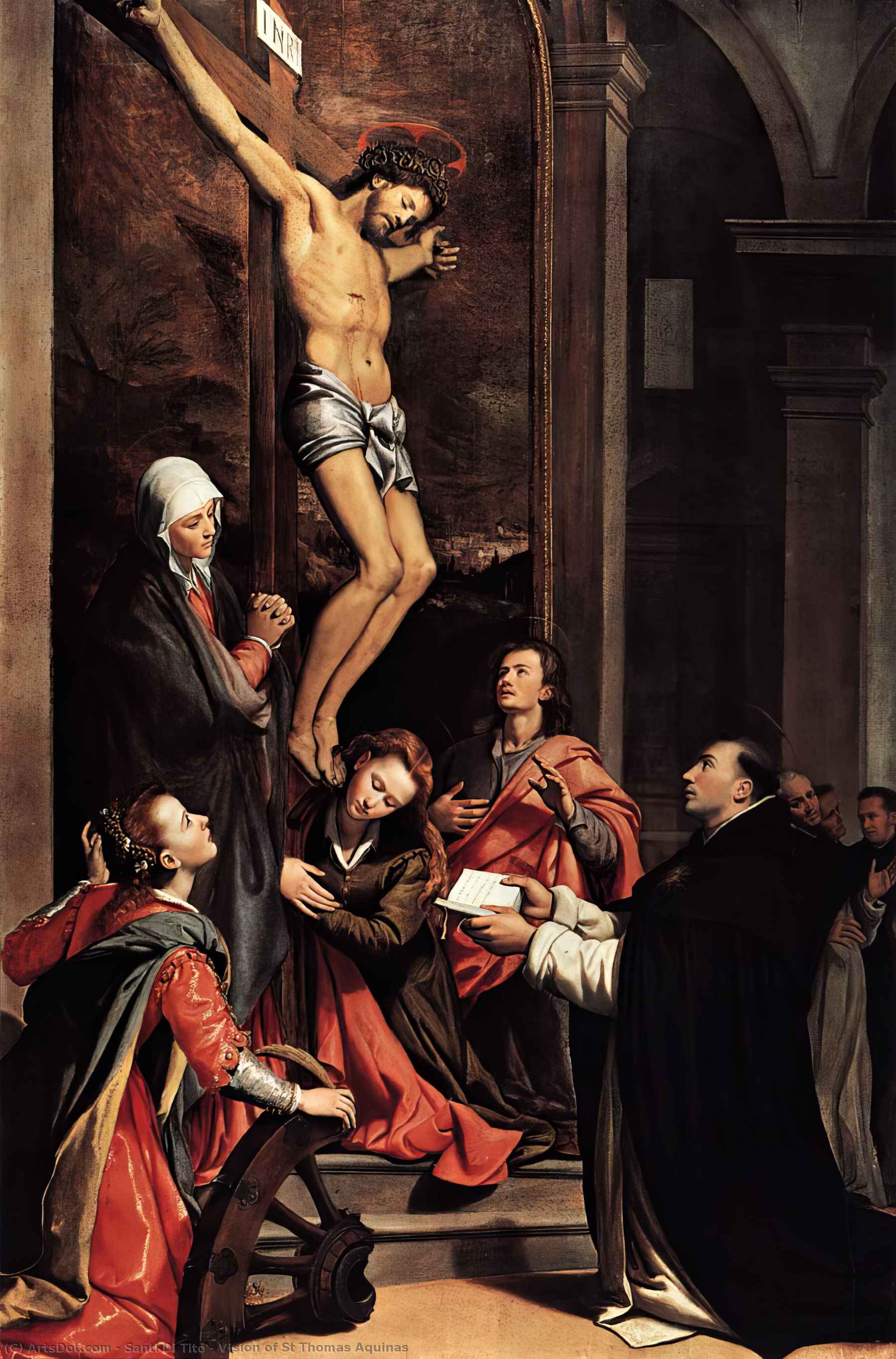
The “Vision of St Thomas Aquinas” by Santi di Tito, completed in 1593, transcends mere depiction; it embodies the spirit of Florentine Baroque—a movement striving for balance between classical restraint and emotive fervor. Measuring a substantial 362 x 233 cm and currently residing within the San Marco museum’s collection in Florence, Italy, this oil on panel artwork represents more than just a religious scene – it's a testament to humanist ideals interwoven with profound spiritual yearning.Composition and Narrative Depth
At its core lies Jesus Christ crucified, positioned centrally against a backdrop of muted hues that emphasize the solemnity of the occasion. Surrounding him are figures engaged in mourning and reverence, meticulously rendered by Di Tito’s hand. The artist skillfully employs spatial layering—a chair and bench anchoring the scene—to create an illusionistic depth that draws viewers into the contemplative space. Each figure is imbued with palpable emotion, conveying sorrowful piety and highlighting the universality of human experience confronting divine majesty.Technique and Artistic Innovation
Santi Di Tito’s mastery lies in his masterful manipulation of oil paint on panel – a technique favored for its ability to achieve luminous colors and textural richness. Unlike the exaggerated Mannerist style prevalent at the time, Di Tito eschewed excessive ornamentation, favoring instead a refined elegance that harkens back to Raphael's harmonious compositions. The artist’s meticulous attention to detail—evident in the drapery folds and facial expressions—demonstrates an unwavering commitment to capturing the psychological nuances of his subjects. This stylistic choice distinguishes him from many of his contemporaries who prioritized flamboyant display over nuanced representation.Historical Context: Florentine Baroque and Humanist Thought
The painting emerged during a period marked by significant intellectual ferment – the Renaissance’s legacy continuing to shape artistic sensibilities. Di Tito's work reflects the humanist preoccupation with human dignity and moral virtue, mirroring the broader cultural currents of Florence under Cosimo I de’ Medici. Comparing it to William H. Johnson’s “Mount Calvary,” which similarly explores themes of faith and sacrifice, illuminates the shared ambition to convey spiritual truths through visual eloquence.Symbolism: The Crucifixion as Reflection of Divine Sacrifice
The crucifix itself serves as a potent symbol—a focal point for contemplation and representing Jesus Christ's sacrificial death for humanity’s salvation. St Thomas Aquinas, kneeling in prayer, embodies intellectual piety – the pursuit of knowledge informed by faith. His gaze upward towards the crucifix underscores the importance of reconciling reason and spirituality, a cornerstone of humanist philosophy and Di Tito’s artistic vision.- Consider commissioning a high-quality reproduction to enrich your interior space.
- Explore similar artworks by Santi di Tito on ArtsDot.
Related Artworks

Artist Biography
The Architect of Counter-Maniera
In the vibrant, shifting landscape of late 16th-century Italy, few figures played as pivotal a role in redefining the visual language of Florence as Santi di Tito. Born in 1536, this master emerged during a period of profound artistic transition, standing at the crossroads between the highly stylized, artificial elegance of Mannerism and the burgeoning naturalism that would eventually blossom into the Baroque. While his contemporaries often sought refuge in the complex, elongated forms and intellectual puzzles of the Maniera, di Tito embarked on a different journey—one of reform, clarity, and a return to the profound grace of classical tradition.
The early years of his career were marked by significant collaborative endeavors that expanded his horizons far beyond the borders of Tuscany. Between 1558 and 1564, di Tito’s presence was felt in the grand halls of Rome, where he worked alongside talented peers such as Giovanni de’ Vecchi and Niccolò Circignani. Their monumental fresco projects at the Palazzo Salviati and the Sala Grande of the Belvedere served as a crucible for his developing style. It was during this Roman period that he began to absorb the Raphaelesque influences that would become the hallmark of his mature work, moving away from the crowded, ornamental aesthetics of the Zuccari brothers toward a more balanced and legible composition.
A Departure from Tradition
Upon his return to Florence in 1564, Santi di Tito did not merely rejoin the existing artistic community; he sought to transform it. As a member of the prestigious Accademia del Disegno, he became a central figure in a movement often described by historians as Counter-Maniera. This was not simply a rejection of style, but a profound intellectual shift. While his early contributions to Francesco I de’ Medici's Studiolo—such as The Sisters of Pheton and Hercules and Io—still echoed the stylized conventions of Florentine Mannerism, they contained the seeds of his later revolution.
Driven by a desire for greater naturalism and emotional sincerity, di Tito famously distanced himself from the influence of Bronzino. He viewed the prevailing trend of extreme artifice as a barrier to true artistic expression. Instead, he looked backward to the clarity of the High Renaissance and forward toward a more direct, humanistic approach to painting. His work began to emphasize:
- Classical Form: A renewed focus on anatomical accuracy and structural integrity.
- Clarity of Composition: Moving away from overwhelming, overcrowded scenes toward more legible and focused narratives.
- Innovative Color Palettes: The use of light and color to create depth and atmosphere rather than mere decorative effect.
Legacy and Historical Significance
The legacy of Santi di Tito is etched into the very fabric of Italian art history. By championing a style that favored clarity and naturalism, he paved the way for the dramatic innovations of the 17th century. His ability to marry the intellectual rigor of Florentine training with a new, accessible emotionality made him one of the most respected painters of his era. His prolific output, including monumental altarpieces such as The Resurrection for Santa Croce, demonstrated that art could be both profoundly beautiful and deeply communicative.
Ultimately, di Tito stands as a bridge between two worlds. He took the sophisticated, often impenetrable language of the late Renaissance and refined it into something more enduring and human. In doing so, he helped steer the course of Western art, ensuring that the transition from the complex Mannerist era to the emotive Baroque was marked by a profound respect for the classical foundations of beauty.

Santi di Tito
1536 - 1603 , Italy
Quick Facts
- Artistic Movement Or Style: Proto-Baroque & Counter-Maniera
- Artists Or Movements Influenced By This Artist:
- Vasari
- Alessandro Allori
- Artists Who Influenced This Artist:
- Titian
- Bronzino
- Date Of Birth: Florence, Italy (1536)
- Date Of Death: 1603
- Full Name: Santi di Tito
- Nationality: Italian
- Notable Artworks:
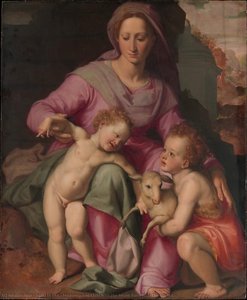
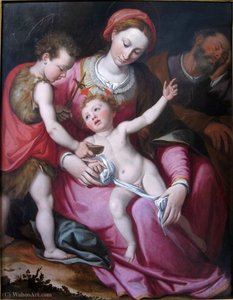
- Madonna and Child with the Infant Saint John the Baptist
- Vision of St Thomas Aquinas
- Saint Eustahe
- Place Of Birth: Florence
Related Articles

El Greco's Masterpieces: Explore 25 Iconic Paintings & Spiritual Visions | ArtsDot
Journey through El Greco's 25 most iconic paintings! Explore the spiritual depth & dramatic beauty of this Spanish Renaissance master. Discover art history, techniques & find museum-quality reproductions for your home at ArtsDot.com.

The Dramatic Flourish: Exploring the Baroque Movement's Enduring Legacy in Art History
Explore the dramatic world of Baroque art! Discover iconic artists like Caravaggio & Rubens, defining techniques, and its lasting impact on art history. Expert insights for collectors & enthusiasts at ArtsDot.

The Enduring Power of Painting: A Historical & Contemporary Exploration of Form and Emotion
Explore the rich history & enduring techniques of oil painting with ArtsDot. Discover masterpieces, learn about art collecting, and find authentic handmade reproductions crafted by skilled artists.

Oil on Canvas: A Historical & Technical Exploration of a Timeless Artistic Medium
Explore the rich history & enduring techniques of oil painting on canvas. Discover the science behind its longevity, conservation practices, and contemporary relevance. Expert insights for art enthusiasts.

The Visceral Stage: Exploring Dramatic Narratives & Emotional Intensity in Baroque Art
Explore the dramatic world of Baroque art! Discover iconic masters like Caravaggio & Rembrandt, their techniques, and the movement's lasting impact. Expert insights for collectors & enthusiasts at ArtsDot.