 Preview
 Send
Send Share
Share
 Details

 Download
 Similars
 X-Ray
X-Ray Diaporama
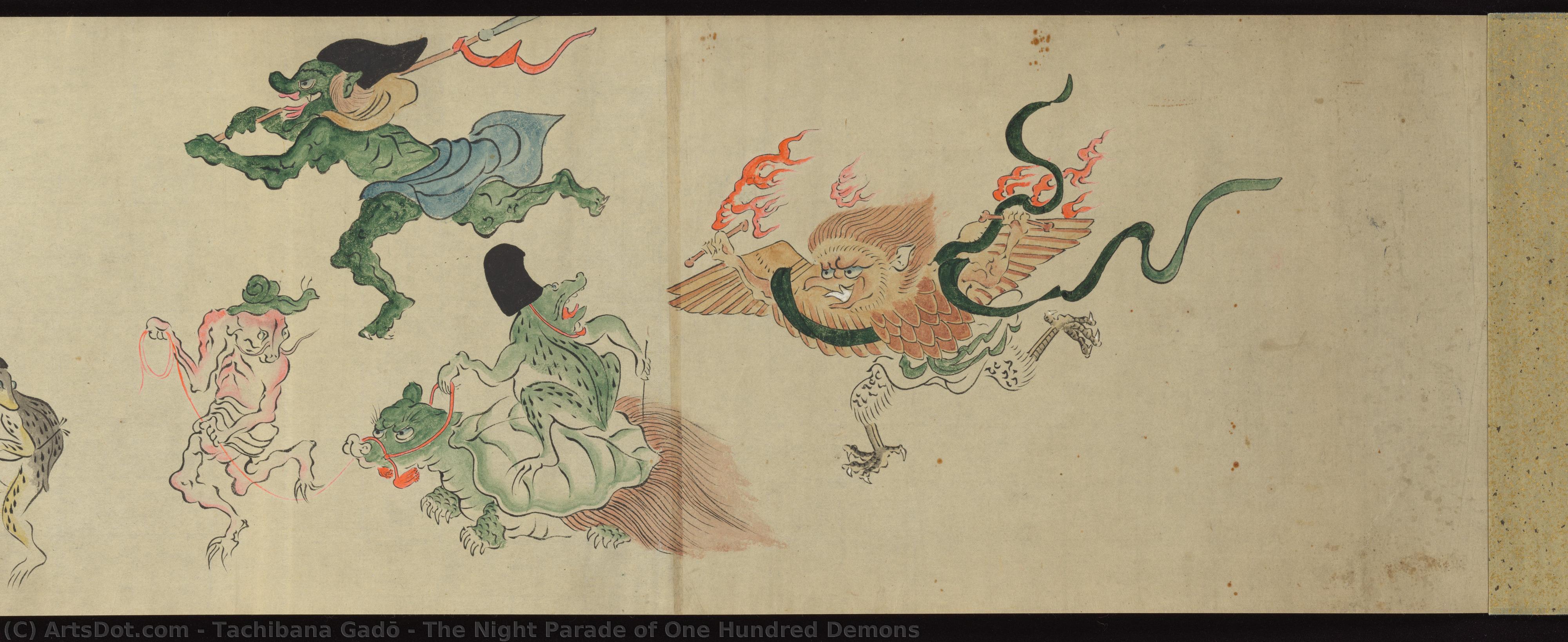
The Night Parade of One Hundred Demons
 1892
1892 29.0 x 760.0 cm
 Read More
Giclée / Art Print
Museum-quality giclée or canvas print with fast production and flexible finish options. ( Buy Hand Made Painting Buy Image)




































Pick from our preset sizes that match the artwork's original proportions.

You may enter your own dimensions to fit a specific frame or space. If your selected size does not match the original image's proportions, we will either crop the artwork or extend the image with a mirrored or solid-fill edge. A digital mockup will be sent for your approval before production begins.
Please note that the on-screen preview does not reflect the actual cropping or extension. Only the mockup will accurately show the final composition.
While custom sizes are available, we recommend selecting a dimension from the predefined list to preserve the original proportions.
Worldwide Delivery () in 2 weeks instead of standard 4/5 weeks. (27 August)

Free Worldwide Express Shipping

High-Quality Linen Canvas

Full Shipping Insurance

Customs Tax Refund Guarantee

True Color Matching Guarantee

60-Day Return Policy (Defects Only)

100% Money-Back Guarantee

Bulk Discount Offer
 Glass option is only available in size under 110 CM

The Night Parade of One Hundred Demons
Giclée / Art Print
Reproduction Size
-


Total Price
$ 63
Related Artworks









Artist Biography
The Meticulous Vision of Tachibana Morikuni
In the vibrant, shifting landscape of Japan’s Edo period, few artists captured the delicate balance between tradition and innovation as exquisitely as Tachibana Morikuni. Known also by his name Tachibana Gadō, this master of the brush emerged from the cultural heart of Ōsaka, leaving behind a legacy defined by an almost supernatural attention to detail. His life, spanning from approximately 1679 to 1748, coincided with a golden age of Japanese visual culture, a time when the boundaries of book illustration and woodblock printing were being pushed toward new heights of sophistication. Morikuni was not merely a recorder of scenes; he was an architect of atmosphere, using his mastery of line and color to breathe life into the historical and legendary narratives that defined the Japanese consciousness.
The foundation of Morikuni’s artistry was laid through a prestigious lineage of mentorship. He studied under Tsuruzawa Tanzan, a pupil of the great Kano Tan’yu, which connected him directly to the venerable Kano school. This training provided him with a rigorous technical vocabulary, emphasizing the importance of idealized beauty and subtle tonal gradations. However, Morikuni was far from a rigid traditionalist. While he upheld the core principles of Kanō painting, he possessed a unique ability to infuse his work with the vitality of the Tosa style and the bold, decorative spirit of the Rinpa tradition. This synthesis allowed him to move seamlessly between the formal elegance required for classical subjects and the expressive energy needed for more dynamic, contemporary compositions.
A Mastery of Detail and Narrative Depth
To gaze upon a work by Morikuni is to enter a world where every texture and nuance has been considered. His technique was characterized by an unparalleled precision that set him apart from his contemporaries. While many artists of the era favored broad, sweeping brushstrokes to convey movement, Morikuni sought perfection in the minute. He possessed a singular talent for rendering the subtle play of light across silk, the intricate patterns of a kimono, and the delicate anatomy of nature. This dedication to realism was never at odds with artistic convention; rather, he used his observational prowess to enhance the idealized beauty inherent in Japanese aesthetics, creating images that felt both tangibly real and dreamily transcendent.
His contributions to the medium of book illustration were particularly profound. Morikuni became one of the most prolific illustrators of his time, utilizing the woodblock medium to disseminate complex stories to a wider audience. His work often breathed life into the epic chronicles of Japanese history, such as The Tale of the Heike and The Tale of Genji. Through these illustrations, he did more than decorate pages; he provided a visual heartbeat to the nation's most cherished literature. One of his most celebrated achievements is found in the series Unpitsu soga (The Moving Brush in Rough or Quick Painting), published shortly after his death. In this work, he demonstrated a remarkable ability to simulate rapid, spontaneous brushwork within the structured medium of woodcut, proving that even within the constraints of print, the artist's hand could remain fluid and alive.
Legacy and Historical Significance
The historical significance of Tachibana Morikuni lies in his role as a bridge between eras. He stood at the intersection of the classical Kano traditions and the burgeoning popularity of more accessible, narrative-driven art forms that would eventually pave the way for the Ukiyo-e movement. His ability to blend the scholarly depth of historical painting with the decorative allure of popular printmaking helped shape the visual language of the Edo period. Even today, his works serve as vital windows into the aesthetic soul of 18th-century Japan, reflecting a society that found profound meaning in the intersection of meticulous craftsmanship and poetic storytelling.
His enduring impact can be summarized through several key artistic pillars:
- Technical Lineage: His connection to the Kano school ensured the preservation of classical Japanese painting techniques.
- Narrative Innovation: He elevated book illustration from simple decoration to a sophisticated form of visual storytelling.
- Stylistic Synthesis: His unique ability to merge the precision of the Kano style with the decorative elegance of Rinpa and Tosa traditions.
- Cultural Preservation: Through his depictions of historical figures and legends, he helped cement the visual identity of Japan's classical literary heritage.
tachibana morikuni
1716 - 1771 , Japan
Quick Facts
- Artistic Movement Or Style: Ukiyo-e School
- Artists Or Movements Influenced By This Artist: ['Kano Einō']
- Artists Who Influenced This Artist: ['Tsuruzawa Tanzan']
- Date Of Birth: Tokyo, Japan (1716)
- Full Name: tachibana morikuni
- Nationality: Japanese
- Notable Artworks:
- The Night Parade of One Hundred Demons
- Flowers and Birds of the Four Seasons
- Place Of Birth: Tokyo