![Nativity (exterior)\n Saints Barbara And Catherine (inner Side Of The Right Wing) — The Elder Bernese Carnation Master [nelkenmeister]](/media/artworks/images-full/78/f2/78f276c7a905d558e81e5b747fa2ecd7.jpg)
 Preview
 Send
Send Share
Share
 Details

 Download
 Similars
 X-Ray
X-Ray Diaporama
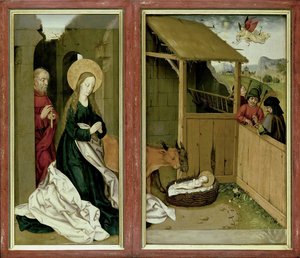
Nativity (Exterior)\n Saints Barbara and Catherine (Inner Side of the Right Wing)
 Tempera On Panel
- Late Gothic
 1490
1490- Renaissance
 112.0 x 73.0 cm
 Kunsthaus Zürich
 Read More
Hand Made Oil Reproduction
Hand-painted oil on canvas in your size and frame, made to order by our artists. ( Buy Print Buy Image)




P118B $10

P118H $10

P118W $10

P438Z $10

P508JH $12

P508YH $12

P805H $10

P805Z $10

P919BZ $10

P919G $10

P919XJ $10

P959ZH $10

P968JZ $12

W106C $8

W218G $10

W218JH $8

W218Y $10

W307PJ $10

W316G $10

W316PJ $8

W316Y $10

W398PJ $8

W4111J $10

W500HY $15

W500JH $15

W692G $12

W849H $8

W940BG $15

W953PJ $8




Pick from our preset sizes that match the artwork's original proportions.

You may enter your own dimensions to fit a specific frame or space. If your selected size does not match the original image's proportions, we will either crop the artwork or extend the painting with additional hand-painted elements. A digital mockup will be sent for your approval before production begins.
Please note that the on-screen preview does not reflect the actual cropping or extension. Only the mockup will accurately show the final composition.
While custom sizes are available, we recommend selecting a dimension from the predefined list to preserve the original proportions.
After order, ArtsDot.com team will email client for instructions and provide a mockup preview
Worldwide Delivery () in 3/4 weeks instead of standard 5 weeks. (28 August). No compromise on quality.

Free Worldwide Express Shipping

High-Quality Linen Canvas

Full Shipping Insurance

Customs Tax Refund Guarantee

True Color Matching Guarantee

60-Day Return Policy (Defects Only)

100% Money-Back Guarantee

Bulk Discount Offer
 Glass option is only available in size under 110 CM

Nativity (Exterior)\n Saints Barbara and Catherine (Inner Side of the Right Wing)
Reproduction Medium
Reproduction Size
-


Total Price
$ 263
A Sacred Vision in Late Gothic Splendor
In the quiet, hallowed atmosphere of late 15th-century Switzerland, a master emerged whose brushwork could breathe life into the most delicate petals and the most profound theological mysteries. The work known as Nativity (Exterior) with Saints Barbara and Catherine is a breathtaking testament to this era, capturing a moment of divine intimacy through the lens of the Nelkenmeister—the Elder Bernese Carnation Master. This exquisite piece, dating back to approximately 1490, serves as more than just a religious icon; it is a window into a world where the earthly and the divine are inextricably entwined. The scene unfolds with a tender grace, presenting the Nativity not merely as a historical event, but as an eternal, living presence that continues to resonate with anyone who gazes upon its storied surface.
The composition is a masterclass in late Gothic storytelling, where every figure and element contributes to a larger tapestry of devotion. At the heart of the narrative, Mary cradles the infant Jesus, her posture embodying a profound, quiet strength. Surrounding this central miracle, the presence of Saints Barbara and Catherine adds layers of spiritual depth, their inclusion inviting the viewer into a communion of saints. The artist’s ability to balance the monumental weight of religious significance with the delicate, almost fragile beauty of the surrounding details is nothing short of miraculous. As one observes the figures—the man standing vigil, the observers on the periphery, and even the subtle presence of animals—there is a sense of a world held in breathless anticipation of the divine.
Technically, the work showcases the meticulous precision that earned its creator such a distinctive moniker. The Nelkenmeister was celebrated for his ability to render botanical details with such startling realism that flowers seemed to possess their own fragrance. In this piece, that same dedication to texture and light is applied to the architectural elements of the stable and the heavy, meaningful folds of the garments. The use of color is both vibrant and somber, creating a chiaroscuro effect that guides the eye through the complex arrangement of figures. This mastery of detail creates an immersive experience, where the viewer is not just looking at a painting, but is being drawn into a sacred space, making it an incomparable centerpiece for any collection dedicated to the preservation of European heritage.
For the discerning collector or interior designer, this reproduction offers a rare opportunity to introduce a sense of historical gravity and soulful elegance into a contemporary setting. The piece carries an emotional weight that transcends time; it evokes feelings of peace, reverence, and a deep connection to the human story. Whether placed in a grand gallery or used as a focal point in a sophisticated study, the painting acts as an anchor of tranquility. It is a work that invites contemplation, sparking conversations about art history, craftsmanship, and the enduring power of beauty. To possess such a piece is to hold a fragment of the late Middle Ages, a beautifully preserved moment of light and shadow from the heart of the Swiss Gothic tradition.
Related Artworks
![Adoration Of The Magi — The Younger Zurich Carnation Master [nelkenmeister], Early Renaissance](/media/artworks/images-thumb/2f/6d/2f6d73ec5fc9c27e013112f02083ff54.jpg)
Artist Biography
A Master of Miniature Worlds: The Elder Bernese Carnation Master
The late 15th century in Switzerland witnessed a flourishing of religious art, often characterized by meticulous detail and vibrant color. Within this milieu emerged an artist known as the Elder Bernese Carnation Master – or *Nelkenmeister* in German – a figure shrouded in mystery yet celebrated for his exquisite depictions of flowers, particularly carnations, woven into the fabric of devotional paintings. While biographical details remain elusive, with even precise birth and death dates unknown, the impact of his work resonates through the surviving examples of his artistry. He is believed to have been active primarily in Bern, Switzerland, leaving behind a legacy that marks him as one of the most important representatives of late Gothic painting in the region. The name itself, “Carnation Master,” speaks volumes about his specialization; he wasn’t merely including flowers in his compositions but elevating them to symbols of profound religious meaning and demonstrating an unparalleled skill in their rendering.The Language of Flowers: Style and Technique
The Elder Bernese Carnation Master's paintings are instantly recognizable for their delicate precision and the almost jewel-like quality of their surfaces. He possessed a remarkable ability to capture the texture and form of flowers, particularly carnations, with astonishing realism. Each petal seems to unfurl before the viewer’s eyes, imbued with subtle gradations of color and light. This wasn't simply botanical illustration; his flowers were integral components of complex religious narratives. The artist employed bright, saturated colors – reds, blues, golds, and greens – characteristic of the late Gothic aesthetic. His compositions often feature intricate patterns in textiles and backgrounds, creating a rich visual tapestry that draws the eye deeper into the scene. The meticulous detail wasn’t merely decorative; it served to enhance the spiritual impact of the work, inviting contemplation and reverence. He frequently worked on altarpieces, utilizing hinged wings (diptychs or triptychs) to create layered narratives that unfolded as the panels were opened and closed.Religious Narratives and Symbolic Carnations
The subject matter of the Elder Bernese Carnation Master’s paintings is almost exclusively religious. Scenes from the Nativity, the Passion of Christ, and depictions of saints are common themes. However, what sets his work apart is the pervasive presence of carnations. In medieval symbolism, the carnation held multiple layers of meaning. The flower was often associated with divine love, representing the blood of Christ or the Virgin Mary. The red carnation specifically symbolized sacrifice and passion, while white carnations represented purity and innocence. By incorporating these flowers into his religious scenes, the artist imbued his paintings with an additional layer of spiritual significance. For example, in depictions of the Nativity, carnations might be found adorning the garments of the Virgin Mary or surrounding the infant Christ, subtly reinforcing themes of divine love and sacrifice. The “Nativity (Exterior) Saints Barbara and Catherine (Inner Side of the Right Wing)” is a prime example of this technique, showcasing both detailed floral work and religious iconography.Influences and Legacy
Pinpointing specific artistic influences on the Elder Bernese Carnation Master remains challenging due to the limited documentation surrounding his life and career. However, scholars suggest connections to broader trends in late Gothic painting prevalent in Northern Europe, particularly the influence of Flemish masters known for their realism and attention to detail. The artist’s style also reflects elements of International Gothic art, characterized by elegant figures, rich colors, and decorative patterns. His work stands as a testament to the unique artistic traditions that flourished in Switzerland during this period. While he didn't establish a large workshop or school of followers, his influence can be seen in the works of other Swiss painters active in the late 15th and early 16th centuries. The Elder Bernese Carnation Master’s legacy lies not only in the beauty and technical skill of his paintings but also in his ability to imbue religious narratives with a profound sense of symbolism and emotional depth, making him a pivotal figure in Swiss Gothic art history.![the elder bernese carnation master [nelkenmeister]](/media/artworks/images/thumbnails/cf/1a/cf1a273b0fc140c596ea90db8a4f60c9.jpg)
Quick Facts
- Artistic Movement Or Style: Early Renaissance
- Artists Or Movements Influenced By This Artist: ['Correggio']
- Artists Who Influenced This Artist:
- Leonardo da Vinci
- Antonello da Messina
- Date Of Birth: c. 1460
- Date Of Death: c. 1524
- Full Name: Andrea Solari
- Nationality: Italian
- Notable Artworks:
- Madonna with Green Cushion
- Ecce Homo (Poldi-Pezzoli Museum)
- Place Of Birth: Milan, Lombardy
Related Articles
The Radiant Dusk of Medieval Vision: Exploring Late Gothic Art's Synthesis of Faith, Form & Emotionality (c. 1300-1500)
Explore the exquisite beauty & spiritual depth of Late Gothic art (c. 1300-1500). Discover key artists, symbolism, and its lasting influence on the Renaissance. Expert insights at ArtsDot.
Raphael's Masterpieces: 25 Iconic Paintings & Renaissance Art for Your Home
Explore 25 breathtaking Raphael paintings! Journey through the Italian Renaissance with masterpieces like 'School of Athens' & iconic Madonnas. Find museum-quality art reproductions and elevate your home decor on ArtsDot.com.

Late Medieval Masterpieces: 10 Artworks That Defined an Era | ArtsDot
Journey through 10 defining Late Medieval masterpieces – from Giotto's frescoes to Jan van Eyck’s realism. Explore the stories, techniques & vibrant colors of Gothic art. Find museum-quality reproductions and elevate your home decor with ArtsDot.com! Discover all masterpieces on ArtsDot.com
Beyond Borders: The Spiritual & Stylistic Innovations of International Gothic Art
Explore the exquisite beauty & spiritual depth of International Gothic art. Discover key artists like Simone Martini & Pol de Limbourg, its origins, symbolism, and lasting influence on European painting. Expert insights at ArtsDot.
The Shadow of Faith: Exploring Gothic Art's Spiritual Intensity & Architectural Innovation
Explore the spiritual intensity & architectural innovation of Gothic art! Discover the symbolism behind cathedrals, stained glass & master artists like Giotto and Monet. A deep dive into medieval history & artistic expression.