 Preview
 Send
Send Share
Share
 Details

 Download
 Similars
 X-Ray
X-Ray Diaporama
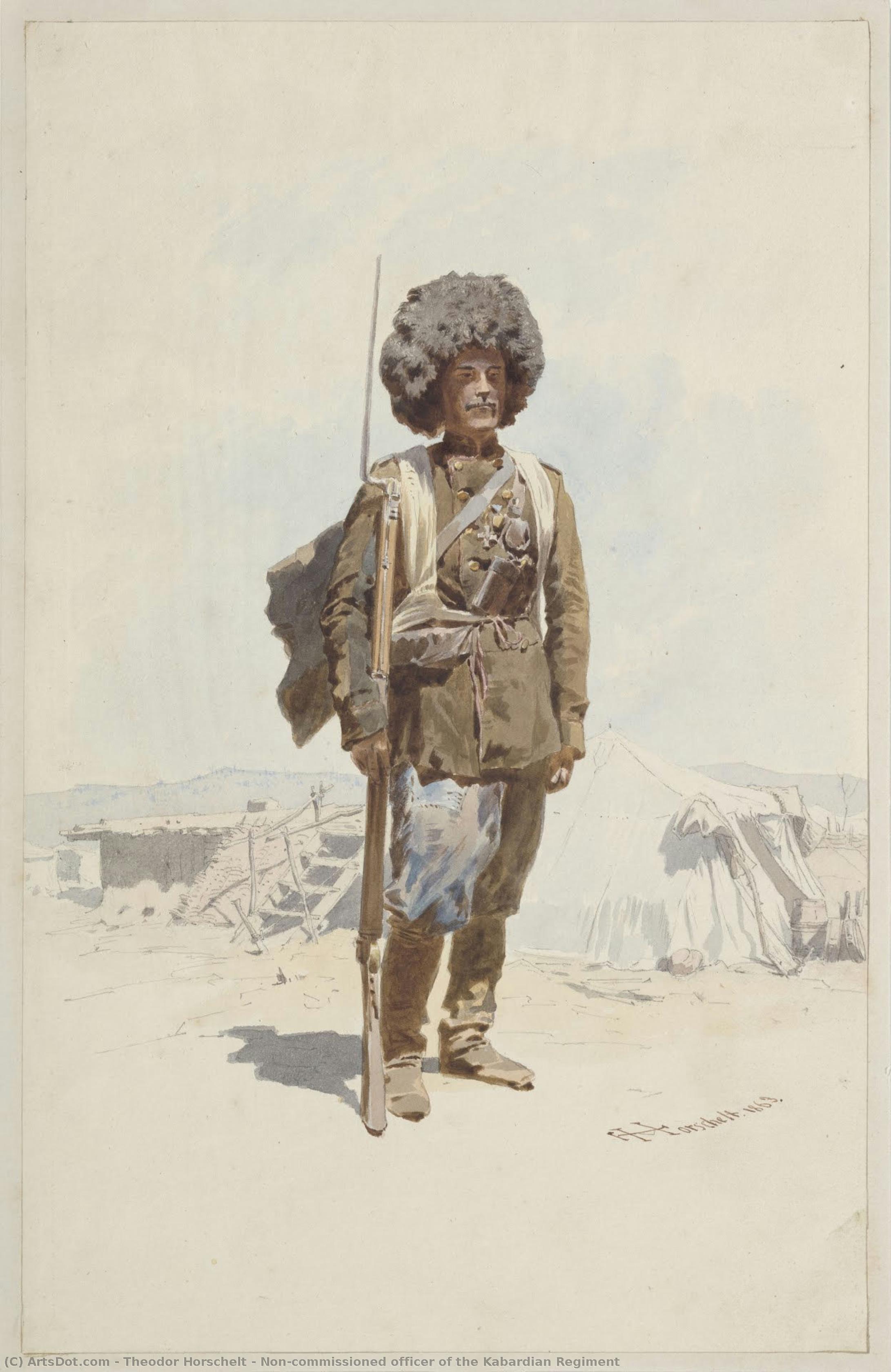
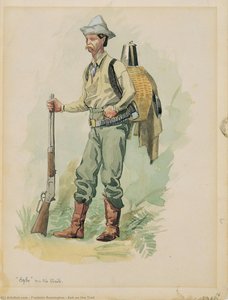
Non-commissioned officer of the Kabardian Regiment


 Read More
Hand Made Oil Reproduction
Hand-painted oil on canvas in your size and frame, made to order by our artists. ( Buy Print Buy Image)




































Pick from our preset sizes that match the artwork's original proportions.

You may enter your own dimensions to fit a specific frame or space. If your selected size does not match the original image's proportions, we will either crop the artwork or extend the painting with additional hand-painted elements. A digital mockup will be sent for your approval before production begins.
Please note that the on-screen preview does not reflect the actual cropping or extension. Only the mockup will accurately show the final composition.
While custom sizes are available, we recommend selecting a dimension from the predefined list to preserve the original proportions.
After order, ArtsDot.com team will email client for instructions and provide a mockup preview
Worldwide Delivery () in 3/4 weeks instead of standard 5 weeks. (2 September). No compromise on quality.

Free Worldwide Express Shipping

High-Quality Linen Canvas

Full Shipping Insurance

Customs Tax Refund Guarantee

True Color Matching Guarantee

60-Day Return Policy (Defects Only)

100% Money-Back Guarantee

Bulk Discount Offer
 Glass option is only available in size under 110 CM

Non-commissioned officer of the Kabardian Regiment
Reproduction Medium
Reproduction Size
-


Total Price
$ 263
Related Artworks









Artist Biography
Theodor Horschelt: A Life Dedicated to War and Equine Art
- Born: Munich, Germany (16 March 1829)
- Died: Munich, Kingdom of Bavaria (3 April 1871)
- Nationality: German
- Artistic Specialization: War Paintings, Equestrian Art, Scenes from the Caucasian Wars
Early Life and Artistic Training
- Theodor Horschelt was born into a family with artistic ties; his father was a ballet master, and his older brother, Friedrich, was a portrait painter.
- He initially studied at the Academy of Fine Arts Munich under Joseph Anton Rhomberg but left after a short period.
- Early self-study focused on scenes from nature and imaginative depictions of the Caucasian Wars.
- Later studies included instruction from Professor Hermann Anschütz, Albrecht Adam, Franz Adam, and Julius Lange, refining his skills in precision and outline.
- He began by sketching horses at the Royal Stables in Stuttgart, demonstrating an early interest in equestrian subjects.
The Caucasian Wars: A Defining Focus
- In 1853, Horschelt undertook study trips to Paris with Friedrich Wilhelm Hackländer and to Spain with him and Christian Friedrich von Leins, experiences that broadened his artistic perspective.
- He dedicated himself exclusively to war paintings after these travels.
- From 1858 to 1863, he lived in the Caucasus region, participating in military campaigns against the Lezghians and witnessing events such as the attack on Imam Shamil's headquarters. He was awarded for his bravery.
- He toured with Tsar Alexander II and Prince Albert of Prussia, documenting the region and its people.
- His paintings of the Caucasian Wars became his most recognized works, capturing both the conflict and the beauty of the landscape and horses.
Key Works and Artistic Style
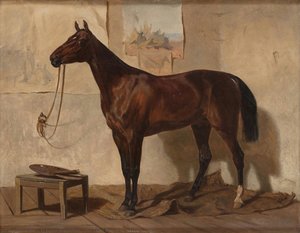
- Horse of Prince A. Baryatinsky: Considered a stunning example of equestrian art, showcasing Horschelt's skill in depicting horses with power and grace.
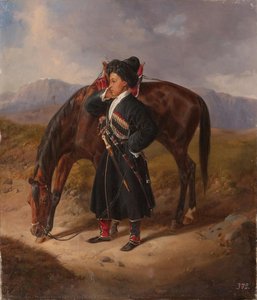
- Depictions of the Caucasian Wars: These paintings are notable for their realistic portrayal of military action and the cultural context of the region.
- Arabian Themes: Early works commissioned by King William focused on Arabian themes, demonstrating his versatility.
- Style: Horschelt's style is characterized by a blend of realism and romanticism, with attention to detail in depicting horses, uniforms, and landscapes. His work conveys a sense of drama and movement.
Legacy and Recognition
- Horschelt’s works are featured in museums such as the Dagestan Museum of Fine Arts named after P. S. Gamzatova in Russia, Leopold-Hoesch-Museum, Museum Ostdeutsche Galerie, Sammlung Schack, Lenbachhaus, City Gallery in Lenbachhous, Herzog Anton Ulrich-Museum and Wallraf-Richartz-Museum in Germany.
- He received numerous awards for his work, including the Grand Cross Star of the Order of Saint Stanislaus and a medal of the Order of St. Anna.
- His paintings were widely reproduced in Russian publications documenting the Caucasian campaigns.
- Horschelt’s legacy lies in his ability to capture the drama and beauty of war, particularly through his depictions of horses and the Caucasus region. He is remembered as a significant figure in 19th-century German art.

Theodor Horschelt
1829 - 1871 , Germany
Quick Facts
- Artistic Movement Or Style: Realism, War Painting
- Artists Who Influenced This Artist:
- Joseph Anton Rhomberg
- Albrecht Adam
- Franz Adam
- Julius Lange
- Date Of Birth: March 16, 1829
- Date Of Death: April 3, 1871
- Full Name: Theodor Horschelt
- Nationality: German
- Notable Artworks:
- Horse of Prince A. Baryatinsky
- Scenes from the Caucasian Wars
- Place Of Birth: Munich, Germany