 Send
Send Share
Share
 Details

 Download
 Similars
 Diaporama
Spectre of Kitty Hawk


 Read More
Giclée / Art Print
Museum-quality giclée or canvas print with fast production and flexible finish options. ( Buy Hand Made Painting Buy Image)




































Pick from our preset sizes that match the artwork's original proportions.

You may enter your own dimensions to fit a specific frame or space. If your selected size does not match the original image's proportions, we will either crop the artwork or extend the image with a mirrored or solid-fill edge. A digital mockup will be sent for your approval before production begins.
Please note that the on-screen preview does not reflect the actual cropping or extension. Only the mockup will accurately show the final composition.
While custom sizes are available, we recommend selecting a dimension from the predefined list to preserve the original proportions.
Worldwide Delivery () in 2 weeks instead of standard 4/5 weeks. (21 August)

Free Worldwide Express Shipping

High-Quality Linen Canvas

Full Shipping Insurance

Customs Tax Refund Guarantee

True Color Matching Guarantee

60-Day Return Policy (Defects Only)

100% Money-Back Guarantee

Bulk Discount Offer
 Glass option is only available in size under 110 CM

Spectre of Kitty Hawk
Giclée / Art Print
Reproduction Size
-


Total Price
$ 63
Collectible Description
The Ascent of Spirit: Exploring Spectre of Kitty Hawk
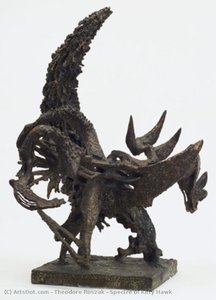
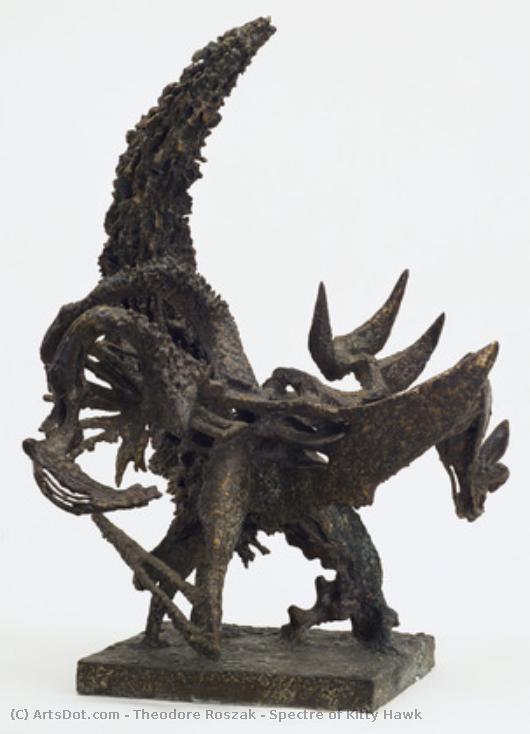
To stand before Theodore Roszak's Spectre of Kitty Hawk is not merely to observe metal; it is to encounter a captured moment of pure, exhilarating becoming. This bronze sculpture pulses with the memory of breakthrough—the very breath of human ambition given tangible form. It speaks directly to the dawn of an age, echoing the monumental achievement of flight while simultaneously transcending its literal depiction. The piece eschews narrative realism for something far more profound: an abstraction of aspiration itself. One feels the upward surge, the desperate, beautiful struggle against gravity, embodied in those complex, interconnected forms that seem to defy solid understanding.
A Symphony in Bronze and Movement
Roszak masterfully employs the inherent drama of bronze to articulate a form that is both fragmented and whole. The composition rejects easy geometry; instead, it flows with an organic, almost visceral energy. Look closely at how the limbs and wings extend—they are not merely attached but seem to erupt from a central core, suggesting a kinetic force barely contained. The surface itself tells a story of its making. It is rough, uneven, bearing the patina of time and the marks of intense craftsmanship. This texture is crucial; it prevents the piece from feeling polished or inert, instead lending it a palpable sense of history and ongoing motion. The interplay between the dark metallic tones and the diffused light suggests that this sculpture exists in perpetual twilight—the moment just before breakthrough.
Symbolism: The Weight of Progress
The subject matter, while ostensibly linked to the pioneering spirit of aviation at Kitty Hawk, operates on a deeply symbolic plane. It is less about the Wright brothers and more about the human condition when faced with the seemingly impossible. The fragmented nature of the figure invites contemplation on complexity—the myriad parts that must align for any great endeavor to succeed. There is an undeniable upward thrust, an almost desperate yearning toward the sky, which speaks volumes about innovation, progress, and the sheer audacity required to dream beyond our immediate physical constraints. It captures not just flight, but the very spirit of invention.
Acquisition for the Modern Sanctuary
For the discerning collector or designer seeking a piece that anchors a space with intellectual weight and dramatic flair, Spectre of Kitty Hawk offers unparalleled depth. Its Expressionistic style ensures it will command attention without shouting; its power is inherent, textural, and deeply resonant. Reproducing this work allows one to bring home not just an object, but a conversation starter—a meditation on human potential. Imagine this sculpture placed against a backdrop of muted tones, allowing the bronze's rich variations in brown and tan to catch the light, transforming any room into a gallery celebrating ambition.
Related Artworks


Artist Biography
Theodore Roszak: A Life in Sculpture and Paint
Theodore Roszak (May 1, 1907 – September 2, 1981) was a prominent Polish-American sculptor and painter whose career spanned much of the 20th century. His work reflects a dynamic evolution from the geometric rigor of Constructivism to the expressive power of abstract Expressionism.
Early Life and Education
Born in Posen, Prussia (now Poznań, Poland), Roszak was the son of Polish parents. He emigrated with his family to the United States at the age of two. This early experience of cultural transition likely informed his later artistic explorations. From 1925 to 1926, he studied at the School of the Art Institute of Chicago, laying the foundation for his formal training.
Artistic Development and Influences
Roszak’s artistic journey was marked by a constant search for new forms of expression. He won the prestigious Logan Medal of the Arts in 1930, which propelled him to New York City where he studied at the National Academy of Design under George Luks, and pursued studies in logic and philosophy at Columbia University. These philosophical inquiries would later subtly influence his artistic approach.
Initially, Roszak’s work was deeply rooted in Constructivism, characterized by its emphasis on geometric abstraction and industrial materials. However, around 1946, a significant shift occurred. His style became increasingly expressionistic, imbued with emotional intensity and a more organic sensibility. He was influenced by the prevailing artistic climate of post-war America, but maintained a unique voice.
Career and Major Achievements
- Works Progress Administration (WPA): During the Depression era, Roszak worked as an artist for the WPA, contributing to public art projects.
- Teaching Positions: He dedicated a significant portion of his life to education, teaching at the Art Institute of Chicago, Sarah Lawrence College throughout the 1940s and 50s, and Columbia University from 1970-1973.
- International Recognition: Roszak gained international acclaim through participation in major exhibitions such as Documenta II in Kassel (1959) and the Venice Biennale (1960).
- U.S. Commission of Fine Arts: He served on the U.S. Commission of Fine Arts from 1963 to 1969, demonstrating his commitment to public art and cultural policy.
Roszak also sculpted the iconic 35-foot gilded aluminum eagle that adorned the pediment of the former US Embassy in Grosvenor Square, London – a testament to his skill in large-scale sculptural work.
Themes and Style
Throughout his career, Roszak explored themes of industrialization, human emotion, and the relationship between form and space. His sculptures often evoke a sense of dynamism and tension, reflecting the anxieties and aspirations of the modern age. He was known for incorporating musical references into his artworks, stemming from his own accomplished violin playing.
Legacy and Historical Significance
Theodore Roszak’s work represents a crucial bridge between the early modernist movements and the emergence of abstract Expressionism. His ability to synthesize diverse influences and forge a unique artistic vision cemented his place as a significant figure in American sculpture. He was affiliated with several prestigious institutions, including the Skowhegan School of Painting and Sculpture, the National Institute of Arts and Letters, and the American Academy in Rome.
His contributions continue to inspire artists and scholars today, ensuring that his legacy endures as a testament to the power of artistic innovation and expression.
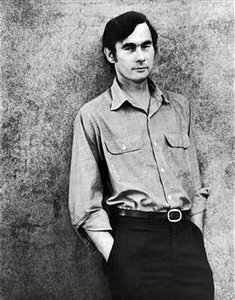
Theodore Roszak
1907 - 1981 , Poland
Quick Facts
- Birth Date: May 1, 1907
- Birth Place: Poznań, Poland
- Death Date: September 2, 1981
- Influenced By: George Luks
- Movement:
- Constructivism
- Expressionism
- Name: Theodore Roszak
- Nationality: Polish-American
- Notable Works:
- Bi-Polar in Red
- Spectre of Kitty Hawk
Related Articles

Bronze Age to Modern Masters: 10 Sculptures That Redefined Art | ArtsDot
Journey through art history with 10 legendary bronze sculptures – from Michelangelo's David to Rodin’s Thinker. Explore the stories, techniques & timeless beauty of these masterpieces. Find museum-quality reproductions & elevate your home decor on ArtsDot.com.

Bronze Sculptures That Defined Art History | ArtsDot
Journey through art history with our Top 10 bronze sculptures! Explore masterpieces by Rodin, Michelangelo & more. Discover stories behind iconic statues and find museum-quality reproductions for your home decor at ArtsDot.com.

The Enduring Legacy of Bronze: A Historical & Artistic Exploration for the Collector
Explore the rich history & enduring appeal of bronze sculpture with expert insights for collectors at ArtsDot. Learn about casting techniques, iconic artists, collecting tips & contemporary interpretations.
The Enduring Legacy of Bronze: History, Technique & Artistic Expression for the Collector
Explore the rich history & enduring appeal of bronze sculpture with expert insights for collectors at ArtsDot. Learn about casting techniques, iconic artists, and collecting tips.

The Enduring Legacy of Bronze Sculpture: A Collector's Guide to Form & Cultural Significance
Explore the rich history & enduring appeal of bronze sculpture with expert insights for collectors at ArtsDot. Learn about casting techniques, iconic artists, and collecting tips to build a discerning art collection.