 Preview
 Send
Send Share
Share
 Details

 Download
 Similars
 X-Ray
X-Ray Diaporama
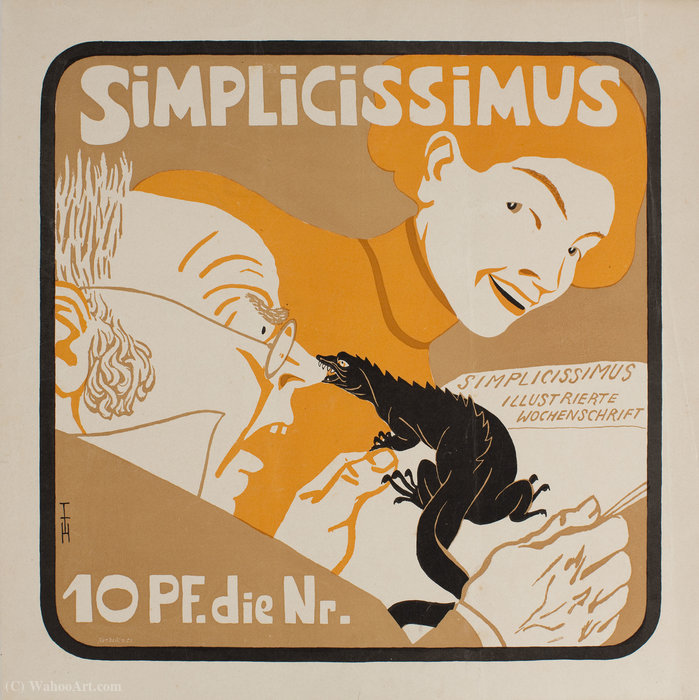
'Simplicissimus', (35 x 35 CM) (1901)
 Read More
Giclée / Art Print
Museum-quality giclée or canvas print with fast production and flexible finish options. ( Buy Hand Made Painting Buy Image)




































Pick from our preset sizes that match the artwork's original proportions.

You may enter your own dimensions to fit a specific frame or space. If your selected size does not match the original image's proportions, we will either crop the artwork or extend the image with a mirrored or solid-fill edge. A digital mockup will be sent for your approval before production begins.
Please note that the on-screen preview does not reflect the actual cropping or extension. Only the mockup will accurately show the final composition.
While custom sizes are available, we recommend selecting a dimension from the predefined list to preserve the original proportions.
Worldwide Delivery () in 2 weeks instead of standard 4/5 weeks. (17 August)

Free Worldwide Express Shipping

High-Quality Linen Canvas

Full Shipping Insurance

Customs Tax Refund Guarantee

True Color Matching Guarantee

60-Day Return Policy (Defects Only)

100% Money-Back Guarantee

Bulk Discount Offer
 Glass option is only available in size under 110 CM

'Simplicissimus', (35 x 35 CM) (1901)
Giclée / Art Print
Reproduction Size
-


Total Price
$ 63
Related Artworks
Artist Biography
Thomas Theodor Heine (1867–1948): The Poet of Disillusionment
Thomas Theodor Heine, born David Theodor Heine on February 28, 1867, in Leipzig, Germany, was a prolific painter, illustrator, and cartoonist whose career spanned from the late Victorian era to World War II. He is best remembered for his uncompromising artistic vision—characterized by biting satire and masterful draughtsmanship—which captured the anxieties and contradictions of early twentieth-century German society. Heine’s work stands as a testament to the power of art to confront uncomfortable truths and challenge prevailing ideologies, cementing his place as one of Germany's most significant visual artists of his time.Early Life and Artistic Training
Heine’s Jewish heritage profoundly shaped his worldview and fueled his intellectual curiosity. From a young age, he demonstrated exceptional talent for drawing and painting, honing his skills through self-study and informal instruction. Recognizing his potential, he enrolled at the Kunstakademie Düsseldorf in 1887, where he studied under Wilhelm Trübschenitsch and Karl Münter, absorbing influences from Impressionism and Symbolism. However, Heine’s ambition extended beyond Düsseldorf; he briefly attended the Academy of Fine Arts Munich in 1889–1890, seeking further artistic refinement alongside fellow artists like Edvard Munch and Gustav Klimt. This exposure to diverse artistic currents would prove crucial in shaping his distinctive style.The Simplicissimus Years: Stylistic Innovation and Political Critique
Heine’s breakthrough came with his involvement in *Simplicissimus*, a Munich satirical magazine founded in 1896. Immediately recognizing the magazine's potential for disseminating subversive ideas, Heine joined its editorial staff and swiftly established himself as its chief illustrator. He embraced the Jugendstil aesthetic—characterized by flowing lines, floral motifs, and stylized ornamentation—injecting it into *Simplicissimus*'s visual language. More importantly, Heine relentlessly scrutinized the social and political landscape of Wilhelmine Germany, exposing hypocrisy and celebrating rebellion with unflinching honesty. His iconic depiction of a menacing red bulldog with bared fangs and broken chain became synonymous with *Simplicissimus*'s defiant spirit—a symbol of its rejection of censorship and its embrace of artistic freedom.Illustrations Beyond Simplicissimus
Beyond *Simplicissimus*, Heine undertook numerous commissions as an illustrator for books, periodicals, and theatrical productions. He collaborated extensively with playwright Frank Wedekind, creating striking visual interpretations of his dramas that mirrored the magazine’s stylistic boldness. His posters for the Deutsche Künstlerbund and the Berlin Secession showcased his mastery of printmaking techniques—particularly lithography—demonstrating a meticulous attention to detail and conveying complex ideas through carefully crafted imagery. Recurring motifs included stylized figures representing artists, intellectuals, and revolutionaries, reflecting Heine's own convictions about the role of art in shaping social consciousness.Later Years and Exile
The rise of Nazism in Germany irrevocably altered Heine’s life trajectory. Facing persecution due to his Jewish ancestry, he fled the country in 1933, initially relocating to Prague before settling in Oslo and Stockholm during World War II. Despite the hardships endured under Nazi occupation, Heine continued to produce artwork—primarily watercolors—expressing his profound disillusionment with totalitarian ideology. His autobiographical novel *Ich warte auf Wunder* (I Wait for Miracles), published in 1942, offered a searing critique of Hitler’s regime and its impact on German culture and society. Heine died peacefully in Stockholm on January 26, 1948, leaving behind a legacy as one of Germany's most uncompromising voices—a poet of disillusionment who bravely confronted the darkness of his time with unwavering artistic integrity.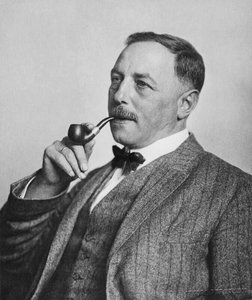
thomas theodor heine
1867 - 1948
Quick Facts
- Artistic Movement Or Style: Jugendstil
- Artists Or Movements Influenced By This Artist: ['German Expressionism']
- Artists Who Influenced This Artist:
- Henri de Toulouse-Lautrec
- Aubrey Beardsley
- Japanese woodcuts
- Date Of Birth: February 28, 1867
- Date Of Death: January 26, 1948
- Full Name: Thomas Theodor Heine
- Nationality: German
- Notable Artworks: ['Simplicissimus']
- Place Of Birth: Leipzig, Germany