 Preview
 Send
Send Share
Share
 Details

 Download
 Similars
 X-Ray
X-Ray Diaporama
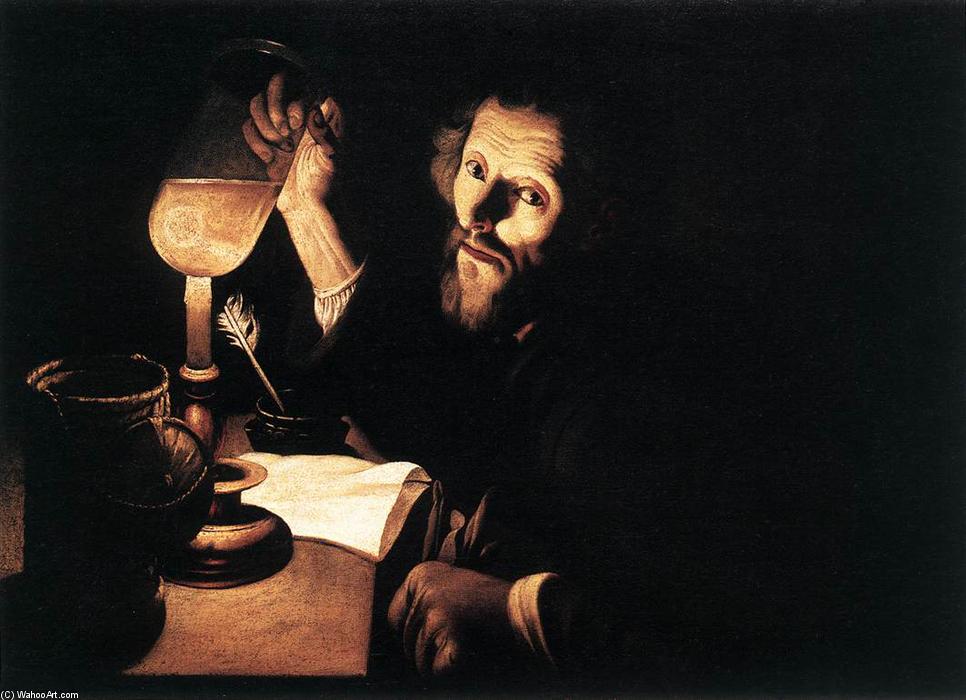
A Doctor Examining Urine
 Oil On Canvas
- WallArt
- Baroque
 Renaissance
 72.0 x 99.0 cm
 Ashmolean Museum
 Read More
Hand Made Oil Reproduction
Hand-painted oil on canvas in your size and frame, made to order by our artists. ( Buy Print Buy Image)




P118B $10

P118H $10

P118W $10

P438Z $10

P508JH $12

P508YH $12

P805H $10

P805Z $10

P919BZ $10

P919G $10

P919XJ $10

P959ZH $10

P968JZ $12

W106C $8

W218G $10

W218JH $8

W218Y $10

W307PJ $10

W316G $10

W316PJ $8

W316Y $10

W398PJ $8

W4111J $10

W500HY $15

W500JH $15

W692G $12

W849H $8

W940BG $15

W953PJ $8




Pick from our preset sizes that match the artwork's original proportions.

You may enter your own dimensions to fit a specific frame or space. If your selected size does not match the original image's proportions, we will either crop the artwork or extend the painting with additional hand-painted elements. A digital mockup will be sent for your approval before production begins.
Please note that the on-screen preview does not reflect the actual cropping or extension. Only the mockup will accurately show the final composition.
While custom sizes are available, we recommend selecting a dimension from the predefined list to preserve the original proportions.
After order, ArtsDot.com team will email client for instructions and provide a mockup preview
Worldwide Delivery () in 3/4 weeks instead of standard 5 weeks. (21 August). No compromise on quality.

Free Worldwide Express Shipping

High-Quality Linen Canvas

Full Shipping Insurance

Customs Tax Refund Guarantee

True Color Matching Guarantee

60-Day Return Policy (Defects Only)

100% Money-Back Guarantee

Bulk Discount Offer
 Glass option is only available in size under 110 CM

A Doctor Examining Urine
Reproduction Medium
Reproduction Size
-


Total Price
$ 263
Artwork Description
A Window into 17th-Century Medicine: "A Doctor Examining Urine" by Trophîme Bigot
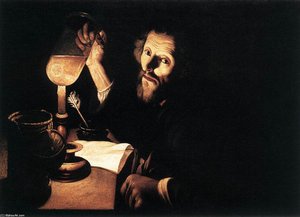
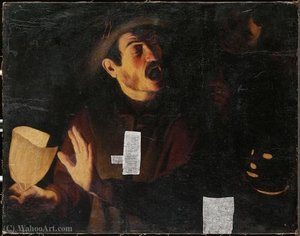
This arresting painting, “A Doctor Examining Urine,” offers a rare and unsettling glimpse into the practices of medicine during the 17th century. Executed by Trophîme Bigot, a contemporary of the renowned El Greco, this work transcends mere documentation; it’s a potent meditation on observation, diagnosis, and the very nature of human vulnerability. The scene depicts a solitary physician, lost in intense concentration, meticulously examining a glass container holding urine – a commonplace yet profoundly significant act within the medical understanding of the time.
- Historical Context: Bigot’s painting speaks to a period when medical knowledge was largely based on observation and humoral theory. Urine analysis was a crucial diagnostic tool, believed to reveal imbalances in the body's vital fluids – blood, phlegm, yellow bile, and black bile – that caused illness.
- The Artist: Trophîme Bigot (1579-1650), born in Arles, France, was a skilled painter working within the traditions of his time. While less celebrated than El Greco, his work reveals a similar dedication to realism and dramatic lighting, hallmarks of the era’s artistic sensibilities.
Composition and Technique: A Masterclass in Chiaroscuro
The composition is strikingly direct, centered around the physician's figure – a deliberate choice that emphasizes the gravity of his task. Bigot employs a masterful use of chiaroscuro, dramatically contrasting areas of intense light with deep shadows. This technique, perfected by artists like Caravaggio, not only illuminates the key elements—the doctor’s face, the glistening urine, and the delicate glassware—but also creates a palpable sense of isolation and focus. The triangular composition, anchored by the table and its contents, provides stability while simultaneously directing the viewer's gaze.
- Oil on Canvas: Executed in oil on canvas, the painting demonstrates Bigot’s technical skill with meticulous detail. The artist skillfully renders textures – the rough fabric of the doctor’s robe, the smooth surface of the glass, and the worn texture of the table – adding a remarkable level of realism to the scene.
- Perspective & Depth: While employing a somewhat shallow perspective, Bigot cleverly utilizes light and shadow to create an illusion of three-dimensionality, drawing the viewer into the intimate space of the examination.
Symbolism and Emotional Resonance
Beyond its technical brilliance, “A Doctor Examining Urine” is rich in symbolism. The act of analyzing urine represents a fundamental attempt to understand and control the human body – a struggle that continues to this day. The doctor’s intense expression conveys dedication and perhaps even a touch of anxiety, reflecting the precariousness of life and the uncertainty inherent in medical practice. The dark, indistinct background further amplifies the sense of solitude and contemplation, inviting viewers to consider the profound responsibility borne by those who sought to heal.
- Diagnostic Ritual: The urine sample itself symbolizes diagnosis and treatment during this era – a direct engagement with the body's vital signs.
- Human Vulnerability: The scene subtly underscores human vulnerability, reminding us of our dependence on skilled practitioners for health and well-being.
Dimensions & Reproduction – Bringing History Home
This original painting measures 72 x 99 cm and dates from the unknown period of Trophîme Bigot’s career. ArtsDot offers a meticulously crafted hand-painted reproduction of this compelling artwork, allowing you to bring its historical significance and artistic power into your own space. Perfect for collectors, art enthusiasts, or those seeking a unique statement piece, our reproductions capture the essence of Bigot's vision with exceptional fidelity.
Related Artworks
Artist Biography
The Master of Shadows: The Life and Legacy of Trophîme Bigot
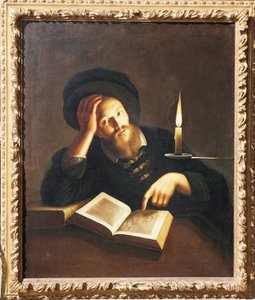
In the flickering, amber-hued depths of the seventeenth century, few artists possessed the ability to command the darkness as masterfully as Trophîme Bigot. Born in Arles, France, around 1579, Bigot emerged as a pivotal figure within the Baroque movement, carving out a niche that would earn him the evocative title of a "Candlelight Master." His life and work represent a profound intersection of French sensibility and the dramatic, theatrical innovations flowing from Italy. To gaze upon a Bigot canvas is to enter a world where light does not merely illuminate, but rather struggles against an encroaching, velvety gloom, creating a sense of intimacy and spiritual weight that remains unparalleled.
The trajectory of Bigot’s career was shaped by his movement between the cultural hubs of Rome and Provence. This dual existence allowed him to absorb the grand, sweeping traditions of the Italian Baroque while maintaining a connection to the more somber, contemplative atmosphere of his French roots. It was in this crucible of influences that he refined his signature technique: chiaroscuro. By utilizing a single, often unseen light source—such as a guttering candle or a hidden flame—he could sculpt figures out of the void, lending them a tactile, three-dimensional presence. This mastery of light and shadow allowed him to transform simple religious subjects into profound psychological studies, where every crease in a robe or furrow in a brow tells a story of devotion or internal struggle.
A Vision of Devotion and Drama
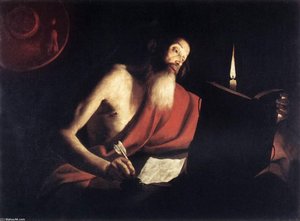
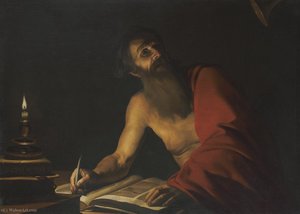
Bigot’s oeuvre is characterized by an extraordinary ability to evoke the sacred through the mundane. His religious altarpieces are not merely depictions of saints, but immersive experiences of faith. In works such as his St. Jerome, one can witness the intense scholarly focus and spiritual fervor of the hermit, rendered with a meticulous attention to detail that brings the textures of parchment and stone to life. The dramatic contrast between the brilliant highlights on the saint's skin and the impenetrable shadows surrounding him serves to isolate the subject in a moment of eternal contemplation, pulling the viewer into his private sanctuary of prayer.
Beyond his religious commissions, Bigot’s contribution to the development of the Baroque style lies in his ability to manipulate atmosphere. His compositions often rely on a sense of quiet tension, where the stillness of the scene is charged with an unseen energy. This approach heavily influenced later masters of the genre, most notably Georges de La Tour, who would further refine the "candlelight" aesthetic. The historical significance of Bigot’s work resides in this bridge he built between the late Mannerist traditions and the high drama of the Baroque, proving that the most profound truths are often found in the softest glow amidst the deepest dark.
The enduring fascination with Trophîme Bigot continues through his remarkable ability to capture the ephemeral. His legacy is defined by:
- Technical Mastery: The sophisticated use of chiaroscuro to create depth and emotional resonance.
- Spiritual Intimacy: A unique talent for rendering religious figures with a human, relatable vulnerability.
- Atmospheric Innovation: The creation of "candlelight" scenes that redefined the boundaries of light and shadow in European art.
- Cultural Synthesis: The seamless blending of Italian dramatic flair with French stylistic restraint.
trophîme bigot
1579 - 1650 , France
Quick Facts
- Artistic Movement Or Style: Mannerism, Expressionism
- Artists Or Movements Influenced By This Artist:
- Picasso
- Cézanne
- Artists Who Influenced This Artist:
- Titian
- Michelangelo
- Date Of Birth: October 1, 1541
- Date Of Death: April 7, 1614
- Full Name: Domenikos Theotokopoulos
- Nationality: Greek, Spanish, Italian
- Notable Artworks:
- The Disrobing of Christ
- Assumption of Virgin
- Burial Count Orgaz
- View of Toledo
- Place Of Birth: Candia (Crete)
Related Articles

El Greco's Masterpieces: Explore 25 Iconic Paintings & Spiritual Visions | ArtsDot
Journey through El Greco's 25 most iconic paintings! Explore the spiritual depth & dramatic beauty of this Spanish Renaissance master. Discover art history, techniques & find museum-quality reproductions for your home at ArtsDot.com.
El Greco: Spirituality, Style & Innovation – A Renaissance Master's Legacy
Explore the captivating world of El Greco! Discover his unique style, spiritual intensity, and lasting impact on art history. Learn about this Renaissance master's life, iconic paintings & legacy.

The Enduring Legacy of Oil on Canvas: Technique, History & Aesthetic Impact
Explore the rich history & techniques of oil painting – from Renaissance masters to Impressionism. Discover pigments, layering methods, and why this timeless medium endures. Expert insights for artists & art enthusiasts.

Oil on Canvas: A Historical & Technical Exploration of a Timeless Artistic Medium
Explore the rich history & enduring techniques of oil painting on canvas. Discover the science behind its longevity, conservation practices, and contemporary relevance. Expert insights for art enthusiasts.

The Enduring Power of Painting: A Historical & Contemporary Exploration of Form and Emotion
Explore the rich history & enduring techniques of oil painting with ArtsDot. Discover masterpieces, learn about art collecting, and find authentic handmade reproductions crafted by skilled artists.