 Preview
 Send
Send Share
Share
 Details

 Download
 Similars
 X-Ray
X-Ray Diaporama
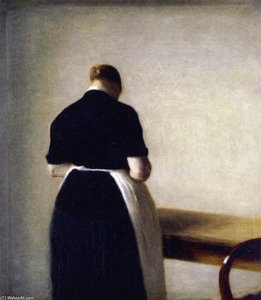
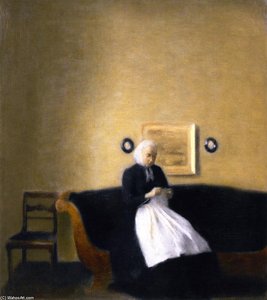
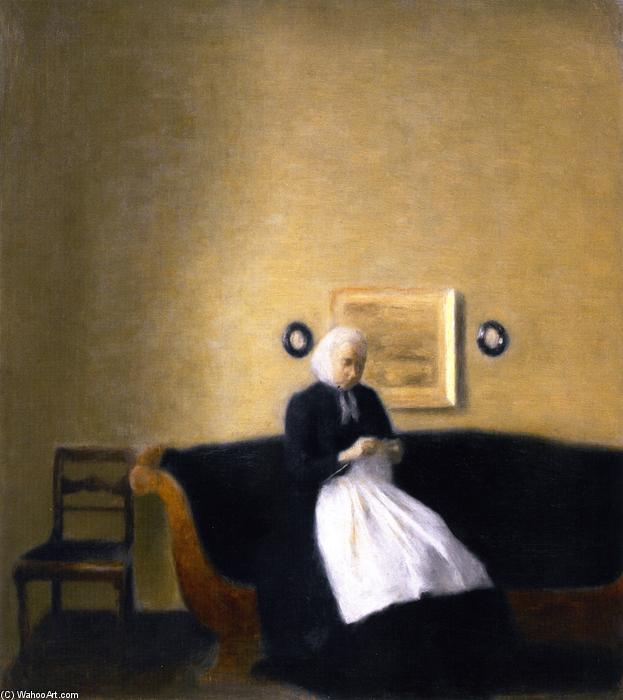
Interior with the Artist's Mother and Sister
 Symbolism
 1889
1889 55.0 x 51.0 cm
 Nationalmuseum
 Read More
Hand Made Oil Reproduction
Hand-painted oil on canvas in your size and frame, made to order by our artists. ( Buy Print Buy Image)




P118B $10

P118H $10

P118W $10

P438Z $10

P508JH $12

P508YH $12

P805H $10

P805Z $10

P919BZ $10

P919G $10

P919XJ $10

P959ZH $10

P968JZ $12

W106C $8

W218G $10

W218JH $8

W218Y $10

W307PJ $10

W316G $10

W316PJ $8

W316Y $10

W398PJ $8

W4111J $10

W500HY $15

W500JH $15

W692G $12

W849H $8

W940BG $15

W953PJ $8




Pick from our preset sizes that match the artwork's original proportions.

You may enter your own dimensions to fit a specific frame or space. If your selected size does not match the original image's proportions, we will either crop the artwork or extend the painting with additional hand-painted elements. A digital mockup will be sent for your approval before production begins.
Please note that the on-screen preview does not reflect the actual cropping or extension. Only the mockup will accurately show the final composition.
While custom sizes are available, we recommend selecting a dimension from the predefined list to preserve the original proportions.
After order, ArtsDot.com team will email client for instructions and provide a mockup preview
Worldwide Delivery () in 3/4 weeks instead of standard 5 weeks. (16 August). No compromise on quality.

Free Worldwide Express Shipping

High-Quality Linen Canvas

Full Shipping Insurance

Customs Tax Refund Guarantee

True Color Matching Guarantee

60-Day Return Policy (Defects Only)

100% Money-Back Guarantee

Bulk Discount Offer
 Glass option is only available in size under 110 CM

Interior with the Artist's Mother and Sister
Reproduction Medium
Reproduction Size
-


Total Price
$ 263
Artwork Description
A Quiet Moment: Exploring Vilhelm Hammershøi’s “Interior with the Artist's Mother and Sister”
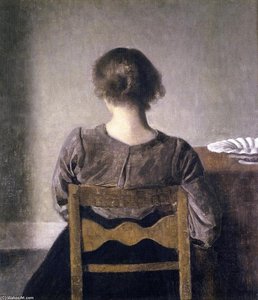
Vilhelm Hammershøi’s 1889 oil on canvas, *Interior with the Artist's Mother and Sister*, is a captivating study in domesticity and understated emotion. Measuring just 55 x 51 cm, this intimate scene, now housed at the Nationalmuseum in Stockholm, draws viewers into a world of quiet contemplation. The painting depicts two women – presumably Hammershøi’s mother and sister – within the confines of a sparsely furnished room. It's not a narrative scene brimming with action, but rather an evocative portrayal of stillness and the subtle poetry of everyday life. The composition is deliberately restrained; the figures are positioned centrally, their forms echoed by the architectural elements surrounding them. This creates a sense of balance and harmony, reinforcing the overall mood of serenity.The Master of Muted Tones: Style & Technique
Hammershøi was a pivotal figure in Danish painting, known for his distinctive style that bridges Realism and Symbolism. He rejected the vibrant colors favored by many of his contemporaries, instead opting for a *remarkably restrained palette* dominated by greys, browns, and muted blues. This deliberate choice isn’t about a lack of skill, but rather a conscious artistic decision to emphasize atmosphere and emotional resonance over superficial detail. His technique is characterized by smooth brushwork and careful attention to light and shadow. The soft, diffused lighting in *Interior with the Artist's Mother and Sister* doesn’t illuminate so much as reveal – gently modeling the forms of the figures and objects within the room. This creates a sense of depth and volume while simultaneously contributing to the painting’s overall feeling of quiet intimacy. Hammershøi masterfully uses perspective, not to create dramatic spatial illusions, but to subtly guide the viewer's eye through the composition.Beyond the Surface: Symbolism & Emotional Impact
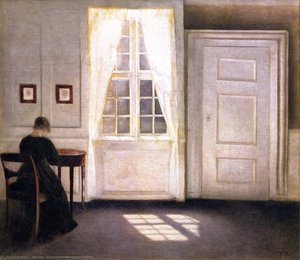
While seemingly simple, *Interior with the Artist’s Mother and Sister* is rich in symbolic potential. The woman seated on the couch, holding a handkerchief, invites speculation about her emotional state – perhaps a quiet sadness, or simply a moment of private reflection. The sparsely furnished room itself can be interpreted as representing a sense of isolation or introspection. Hammershøi's interiors are often described as being devoid of narrative, yet they powerfully evoke a mood of melancholy and longing. The painting isn’t about *what* is happening, but rather *how* it feels to be present in that moment. This emotional ambiguity is key to the work’s enduring appeal. It allows viewers to project their own experiences and feelings onto the scene, creating a deeply personal connection with the artwork. The repetition of rectangular forms – windows, doors, furniture – contributes to a sense of order and control, perhaps reflecting the artist's attempt to impose structure on an otherwise chaotic world.A Legacy of Quietude: Hammershøi’s Place in Art History
Vilhelm Hammershøi stands apart from many of his contemporaries for his unwavering commitment to a unique artistic vision. He wasn’t concerned with depicting grand historical events or dramatic narratives; instead, he found beauty and meaning in the mundane details of everyday life. His work foreshadows the minimalist tendencies of later movements, such as Abstract Expressionism, and has influenced generations of artists seeking to explore the emotional power of restraint. “Interior with the Artist’s Mother and Sister” is a prime example of his mastery – a painting that invites us to slow down, observe, and appreciate the quiet beauty that surrounds us. As a handmade oil painting reproduction, this piece offers an opportunity to bring a touch of Hammershøi's serene world into your own home, fostering contemplation and adding a sophisticated elegance to any interior space.Related Artworks
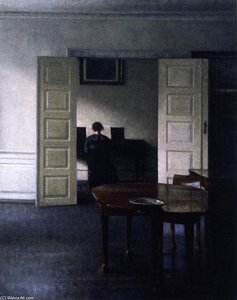
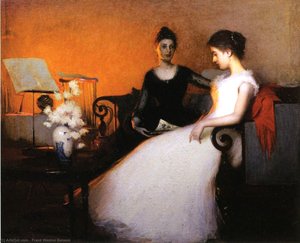
Artist Biography
The Enigmatic Stillness of Vilhelm Hammershøi
To stand before a painting by Vilhelm Hammershøi is to step across a threshold into a realm suspended between memory and dream. His work possesses an almost palpable silence, a quietude that seems to absorb the noise of the modern world. Born in Copenhagen in 1864, this Danish master developed a visual language so distinct, so profoundly atmospheric, that it continues to captivate collectors and critics alike today. Hammershøi’s canvases are not merely depictions of rooms or figures; they are meditations on absence, light, and the delicate passage of time.
His early life was rooted in the cultural milieu of late 19th-century Copenhagen, a period ripe with artistic ferment. While he navigated the currents of academic art, his true calling lay in capturing moments of profound introspection. His dedication to interior spaces became legendary, transforming domestic settings into grand stages for psychological drama. The muted tones—the soft grays, the pale creams, the whisper of dusty ochre—are hallmarks that define his unique visual signature.
Mastery of Light and Atmosphere
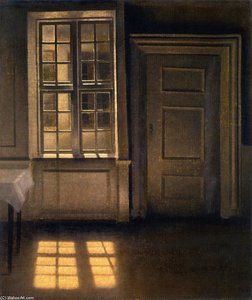
The technical brilliance underpinning Hammershøi’s seemingly simple scenes is nothing short of masterful. He possessed an unparalleled ability to render light not as a mere illumination, but as a tangible, atmospheric element itself. In his depictions of empty hallways or sparsely furnished drawing rooms, the quality of the light seems to emanate from within the paint, suggesting unseen sources and untold narratives. This preoccupation with atmosphere elevated his work beyond simple genre painting; it became an exploration of mood.
His compositions often feature receding perspectives, drawing the viewer deep into the painted space, only to have that depth ultimately dissolve into a soft, ambiguous haze. Whether portraying solitary figures—often veiled or seen from the back—or simply empty architectural volumes, the sense of enclosure and quiet contemplation is overwhelming. It is in this careful management of negative space that his genius resides; the emptiness itself becomes the most eloquent subject.
Symbolism and the Inner Landscape
Hammershøi’s art has always been deeply intertwined with Symbolist currents, even if he never strictly adhered to the movement's dogma. His paintings invite viewers into a space of ambiguity. The figures, when present, often seem detached from their surroundings or lost in thought, suggesting an internal life far richer than what the canvas portrays. There is a pervasive sense of melancholy beauty—a sublime yearning that speaks to universal human experiences: solitude, memory, and the passage of time.
Some scholars have interpreted his work as a visual diary of his own emotional landscape, a retreat into the controlled environment of art when the external world proved too loud or complex. The repetition of motifs—the curtain, the empty chair, the distant window view—lends his oeuvre a ritualistic quality, suggesting that these quiet moments were necessary anchors against the flux of existence.
Legacy and Enduring Influence
Though he passed away relatively young in 1916, Vilhelm Hammershøi’s influence proved remarkably enduring. His commitment to understatement and tonal subtlety provided a crucial counterpoint to the bolder palettes emerging from other contemporary movements. His work resonated deeply with modern sensibilities that valued introspection over overt narrative.
Today, his paintings are sought after for their ability to transform any space they inhabit. They do not shout; they whisper profound truths about beauty found in restraint. To appreciate Hammershøi is to accept the poetry of the unsaid, to find grandeur in the muted tones, and to allow oneself to become momentarily lost within the exquisite, enveloping silence of his painted worlds.
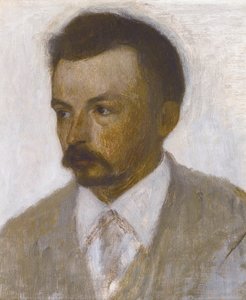
vilhelm (hammershøi)hammershoi
1864 - 1916 , Denmark
Quick Facts
- Artistic Movement Or Style: Symbolism art
- Date Of Birth: 1864
- Date Of Death: 1916
- Full Name: Vilhelm Hammershøi
- Nationality: Danish
- Place Of Birth: Copenhagen, Denmark
Related Articles
Vilhelm Hammershøi: Exploring Interiority, Light & Absence – A Danish Master for the Elite Collector
Discover the captivating world of Vilhelm Hammershøi with ArtsDot. Explore his serene interiors, masterful use of light & symbolism. Expert insights for discerning collectors and art enthusiasts.
Modigliani's Masterpieces: 25 Iconic Paintings & Sculptures | ArtsDot
Explore 25 iconic artworks by Amedeo Modigliani, from his haunting portraits to captivating sculptures. Discover the stories behind these masterpieces of early 20th-century art & find museum-quality reproductions at ArtsDot.com.
The Subdued Resonance: Exploring Emotional Depth & Artistic Nuance within Muted Color Palettes
Explore the captivating world of muted colors in art & design! Discover historical context, psychological effects, techniques, and inspiration for creating serene spaces. Elevate your aesthetic with ArtsDot.
Edward Hopper's Masterpieces: 25 Iconic Paintings & Their Enduring Legacy | ArtsDot
Explore 25 iconic Edward Hopper paintings & their stories. Discover American realism, urban loneliness, and timeless beauty through his masterpieces. Find museum-quality art reproductions & curated decor ideas at ArtsDot.com.

Sir Alfred Munnings' Masterpieces: 25 Paintings That Define Equine Art | ArtsDot
Explore 25 iconic Sir Alfred Munnings paintings! Discover the beauty of British Impressionism, equine art & rural England. Find museum-quality reproductions and elevate your home decor with ArtsDot. Explore the full collection online.