 Preview
 Send
Send Share
Share
 Details

 Download
 Similars
 X-Ray
X-Ray Diaporama
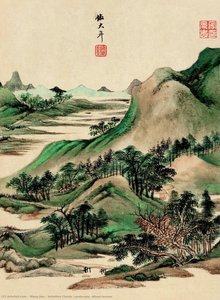
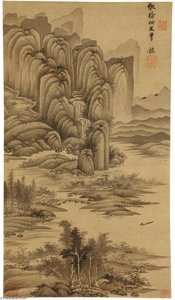
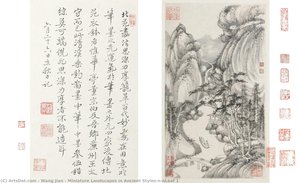
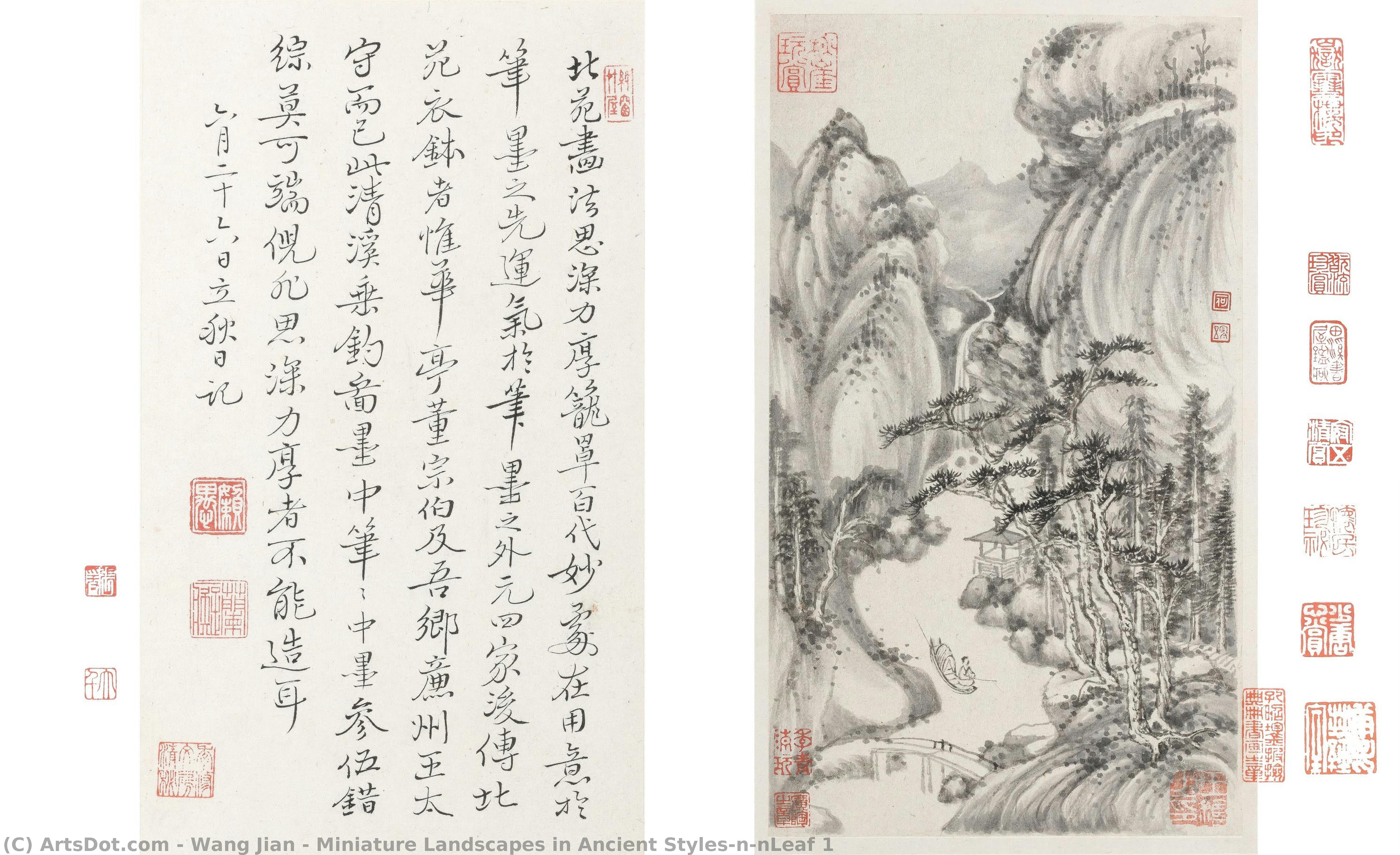
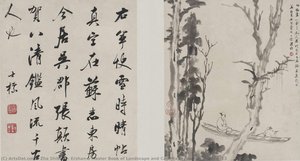
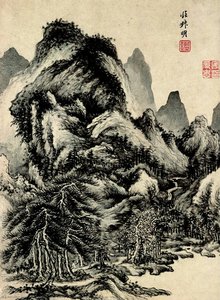
Miniature Landscapes in Ancient Styles\n\nLeaf 1
 Orthodox School of Painting
 1652
1652 20.0 x 11.0 cm
 Read More
Hand Made Oil Reproduction
Hand-painted oil on canvas in your size and frame, made to order by our artists. ( Buy Print Buy Image)




P118B $10

P118H $10

P118W $10

P438Z $10

P508JH $12

P508YH $12

P805H $10

P805Z $10

P919BZ $10

P919G $10

P919XJ $10

P959ZH $10

P968JZ $12

W106C $8

W218G $10

W218JH $8

W218Y $10

W307PJ $10

W316G $10

W316PJ $8

W316Y $10

W398PJ $8

W4111J $10

W500HY $15

W500JH $15

W692G $12

W849H $8

W940BG $15

W953PJ $8




Pick from our preset sizes that match the artwork's original proportions.

You may enter your own dimensions to fit a specific frame or space. If your selected size does not match the original image's proportions, we will either crop the artwork or extend the painting with additional hand-painted elements. A digital mockup will be sent for your approval before production begins.
Please note that the on-screen preview does not reflect the actual cropping or extension. Only the mockup will accurately show the final composition.
While custom sizes are available, we recommend selecting a dimension from the predefined list to preserve the original proportions.
After order, ArtsDot.com team will email client for instructions and provide a mockup preview
Worldwide Delivery () in 3/4 weeks instead of standard 5 weeks. (21 August). No compromise on quality.

Free Worldwide Express Shipping

High-Quality Linen Canvas

Full Shipping Insurance

Customs Tax Refund Guarantee

True Color Matching Guarantee

60-Day Return Policy (Defects Only)

100% Money-Back Guarantee

Bulk Discount Offer
 Glass option is only available in size under 110 CM

Miniature Landscapes in Ancient Styles\n\nLeaf 1
Reproduction Medium
Reproduction Size
-


Total Price
$ 263
Artwork Description
Related Artworks

Artist Biography
The Quiet Resonance of a Master
Born in the fertile cultural landscape of Taicang, Jiangsu, around 1598, Wang Jian emerged as a profound voice during one of China's most transformative eras. As the great-grandson of the illustrious Ming literary figure Wang Shizhen, he was steeped in a tradition of scholarly excellence from birth. His life, spanning the twilight of the Ming and the dawn of the Qing dynasty, was marked by a deliberate retreat from the political turbulence of his time. After serving briefly as the Prefers of Lianzhou, Wang Jian chose to abstain from the Manchu-led court, turning instead toward the eternal, silent realms of Shanshui painting. This period of contemplative seclusion allowed him to cultivate a spirit that would eventually define the Orthodox School of painting, earning him a place among the legendary Four Wangs and the Six Masters of the early Qing period.Through his various pseudonyms, including Xuanzhao and Xiangbi, he projected an identity rooted in the scholarly pursuit of nature's essence. His work was never merely about the depiction of scenery; it was a spiritual endeavor to capture the very breath of the earth.
A Tapestry of Ancient Lineages
Wang Jian’s artistic journey was not a solitary pursuit but a deep, reverent dialogue with the ghosts of the past. Under the masterful guidance of the influential painter-theorist Dong Qichang, Wang honed a technique that sought to preserve the very essence of ancient brushwork. He did not merely copy; he reinterpreted the masters through a lens of profound respect, ensuring that the distinctive characteristics of their ink and brush were preserved even as they were infused with his own interpretative spirit.His stylistic DNA was woven from the most celebrated traditions of the Song and Yuan dynasties, creating a bridge between eras. This commitment to lineage is evident in how he engaged with several key influences:
- The soft, flowing streams and ethereal mists characteristic of Dong Yuan.
- The rugged, tactile textures and "raindrop" strokes reminiscent of Fan Kuan.
- The structural integrity and monumental presence found in the works of Jing Hao and Guan Tong.
The Alchemy of Ink and Atmosphere
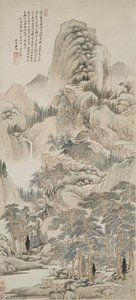
To gaze upon a Wang Jian landscape is to enter a world of profound serenity and controlled emotion. Eschewing the flamboyant ornamentation that occasionally characterized his contemporaries, Wang championed a philosophy of simplicity and restraint. His palette was a masterclass in subtlety, favoring muted hues and delicate gradations of ink wash that could evoke the dampness of a mountain mist or the solid weight of a granite cliff.In masterpieces such as "Mountain Scenery with Streams and Pavilions" (1667), one can witness his technical brilliance. He utilized layered washes to create a palpable sense of depth, where light seems to filter through layers of atmosphere rather than strike surfaces directly. This technique does more than depict scenery; it creates a space for Confucian contemplation, inviting the viewer to find harmony within the natural order. Every stroke, from the finest texture to the broadest wash, serves the ultimate goal of capturing the qi—the vital life force—of the landscape.
An Enduring Legacy of the Orthodox School
The historical significance of Wang Jian lies in his role as a guardian of tradition during a period of immense cultural shift. By anchoring his practice in the classical styles of the Song and Yuan dynasties, he provided a sense of continuity and stability for Chinese art amidst the transition from Ming to Qing rule. His prolific output, ranging from large-scale compositions to intimate, meticulously rendered albums, ensured that the Orthodox School would remain a dominant force in the aesthetic consciousness of the era.His legacy remains etched in the mountains and streams he so lovingly rendered. Through his dedication to the mastery of ancient styles, Wang Jian did not just paint the landscape; he preserved the soul of a civilization within the enduring beauty of ink and paper.
Wang Jian
1598 - 1677 , China
Quick Facts
- Artistic Movement Or Style: Dong Yuan Style
- Artists Or Movements Influenced By This Artist: ['Four Wangs']
- Artists Who Influenced This Artist: ['Dong Yuan']
- Date Of Birth: 1598
- Date Of Death: 1677
- Full Name: Wang Jian
- Nationality: Chinese
- Notable Artworks:
- Landscapes Painted for Wang Kui
- Miniature Landscapes in Ancient Styles\n\nLeaf 1
- Mountain Scenery with Streams and Pavilions in the Style of Fan Kuan
- Place Of Birth: Taicang, China
Related Articles

Beyond the Horizon: 10 Landscape Masterpieces for Your Home Decor
Journey through 10 breathtaking landscape paintings by Monet, Van Gogh & more! Explore iconic artworks, artistic techniques & find inspiration for your home decor. Museum-quality reproductions at ArtsDot.com. Discover all masterpieces on ArtsDot.com

Hokusai's Masterpieces: 25 Iconic Prints & Paintings for Art Lovers | ArtsDot
Journey through Katsushika Hokusai’s 25 most iconic artworks, including *The Great Wave*. Explore the ukiyo-e master's history, style & timeless Japanese woodblock prints. Find museum-quality reproductions for your home at ArtsDot.com.

Romantic Landscapes: 10 Masterpieces for Your Home | ArtsDot
Journey through 10 Romantic landscape masterpieces by Friedrich, Turner & Cole. Explore emotional art, sublime nature scenes & iconic 19th-century paintings. Find museum-quality reproductions for your home at ArtsDot.com – discover the full collection online!

Evocations of Place: A Historical Journey Through Landscape Art
Explore the rich history of landscape art with ArtsDot. Discover renowned artists, movements like Impressionism & Romanticism, and expert guidance for collecting timeless pieces. Find your perfect serene escape today!

John Constable's Masterpieces: Explore 25 Iconic Landscapes for Your Home
Journey through John Constable's 25 most celebrated landscapes. Explore Romanticism, Dedham Vale & his masterful use of light in iconic paintings like 'Hay Wain'. Find museum-quality art reproductions and elevate your home decor on ArtsDot.com.