 Preview
 Send
Send Share
Share
 Details

 Download
 Similars
 X-Ray
X-Ray Diaporama
The Race to Market

 Read More
Hand Made Oil Reproduction
Hand-painted oil on canvas in your size and frame, made to order by our artists. ( Buy Print Buy Image)




P118B $10

P118H $10

P118W $10

P438Z $10

P508JH $12

P508YH $12

P805H $10

P805Z $10

P919BZ $10

P919G $10

P919XJ $10

P959ZH $10

P968JZ $12

W106C $8

W218G $10

W218JH $8

W218Y $10

W307PJ $10

W316G $10

W316PJ $8

W316Y $10

W398PJ $8

W4111J $10

W500HY $15

W500JH $15

W692G $12

W849H $8

W940BG $15

W953PJ $8




Pick from our preset sizes that match the artwork's original proportions.

You may enter your own dimensions to fit a specific frame or space. If your selected size does not match the original image's proportions, we will either crop the artwork or extend the painting with additional hand-painted elements. A digital mockup will be sent for your approval before production begins.
Please note that the on-screen preview does not reflect the actual cropping or extension. Only the mockup will accurately show the final composition.
While custom sizes are available, we recommend selecting a dimension from the predefined list to preserve the original proportions.
After order, ArtsDot.com team will email client for instructions and provide a mockup preview
Worldwide Delivery () in 3/4 weeks instead of standard 5 weeks. (31 August). No compromise on quality.

Free Worldwide Express Shipping

High-Quality Linen Canvas

Full Shipping Insurance

Customs Tax Refund Guarantee

True Color Matching Guarantee

60-Day Return Policy (Defects Only)

100% Money-Back Guarantee

Bulk Discount Offer
 Glass option is only available in size under 110 CM

The Race to Market
Reproduction Medium
Reproduction Size
-


Total Price
$ 288
A Journey West: Unpacking Willem Carel Nakken’s “The Race to Market”
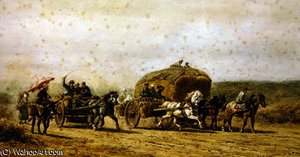
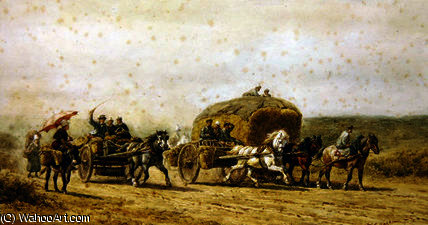
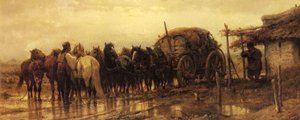
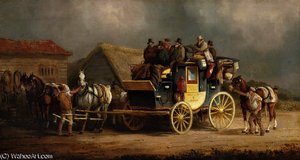
- Subject & Narrative: “The Race to Market” transports us to 19th-century America, though painted through the eyes of a Dutch artist. The scene depicts a wagon train – a lifeline for pioneers and settlers – making its way across a vast, dusty landscape. It’s not merely a depiction *of* travel; it's a visual story about the relentless push westward, the economic necessity driving expansion, and the daily rhythm of life on the frontier. A heavily laden hay wagon takes center stage, suggesting the importance of provisions for both livestock and communities. The procession of horses and riders emphasizes the collective effort required to overcome the challenges of this arduous journey.
- Style & Technique: Nakken masterfully blends realism with a touch of romanticism. While grounded in accurate detail – from the texture of the wagon’s wood to the musculature of the horses – there's an undeniable drama infused into the scene through lighting and composition. The visible brushstrokes are key; they aren’t hidden but celebrated, creating a rich, tactile surface that speaks to the ruggedness of the environment and the wear-and-tear on both people and equipment. The oil paint allows for nuanced color blending and layering, contributing to the painting's depth and atmospheric quality.
Dutch Eyes on the American Frontier: Historical Context & Artistic Influence
- An Outsider’s Perspective: Willem Carel Nakken was a Dutch artist, born and trained in The Hague. His choice to depict an American subject is intriguing. It reflects a broader European fascination with the American West during this period – a land perceived as both wild and full of opportunity. Nakken brings a distinctly *European* sensibility to the genre, perhaps focusing more on the human element and the everyday struggles than some of his American contemporaries might have.
- Genre Painting & Dutch Tradition: Nakken’s work aligns with the tradition of Dutch genre painting – scenes from daily life. While often focused on domestic interiors or town squares in the Netherlands, Nakken adapts this approach to a new setting. This connection to his artistic roots is evident in the careful observation of detail and the emphasis on portraying authentic moments.
Symbolism & Emotional Resonance
- Perseverance & Resilience: The painting isn’t simply a record of travel; it's imbued with symbolism. The wagon train itself represents perseverance, the relentless forward motion despite hardship. The vastness of the landscape emphasizes the challenges faced by these pioneers, while their continued progress speaks to their resilience and determination.
- A Muted Palette & Evocative Mood: Nakken’s color palette – dominated by earthy browns, ochres, and grays – reinforces this sense of struggle and endurance. The subtle touches of red and yellow in clothing and wagon details provide visual interest without disrupting the overall somber mood. The painting evokes a feeling of arduous travel, but also a quiet dignity and unwavering spirit.
Bringing “The Race to Market” into Your Space
- For Collectors: This piece offers a unique perspective on a pivotal moment in American history, viewed through the lens of a skilled European artist. Its blend of realism and romanticism makes it a compelling addition to any collection focused on 19th-century painting or Western art.
- For Interior Designers: The muted color palette and historical subject matter lend themselves well to a variety of interior styles, from rustic farmhouse to traditional study. A high-quality reproduction would serve as a striking focal point in a living room, dining room, or office, adding depth and character to the space.
Related Artworks

Artist Biography
A Life Immersed in Dutch Countryside: The World of Willem Carel Nakken
Willem Carel Nakken, born in the charming city of The Hague, Netherlands, in 1835 and passing away in Rijswijk in 1926, was a painter deeply connected to the heart of his nation’s artistic traditions. While not a household name like some of the Dutch Masters who preceded him, Nakken carved out a significant niche for himself as a chronicler of everyday life, particularly within the rural landscapes and bustling market scenes that defined 19th-century Netherlands. His work offers a captivating glimpse into a world undergoing subtle but profound changes—a time when traditional agrarian society was beginning to feel the stirrings of modernity. Nakken’s paintings aren't grand historical statements; instead, they are intimate portraits of labor, community, and the simple beauty found in the rhythms of daily existence.Early Life and Artistic Formation
Details surrounding Nakken’s formal artistic training remain somewhat scarce, a common occurrence for artists working outside the immediate orbit of major academies. However, his style clearly demonstrates an understanding of the Dutch Realist tradition, heavily influenced by painters like the Barbizon school and their commitment to *plein air* painting—working directly from nature. It is known that he undertook two journeys to Normandy in France alongside fellow artist Wouter Verschuur Jr., a period which undoubtedly shaped his observational skills and palette. These travels exposed him to different light conditions and rural scenes, enriching his artistic vocabulary. Nakken’s early works already reveal a keen eye for detail and an ability to capture the atmosphere of a place—the quality of light filtering through trees, the texture of weathered wood, the subtle expressions on people's faces. He wasn’t interested in idealizing the countryside; rather, he sought to represent it with honesty and authenticity.Themes and Techniques: Capturing Dutch Genre Scenes
Nakken dedicated his career primarily to genre painting—depicting scenes from everyday life. His subjects often revolved around rural activities: farmers bringing their produce to market, horses being tended to in farmyards, families engaged in domestic tasks. He possessed a remarkable talent for portraying the energy and bustle of market days, capturing the vibrant colors, lively interactions, and sense of community that characterized these gatherings. His paintings are not merely depictions of scenes; they are narratives—small windows into the lives of ordinary people. Technically, Nakken employed a realistic style with careful attention to detail. His brushwork is generally smooth and refined, creating a sense of clarity and precision. He masterfully used light and shadow to create depth and atmosphere, drawing the viewer’s eye to key elements within the composition. The color palettes are typically warm and earthy, reflecting the natural tones of the Dutch countryside.Development and Recognition
Throughout his career, Nakken's style remained remarkably consistent, a testament to his unwavering commitment to his chosen subject matter. While he didn’t experience widespread fame during his lifetime, his work was appreciated by collectors who valued its authenticity and charm. He successfully captured the essence of Dutch rural life at a time when it was undergoing significant transformation. His paintings offer valuable insights into the social and economic conditions of the period, providing a visual record of traditions and ways of life that were gradually disappearing. Although documentation is limited, his presence in various collections suggests a steady demand for his work among those who appreciated realistic depictions of Dutch countryside scenes.Legacy and Historical Significance
Willem Carel Nakken’s legacy lies in his ability to capture the spirit of 19th-century Netherlands with honesty and sensitivity. His paintings are not grand statements about history or politics; they are intimate portraits of everyday life, offering a glimpse into the world of ordinary people.- Nakken's work provides valuable documentation of Dutch rural life during a period of change.
- His realistic style and attention to detail offer insights into the social and economic conditions of the time.
- He successfully captured the atmosphere and energy of bustling market scenes, creating vibrant and engaging compositions.
willem carel nakken
1835 - 1926 , Netherlands
Quick Facts
- Artistic Movement Or Style: Genre painting
- Date Of Birth: 1835
- Date Of Death: 1926
- Full Name: Willem Carel Nakken
- Nationality: Dutch
- Notable Artworks: ['The Race to Market']
- Place Of Birth: The Hague, Netherlands
Related Articles
Hendrik Willem Mesdag: Pioneering Impressionism & the Dutch Maritime Tradition
Explore the life & work of Hendrik Willem Mesdag, a pioneer of Dutch Impressionism and leading figure of the Hague School. Discover his captivating seascapes and the immersive Panorama Mesdag – a true masterpiece.

Golden Age Reflections: Dutch Baroque Painting & Cultural Innovation
Explore the Dutch Golden Age of painting! Discover key artists like Vermeer & ter Borch, their innovative techniques, and the rich cultural context behind these Baroque masterpieces. Learn about collecting & appreciating this iconic art period.

19th Century Masterpieces: 10 Paintings That Defined an Era | ArtsDot
Journey through 19th century art with ArtsDot! Explore 10 iconic paintings – from Monet & Renoir to Courbet – and discover the stories behind Romanticism, Realism & Impressionism. Find museum-quality reproductions for your home decor. Explore the full collection online!
Genre Painting: A Window into Daily Life & Societal Values of the Dutch Golden Age
Explore the captivating world of Dutch Golden Age genre painting! Discover realistic depictions of daily life, masterful artists like Ostade & Metsu, and hidden symbolism. Learn about this influential art movement with ArtsDot.
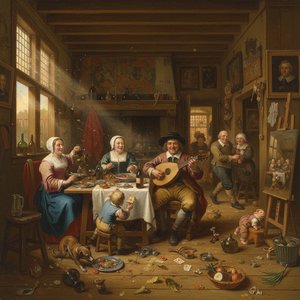
Jan Steen: A Master of Dutch Genre Painting & the Golden Age
Explore the life & art of Jan Steen, a leading Dutch Golden Age painter renowned for his humorous genre scenes & insightful social commentary. Discover his techniques, legacy, and collecting tips.