 Preview
 Send
Send Share
Share
 Details

 Download
 Similars
 X-Ray
X-Ray Diaporama
Still Life With Watermelon
 Oil On Canvas
- WallArt
- Impressionist Style
 1869
1869- 19th Century
 61.0 x 71.0 cm
 Read More
Hand Made Oil Reproduction
Hand-painted oil on canvas in your size and frame, made to order by our artists. ( Buy Print Buy Image)




P118B $10

P118H $10

P118W $10

P438Z $10

P508JH $12

P508YH $12

P805H $10

P805Z $10

P919BZ $10

P919G $10

P919XJ $10

P959ZH $10

P968JZ $12

W106C $8

W218G $10

W218JH $8

W218Y $10

W307PJ $10

W316G $10

W316PJ $8

W316Y $10

W398PJ $8

W4111J $10

W500HY $15

W500JH $15

W692G $12

W849H $8

W940BG $15

W953PJ $8




Pick from our preset sizes that match the artwork's original proportions.

You may enter your own dimensions to fit a specific frame or space. If your selected size does not match the original image's proportions, we will either crop the artwork or extend the painting with additional hand-painted elements. A digital mockup will be sent for your approval before production begins.
Please note that the on-screen preview does not reflect the actual cropping or extension. Only the mockup will accurately show the final composition.
While custom sizes are available, we recommend selecting a dimension from the predefined list to preserve the original proportions.
After order, ArtsDot.com team will email client for instructions and provide a mockup preview
Worldwide Delivery () in 3/4 weeks instead of standard 5 weeks. (17 August). No compromise on quality.

Free Worldwide Express Shipping

High-Quality Linen Canvas

Full Shipping Insurance

Customs Tax Refund Guarantee

True Color Matching Guarantee

60-Day Return Policy (Defects Only)

100% Money-Back Guarantee

Bulk Discount Offer
 Glass option is only available in size under 110 CM

Still Life With Watermelon
Reproduction Medium
Reproduction Size
-


Total Price
$ 263
Artwork Description
The Painting's Details
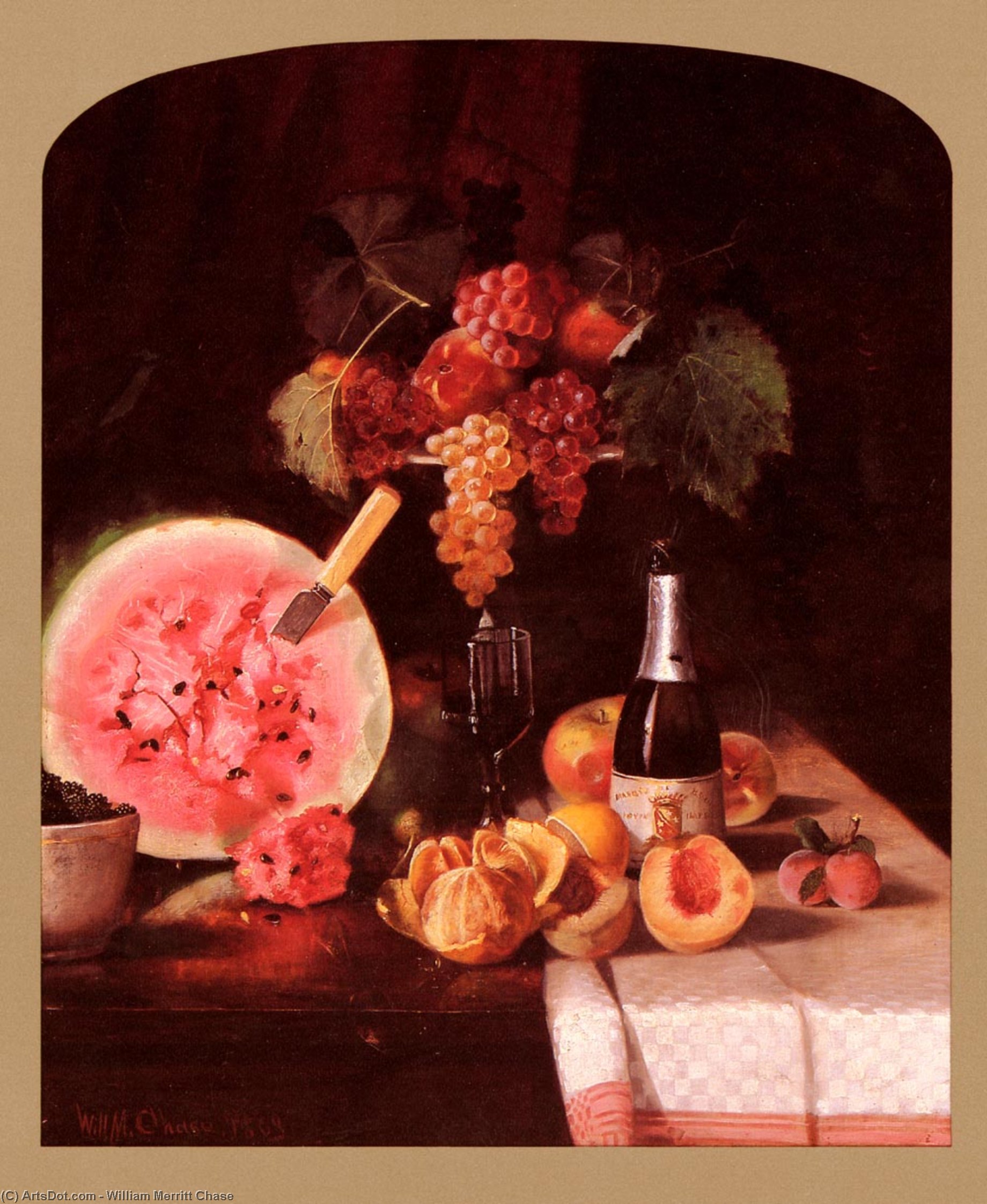
William Merritt Chase's Still Life with Watermelon is a captivating oil on canvas painting, measuring 61 x 71 cm. Created in 1869, it exemplifies the artist's skill in capturing everyday scenes with elegance and simplicity.The Composition
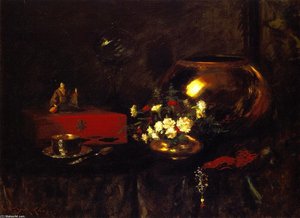
The painting features a table set against a dark background, which adds depth to the composition. The main focus is a large watermelon that dominates the scene. Scattered around the table are several apples, some near the watermelon and others further away. A bottle is placed towards the right side of the table, while a bowl is located on the left side. This arrangement creates a sense of balance and harmony.Artistic Style
The painting is characterized by Chase's use of Impressionism, a style that emphasizes capturing light and color. The brushstrokes are bold and expressive, giving the painting a dynamic feel. The dark background contrasts with the vibrant colors of the fruits, creating a visually appealing contrast.Artist's Background
William Merritt Chase was an American painter known for his contributions to Impressionism in the United States. His work often featured everyday subjects, such as still lifes and landscapes, which he depicted with a sense of realism and beauty.Museum Collection
The Snite Museum of Art, located at the University of Notre Dame, houses an extensive collection of artworks from various cultures and periods. This museum is notable for its diverse holdings, including works by prominent artists like Chase.Relevance to ArtsDot.com
At ArtsDot.com, we offer high-quality, handmade oil painting reproductions of famous artworks, including those by William Merritt Chase. Our collection includes other notable works such as Henri Matisse's The Dream and William Merritt Chase's Virginia Stewart.Conclusion
Still Life with Watermelon by William Merritt Chase is a testament to the artist's skill in capturing the beauty of everyday life. The painting's composition, style, and historical context make it a significant piece in the world of Impressionism. For those interested in art history or seeking high-quality reproductions, ArtsDot.com provides an excellent resource.- Painting by 'William Merritt Chase' | William Merritt Chase: Still Life With Watermelon
- Painting by 'Henri Matisse' | Henri Matisse: The Dream
- Painting by 'William Merritt Chase' | William Merritt Chase: Virginia Stewart
Related Artworks
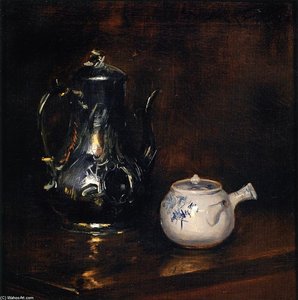
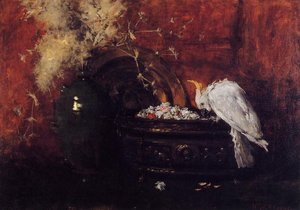
Artist Biography
A Life Painted in Light: The World of William Merritt Chase
William Merritt Chase, a name synonymous with the blossoming of American Impressionism, was more than just a painter; he was a pivotal force in shaping the nation’s artistic identity at the turn of the 20th century. Born on November 1, 1849, in the humble surroundings of Williamsburg (later Nineveh), Indiana, Chase's journey from rural beginnings to becoming a celebrated artist and influential educator is a testament to his unwavering dedication and innate talent. His early life was marked by a familial relocation to Indianapolis in 1861, where he initially assisted in his father’s business ventures. However, even amidst these practical obligations, the seeds of artistic passion were sown, nurtured by studies with local instructors Barton S. Hays and Jacob Cox. This foundational training ignited a desire for further exploration, leading him briefly into naval service before ultimately gravitating towards the vibrant art scene of New York City in 1869. There, under the tutelage of Joseph Oriel Eaton at the National Academy of Design, and later Lemuell Wilmarth, a student of Jean-Léon Gérôme, Chase began to hone his skills, laying the groundwork for a career that would redefine American painting. A temporary financial setback forced a move to Saint Louis in 1870, but even this challenge proved fruitful, allowing him to establish himself within the local art community and gain recognition for his burgeoning talent.From Academic Roots to Impressionistic Brilliance
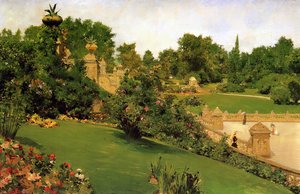
Chase’s artistic development was not a sudden leap into Impressionism, but rather a gradual evolution informed by rigorous academic training and extensive travels abroad. A crucial turning point came with his extended sojourn in Munich beginning in 1872, where he studied at the Academy of Fine Arts under Alexander von Wagner and Karl von Piloty. This period instilled in him a mastery of traditional techniques and a penchant for dramatic compositions, yet it was during a subsequent visit to Venice with fellow American artists Frank Duveneck and John Twachtman that Chase began to embrace a more liberated approach to painting. Inspired by the luminous light and vibrant colors of the Italian landscape, he started experimenting with looser brushwork and a heightened sensitivity to atmospheric effects. Upon his return to New York in 1878, Chase fully embraced Impressionistic principles, capturing fleeting moments of modern life with an energetic and captivating style. Works like Keying Up – The Court Jester (1876), exhibited to critical acclaim at the Boston Art Club and Philadelphia Centennial Exposition, showcased his ability to convey movement and personality through bold brushstrokes and a dynamic composition. He continued to explore diverse subjects—striking portraits such as Portrait of Virginia Gerson, evocative landscapes like Gowanus Bay (aka Misty Day, Gowanus Bay), and scenes depicting the vibrancy of urban life, including Alice Fernandez. Other notable works include “A Friendly Call,” “A Study in Curves,” and “Terrace at the Mall, Central Park.”The Educator: Shaping a Generation of Artists
Beyond his accomplishments as a painter, William Merritt Chase left an indelible mark on American art through his dedication to teaching. Recognizing the need for innovative art education, he founded the Chase School in New York City in 1896, which later evolved into Parsons The New School for Design. This institution became a breeding ground for artistic talent, emphasizing direct observation, technical proficiency, and creative experimentation. Unlike many of his contemporaries who favored rigid academic instruction, Chase encouraged his students to develop their individual voices and explore diverse styles. He held teaching positions at the Pennsylvania Academy of the Fine Arts, the Art Students League, and the Brooklyn Art Association, disseminating his artistic philosophy far and wide. His influence extended to numerous artists, including Wayman Elbridge Adams, who openly acknowledged Chase as a mentor. The emphasis on plein air painting—painting outdoors directly from nature—became a cornerstone of his pedagogical approach, fostering a deeper connection between students and their subjects.Legacy and Historical Significance
William Merritt Chase’s place in American art history is secure. He bridged the gap between established academic traditions and the burgeoning Impressionist movement, contributing significantly to the development of a distinctly American artistic identity. His commitment to capturing the essence of modern life—the bustling cityscapes, intimate domestic interiors, and leisurely pursuits of his time—resonated with audiences eager for a new visual language. While his later years saw a temporary eclipse in critical recognition, his work has experienced a resurgence in recent decades, solidifying his reputation as one of America’s most important and influential artists. He wasn't merely documenting scenes; he was interpreting the spirit of an evolving nation through the vibrant lens of Impressionism. His legacy extends beyond his canvases to the countless artists he inspired, ensuring that his innovative approach to painting continues to shape the landscape of American art for generations to come.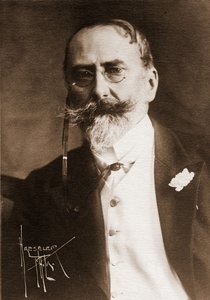
William Merritt Chase
1849 - 1916 , United States of America
Quick Facts
- Artistic Movement Or Style: Impressionism
- Artists Or Movements Influenced By This Artist: ['Wayman Elbridge Adams']
- Artists Who Influenced This Artist: ['Jean-Léon Gérôme']
- Date Of Birth: November 1, 1849
- Date Of Death: October 25, 1916
- Full Name: William Merritt Chase
- Nationality: American
- Notable Artworks:
- Keying Up – The Court Jester
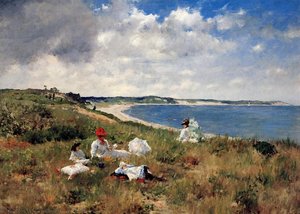
- Idle Hours
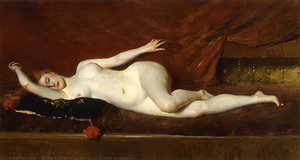
- A Study in Curves
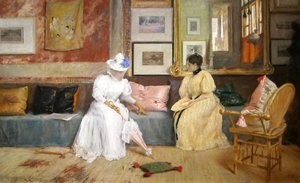
- A Friendly Call
- Alice Fernandez
- Place Of Birth: Nineveh, USA
Related Articles

Giclée Prints: Archival Quality & Aesthetic Nuances for the Discerning Collector
Explore the world of giclée prints with ArtsDot. Learn about archival quality, aesthetic nuances & investment potential. Expert guidance for discerning art collectors seeking museum-quality reproductions and lasting value.
The Bountiful Still Life: Symbolism & Artistic Representation of Fruit Across Art History
Explore the rich history of still life painting & the symbolism of fruit across art movements. Discover masterpieces from Caravaggio to Cézanne with ArtsDot – expert guidance & museum-quality reproductions.

The Enduring Legacy of Fine Art Prints: Technique, History & Aesthetic Impact
Explore the rich history & techniques of fine art prints. Discover investment potential, assess authenticity, and learn how to preserve your collection with expert guidance. Trusted insights for discerning collectors.

Echoes of Time: Exploring the Enduring Appeal & Historical Context of Vintage Art Prints
Explore the captivating world of vintage art prints! Discover their history, collecting tips & enduring appeal. Expert insights on chromolithography and building a legacy collection with ArtsDot.
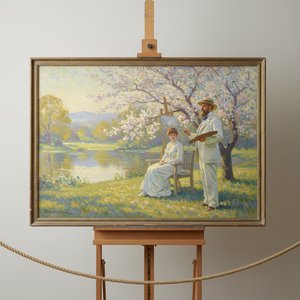
William Merritt Chase: A Study in American Impressionism & Artistic Luminosity
Explore the life & work of William Merritt Chase, a leading American Impressionist painter and influential art educator. Discover his vibrant portraits, landscapes, and lasting legacy with ArtsDot.