 Preview
 Send
Send Share
Share
 Details

 Download
 Similars
 X-Ray
X-Ray Diaporama
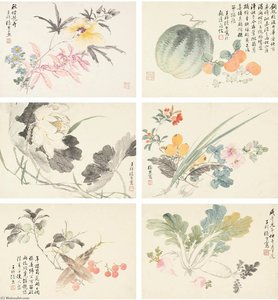
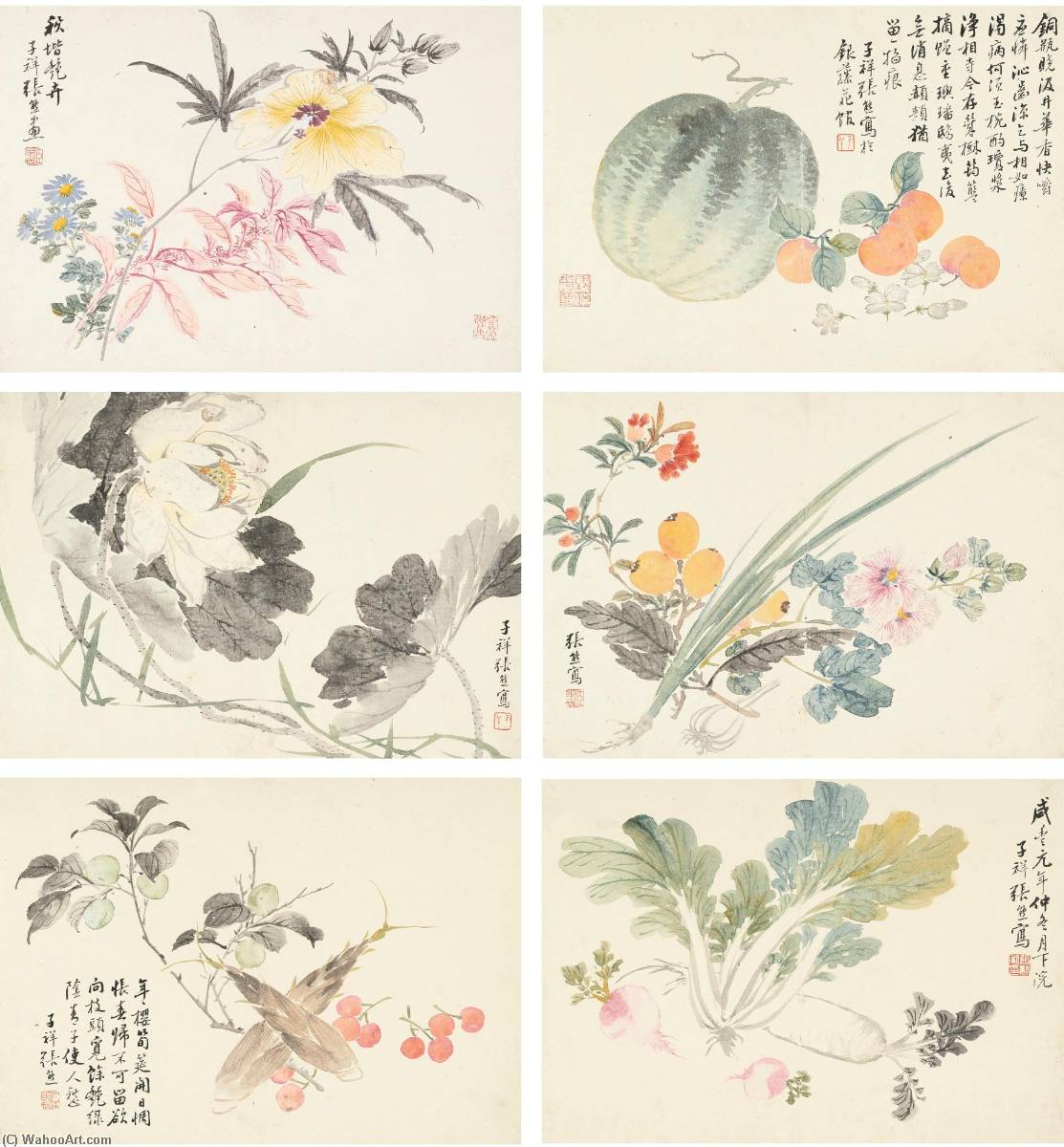
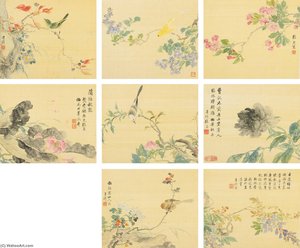
FLOWERS AND FRUITS
 26.0 x 37.0 cm
 Read More
Giclée / Art Print
Museum-quality giclée or canvas print with fast production and flexible finish options. ( Buy Hand Made Painting Buy Image)




































Pick from our preset sizes that match the artwork's original proportions.

You may enter your own dimensions to fit a specific frame or space. If your selected size does not match the original image's proportions, we will either crop the artwork or extend the image with a mirrored or solid-fill edge. A digital mockup will be sent for your approval before production begins.
Please note that the on-screen preview does not reflect the actual cropping or extension. Only the mockup will accurately show the final composition.
While custom sizes are available, we recommend selecting a dimension from the predefined list to preserve the original proportions.
Worldwide Delivery () in 2 weeks instead of standard 4/5 weeks. (28 August)

Free Worldwide Express Shipping

High-Quality Linen Canvas

Full Shipping Insurance

Customs Tax Refund Guarantee

True Color Matching Guarantee

60-Day Return Policy (Defects Only)

100% Money-Back Guarantee

Bulk Discount Offer
 Glass option is only available in size under 110 CM

FLOWERS AND FRUITS
Giclée / Art Print
Reproduction Size
-


Total Price
$ 63
Related Artworks
Artist Biography
A Legacy of Serenity: The Artistry of Zhang Xiong
In the vibrant and transformative landscape of the Qing dynasty, few artists captured the quiet pulse of nature with as much grace as Zhang Xiong. Born around 1803, a period of profound cultural shifts in China, Zhang emerged not merely as a painter, but as a poet of the brush. His life, which spanned the mid-to-late 19th century until his passing in 1886, was deeply rooted in the scholarly traditions of the literati. While many of his contemporaries sought to capture grand historical epics or mythological dramas, Zhang turned his gaze inward and toward the subtle wonders of the natural world. His work serves as a window into an era where the pursuit of tranquility through art was a spiritual endeavor, reflecting the harmonious ideals of Neo-conducianism and the delicate balance of Taoist thought.
The foundations of Zhang’s mastery were laid in the scenic environs of Hangzhou and Wuxi. As a well-established figure in Shanghai during the latter half of the 19th century, he became a pivotal mentor to the next generation of masters. It is a remarkable testament to his skill that renowned artists such as Ren Bonian sought him out for instruction, and even the legendary Wu Changshi shared a studio space with him. This lineage of teaching ensured that Zhang’s refined techniques—a blend of bold brushwork and meticulous detail—would ripple through the development of the influential Shanghai School of painting. His training was comprehensive, encompassing not just the visual arts but the classical disciplines of calligraphy and poetry, allowing him to imbende every stroke with a literary depth that transcends simple representation.
The Language of Color and Light
To encounter a work by Zhang Xiong is to step into a world of atmospheric elegance. His technique was characterized by an extraordinary ability to manipulate tonal variations, creating what many scholars describe as a luminous, misty perspective. He favored a palette of muted, sophisticated hues—predominantly soft blues, verdant greens, and earthy browns—which he blended with a delicate touch to evoke the damp, cool air of a mountain stream or the fleeting light of an autumn afternoon. His brushwork was never merely decorative; it was a rhythmic expression of emotion. Through subtle gradations and fine, layered strokes, he could transform a flat piece of paper into a breathing landscape, where the viewer can almost feel the humidity of a forest or the stillness of a garden.
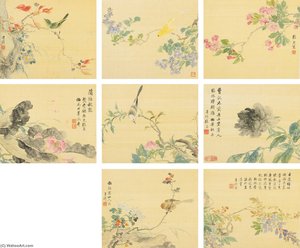
His subject matter often focused on the flower-and-bird genre, a tradition he elevated through his unique stylistic lens. In these works, Zhang achieved a balance between the realistic and the ethereal. One might observe:
- Floral Compositions: Meticulously rendered blossoms that capture the ephemeral beauty of spring and the nostalgic decay of autumn.
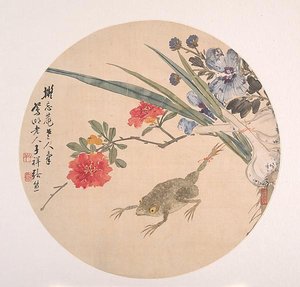
- Symbolic Fauna: The inclusion of creatures like toads or birds, which often served as metaphors for harmony, resilience, or the interconnectedness of all living things.
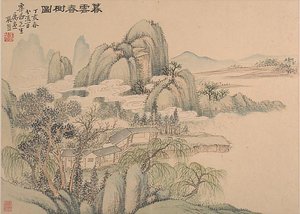
- Landscape Elements: The use of "mountain stream" motifs to demonstrate his command over depth, movement, and the interplay of water and stone.
Historical Significance and Enduring Spirit
The historical importance of Zhang Xiong lies in his role as a bridge between tradition and the burgeoning modernism of the Shanghai School. While he remained deeply respectful of the classical styles of the Yuan and early Qing masters, such as Yün Shouping, he infused his work with an individualistic expressiveness that resonated with the changing tastes of his time. His ability to convey "nostalgic autumn views" or the "cool elegance" of nature allowed him to touch upon universal human emotions—longing, peace, and reverence—making his art accessible across cultural boundaries.
Today, Zhang Xiong’s legacy is preserved in prestigious institutions such as the Metropolitan Museum of Art and the Birmingham Museum of Art. His paintings remain more than mere historical artifacts; they are enduring meditations on the beauty of the transient moment. Through his mastery of ink and color, Zhang Xiong continues to invite us to slow our pace, to observe the "featherlike leaves" of a bird's perch, and to find profound meaning in the quietest corners of the natural world.
zhang xiong
1803 - 1886
Quick Facts
- Artistic Movement Or Style: Traditional Chinese Brushwork
- Artists Or Movements Influenced By This Artist: ['Qing Dynasty Art']
- Artists Who Influenced This Artist: ['Ren Bonian']
- Date Of Death: 1886
- Full Name: Zhang Xiong
- Nationality: Chinese
- Notable Artworks:
- Flower and Toad
- Landscape
- Place Of Birth: Shanghai, China