The Soul of the Canvas: Defining the Expressionist Vision
To gaze upon an Expressionist landscape is not merely to observe a view, but to witness a psychological event. Unlike the Impressionists, who sought to capture the fleeting dance of light upon a surface, the Expressionists turned their gaze inward, seeking to project the turbulence of the human spirit onto the external world. This movement, emerging from the profound social and political shifts of the early 20th century, abandoned the safety of mimesis in favor of a raw, unmediated truth. The canvas became a vessel for anxiety, ecstasy, and existential longing, where the boundaries between the observer and the observed began to dissolve into a singular, emotive experience.
In this artistic revolution, the landscape ceased to be a static backdrop for human drama and instead became the protagonist itself. The artist’s hand did not seek to replicate the precise anatomy of a tree or the exact gradient of a sunset; rather, it sought to capture the essence of those forms through distortion and exaggeration. This departure from reality was not an act of inaccuracy, but an act of profound honesty—a way to communicate truths that the literal eye could never perceive. It is within this tension between what is seen and what is felt that the true power of Expressionism resides.
Chromatic Turbulence: The Language of Bold Color and Distorted Form
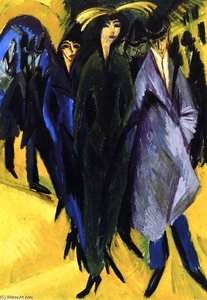
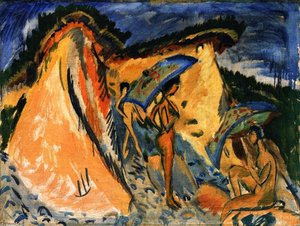
The visual vocabulary of Expressionism is defined by a radical use of color, often divorced from any naturalistic obligation. Colors are deployed with a rhythmic intensity, used as psychological triggers to evoke specific emotional responses. One might encounter jarring, clashing hues that create a sense of dissonance and unrest, or deep, saturated tones that suggest a heavy, brooding melancholy. This chromatic turbulence serves to destabilize the viewer’s perception, forcing an engagement with the painting that is visceral rather than intellectual.
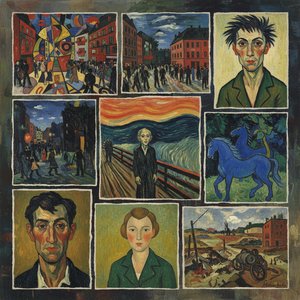
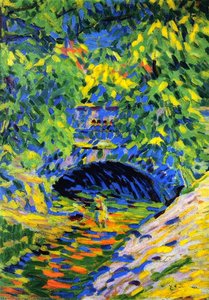
Complementing this coloristic intensity is the deliberate use of distorted forms. Lines become jagged, perspectives are warped, and shapes are stretched or compressed to mirror the internal state of the artist. In works such as those by Alexej von Jawlensky, particularly his Landscape with Small Wood, we see how bold colors and fractured forms work in tandem to create a sense of depth that is more spiritual than spatial. The distortion acts as a bridge, allowing the viewer to step out of the physical world and into a realm where the architecture of the landscape is built from emotion rather than earth and stone.
Echoes of the Emotive: Analyzing Masterworks of Emotional Depth
When we delve into the canon of Expressionist masters, we find that each artist brings a unique emotional frequency to the landscape. The works are often characterized by a sense of movement—not just the movement of wind or water, but the movement of thought and feeling across the canvas. There is a palpable weight to the brushstrokes, an impasto texture that gives the paint a sculptural, almost tactile presence, reminding us of the physical labor involved in translating emotion into matter.
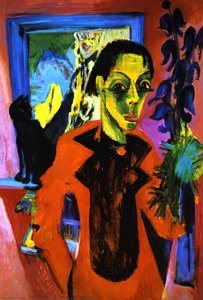
Consider the haunting resonance found in the works of Edvard Munch. His Springtime Landscape with Red House offers a fascinating study in contrast; while it may present a scene of rural charm, the vibrant, almost aggressive application of color and the stylized elements suggest an underlying tension. The landscape is alive, breathing with a vitality that can feel both enchanting and unsettling. These masterworks do not merely sit on a wall; they vibrate with a life force that demands a response, echoing the complexities of our own inner landscapes.
Nature Reimagined: From Serene Moonlight to Vibrant Rural Charm
The Expressionist reimagining of nature often oscillates between the serene and the unsettling. The natural world is stripped of its traditional tranquility and replaced with a landscape that feels sentient and reactive. This can manifest as a quiet, nocturnal introspection or a loud, daylight-driven frenzy. The artist’s ability to manipulate the atmosphere of a scene allows for a profound exploration of the human condition through the lens of the environment.
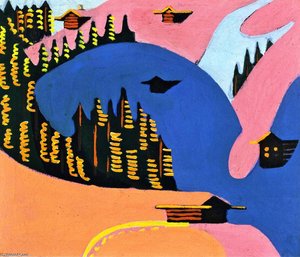
A striking example of this duality is found in Ernst Ludwig Kirchner’s Winter Landscape by Moonlight. Here, the night scene is captured with a powerful emotionality that transcends simple depiction. Through the use of bold colors and distorted forms, Kirchner creates a world that feels both serene in its stillness and unsettling in its strange, luminous intensity. The moonlight does not merely illuminate; it transforms, casting the landscape into a dreamlike state where the familiar becomes mysterious. This ability to reinvent the natural world—to find the uncanny within the familiar—is perhaps the greatest achievement of the Expressionist movement.
The Legacy of Feeling: How Expressionism Redefined the Landscape Genre
The impact of Expressionism on the trajectory of modern art cannot be overstated. By breaking the shackles of realism, it paved the way for subsequent movements such as Abstract Expressionism, where the subject matter would eventually vanish entirely, leaving only the pure gesture of the artist. The movement fundamentally altered our understanding of what a landscape could be: no longer a window to look through, but a mirror in which to see ourselves.
Today, the legacy of these emotive landscapes continues to inspire collectors and enthusiasts alike. The raw energy, the unapologetic use of color, and the profound psychological depth found in these works remain as potent now as they were a century ago. As we continue to explore the intersections of art history and human emotion, the Expressionist landscape stands as a testament to the enduring power of the artist to capture the intangible, turning the fleeting shadows of the soul into permanent, vibrant legacies on canvas.
At ArtsDot.com, we celebrate this profound connection between artistry and emotion. Our mission is to make these extraordinary moments of human creativity accessible to a global audience. Whether through our meticulously hand-painted oil reproductions that capture every authentic brushstroke, or our specialized services for custom commissions and digital transformations, we strive to preserve the soul of fine art. From the mastery of the Old Masters to the evocative power of the Expressionists, ArtsDot brings the museum experience into your home, ensuring that the beauty of the past continues to illuminate the present.