The Shattered Mirror: Understanding the Birth of Cubism
 Cubism Unveiled: How Picasso and Braque Redefined Reality Through Geometric Abstraction
The Fracture of Perspective: The Birth of a Revolution Cubism - Tate --- title: Cubism | Tate author: Clarrie Wallis url: https://www.tate.org.uk/art/art-terms/c/cubism hostname: tate.org.uk description: Tate glossary definition for cubism: A revolut...
To understand the seismic shift that Cubism brought to the twentieth century, one must first envision the world as it was perceived before 1907. For centuries, Western art had been anchored by the Renaissance ideal of a single, fixed viewpoint—a window into a three-dimensional reality governed by linear perspective and the illusion of depth. However, as the dawn of the new century arrived, marked by rapid industrialization and the mind-bending scientific revelations of Einstein, the traditional canvas began to feel insufficient. The artists who would become the architects of Cubism felt a profound need to move beyond mere imitation of nature. They sought a more permanent, structural truth, rejecting the Impressionist obsession with fleeting light and the Fauvist embrace of unbridled color.
This movement emerged not as a sudden rupture, but as an intellectual evolution born in the vibrant, often chaotic studios of Paris. It was a period where reality itself was being redefined by technology and physics, and art responded by breaking the very concept of the viewpoint into a thousand shimmering fragments. At its heart, Cubism was about capturing what the eye knows rather than just what the eye sees. By dismantling the subject, these pioneers sought to represent objects in a greater context, inviting the viewer to participate in a reconstruction of reality that was as much an intellectual exercise as it was a visual one.
Deconstructing Reality: Analytical vs. Synthetic Cubism
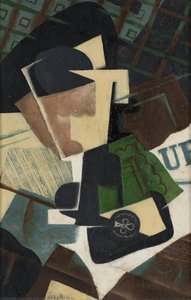 Glass and Ace of Clubs
A Symphony of Fragments: The Cubist Vision of Juan Gris In the quiet evolution of modern art, few moments are as intellectually arresting as the creation of Juan Gris’s “Glass and Ace of Clubs.” Completed in 1917, this masterpiece serves as a profoun...
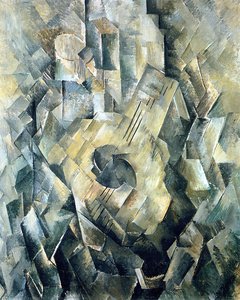
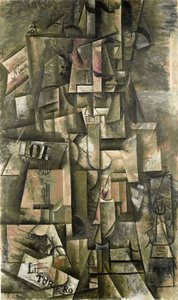
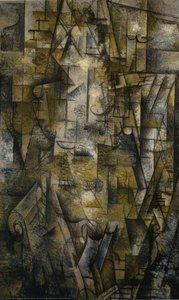
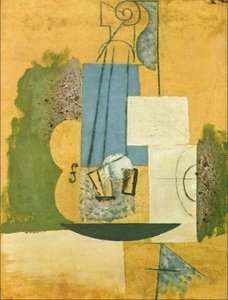
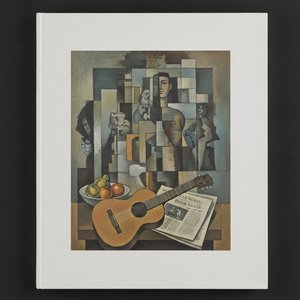
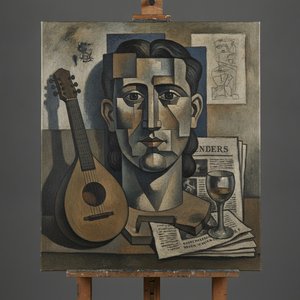
As the movement matured, it transitioned through two distinct phases, each offering a unique way to perceive the world. The first, known as Analytical Cubism, is perhaps the most intellectually arresting. In this phase, artists like Pablo Picasso and Georges Braque began to deconstruct their subjects into a series of overlapping planes and intersecting lines. The palette often became muted—dominated by ochres, deep browns, and subtle grays—to ensure that the viewer’s focus remained on the complex structure rather than the distraction of color. A masterpiece like Juan Gris’s
Glass and Ace of Clubs exemplifies this period; it orchestrates a complex dance of light and geometry where the transparency of glass and the solid weight of a playing card exist in a shared, fractured space.
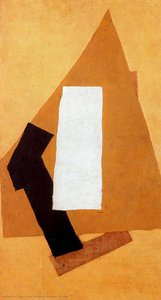
The second phase, Synthetic Cubism, brought a different kind of magic to the canvas. If the Analytical phase was about taking things apart, the Synthetic phase was about putting them back together in new, unexpected ways. This era introduced the revolutionary concept of collage, where artists incorporated real-world elements like newspaper clippings, sand, or cloth into their works. This approach allowed for a richer texture and a more playful use of color and shape. It moved away from the monochromatic fragmentation of the earlier years toward a construction of meaning through layers, creating a bridge between the painted world and the tangible reality of the viewer’s own life.
The Architects of Abstraction: Picasso, Braque, and the Visionaries
 Pablo Picasso
The Enduring Legacy of Pablo Picasso Pablo Ruiz y Picasso, a name synonymous with artistic revolution, was born in Málaga, Spain, on October 25, 1881. His very existence seemed destined for creative expression; legend has it his first uttered words w...
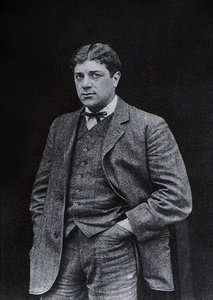
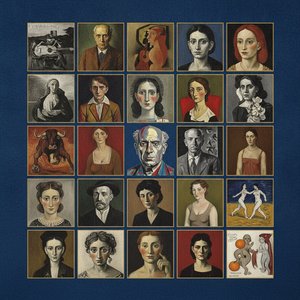
No exploration of Cubism is complete without honoring the titans who led the charge. Pablo Picasso, a name synonymous with artistic revolution, brought an unparalleled intensity to the movement. His journey from the somber, emotionally charged Blue Period to the fractured geometries of Cubism reflects a restless, evolving mind. Alongside him stood Georges Braque, whose technical mastery and background in the trades provided a structural foundation for the movement. While Picasso often captured the headlines with his notoriety, Braque’s work was equally vital, characterized by a more restrained and analytical approach that helped define the very essence of the Cubist vision.
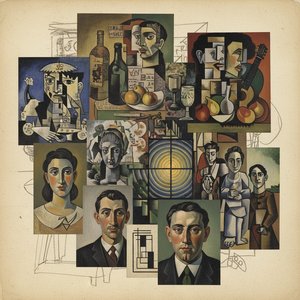
Yet, these two were not alone in their quest for a new visual language. The movement was supported by a constellation of brilliant minds, including Juan Gris, who brought a unique, mathematical precision to his canvases, likely influenced by his early training in engineering. Others, like Robert and Sonia Delaunay, pushed the boundaries further through Orphism, an offshoot that re-introduced vibrant color and light into the Cubist framework. Together, this group of visionaries dismantled the traditional portrait and landscape, replacing them with a symphony of fragments that would forever change the trajectory of modern art, influencing everything from music and ballet to architecture and literature.
Geometry in Motion: How Cubism Redefined Modern Perspective
 Geometric abstraction
Geometric abstraction is a form of abstract art based on the use of geometric forms sometimes, though not always, placed in non-illusionistic space and combined into non-objective (non-representational) compositions. Although the genre was popularize...
The true magic of Cubism lies in its ability to present multiple perspectives simultaneously. In a traditional painting, you are a stationary observer looking through a single window. In a Cubist work, you are invited to move around the subject, seeing the front, side, and top all at once. This technique, often referred to as simultaneity, allows the artist to represent a subject in its most complete form. It is a way of honoring the complexity of an object by showing all its facets, refusing to let any part of its essence remain hidden behind a single angle.
This use of geometric abstraction—the reliance on spheres, cones, and cubes—was not merely a stylistic choice but a way to find order within the chaos of the modern experience. By breaking subjects into geometric forms, artists could explore the relationship between space and volume with unprecedented clarity. This approach laid the groundwork for much of the abstract art that followed, proving that beauty could be found not just in the imitation of nature,_but in the very structure of form itself. It was a celebration of the intellect, challenging the viewer to navigate a labyrinth of shapes to find the truth hidden within the abstraction.
Bringing the Revolution Home: Incorporating Cubist Energy into Modern Interiors
 Cubism
Cubism is an early-20th-century avant-garde art movement which began in Paris. It revolutionized painting and the visual arts, and sparked artistic innovations in music, ballet, literature, and architecture. Cubist subjects are analyzed, broken up, a...
For the contemporary art enthusiast, Cubism offers a wonderful opportunity to inject character and intellectual depth into a living space. The bold, geometric lines and the fascinating interplay of light and shadow found in Cubist-inspired works can serve as a striking focal point in any room. Whether you are drawn to the monochromatic, structural elegance of an Analytical piece or the textured, colorful vibrancy of a Synthetic collage, these works bring a sense of "discovery" to your decor.
When decorating, consider how the fragmented energy of a Cubist print or painting can interact with your existing furniture and color palette. A large-scale, multi-panel Cubist set can transform a wide wall or a staircase into a modern architectural feature, creating a sense of movement and flow. At ArtsDot.com, we believe that art should be an accessible adventure. We specialize in bringing these historical masterpieces to life through hand-painted oil reproductions, allowing you to experience the visible brushstrokes and deep tonal ranges that define the Cubist spirit. By choosing pieces that resonate with your personal style—whether through color, mood, or geometric complexity—you can create a home that is not just decorated, but meaningfully curated.