Defining Neo-Expressionism: The Rejection of Minimalism and the Return to Visceral Painting
Neo-expressionism - Tate--- title: Neo-expressionism | Tate url: https://www.tate.org.uk/art/art-terms/n/neo-expressionism hostname: tate.org.uk description: Tate glossary definition for neo-expressionism: The international phenomenon of a major revival of painting in an ex...
The late twentieth century witnessed a seismic shift in the global art landscape, a moment when the sterile, intellectualized corridors of Minimalism and Conceptual Art were suddenly breached by a wave of unbridled emotion. This was the dawn of Neo-Expressionism, an international phenomenon that reclaimed the canvas as a site of raw, human struggle. Where previous movements sought to strip art down to its most fundamental, often detached geometric forms, Neo-Expressionism demanded a return to the figure, the brushstroke, and the palpable weight of paint itself. It was not merely a stylistic choice but a profound rebellion against the perceived coldness of the era, seeking instead to re-establish a connection between the viewer and the visceral reality of human experience.
For the professional designer or procurement manager, understanding this movement is essential for navigating the complexities of modern aesthetic impact. Neo-________________Expressionism does not ask for quiet contemplation; it demands engagement. It draws its strength from the tension between recognizable forms and radical distortion, presenting a world that is often chaotic, fragmented, and intensely subjective. By embracing the tactile nature of oil on canvas—the thick impasto, the visible energy of the artist's hand—this movement provides a sense of permanence and soul that digital or mass-produced prints simply cannot replicate. It offers an architectural anchor for spaces that require a commanding presence and a narrative depth that transcends mere decoration.
Key Figures and Masterworks: From Basquiat’s Urban Energy to Baselitz’s Inverted Compositions
 Basquiat & Raw Pop: The Unfiltered Energy of Neo-Expressionism and the Legacy of Urban Rebellion
The Genesis of Chaos: From SAMO© to the Streets of New York Jean-Michel Basquiat: Deconstructing Identity & Power Through Neo-Expressionist Graffiti The Rise of SAMO: Basquiat’s Early Provocations & New York Roots Jean-Michel Basquiat Explore the raw...
To truly grasp the breadth of Neo-Expressionism, one must look toward the titans who redefined the boundaries of the medium. Jean-Michel Basquiat stands as perhaps the most iconic figure of this urban rebellion, a painter whose work emerged from the rhythmic, chaotic heartbeat of New York City’s streets. His transition from the cryptic, poetic interventions of his SAMO© graffiti era to museum-grade masterpieces brought an unfiltered energy into the gallery space. Basquiat’s canvases are layered with symbols, text, and social commentary, creating a multilingual visual language that deconstructs identity and power through a lens of raw, street-born intensity.
In stark contrast to Basquiat's urban grit, the German master Georg Baselitz offers a more structural, yet equally provocative, approach to the movement. His work is famously characterized by the inversion of his subjects—turning figures upside down to de-emphasize literal content and force the viewer to confront the raw materiality of the painting itself. In monumental works such as
Supper in Dresden, Baselitz utilizes a vast, commanding expanse to reimagine history through a lens of disruption and reconstruction. His technique, which oscillates between recognizable figuration and robust chromatic harmonies, creates a restless energy that is particularly effective for large-scale installations in grand lobbies or corporate halls where a sense of historical weight and revolutionary spirit is desired.
The Aesthetic of Emotion: Analyzing Texture, Color Palette, and Subjective Reality in Modern Works
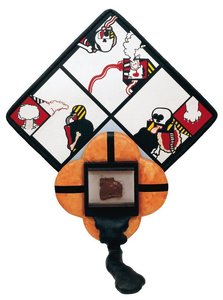 antônio dias dos santos
Antonio Dias dos Santos: A Bold Vision of Brazilian Identity Antonio Dias dos Santos (1948 – 1999), a Brazilian artist whose work embodies the spirit of Neo-Expressionism, remains an enigmatic figure within contemporary art history. Born in Vera Cruz...
The true power of Neo-Expressionist art lies in its ability to communicate through the language of texture and color rather than mere representation. The movement utilizes a highly subjective perspective, where the world is distorted to reflect inner turmoil or psychological depth. This is achieved through the masterful use of heavy, textured surfaces—often employing thick impasto that creates a three-dimensional landscape on the canvas. When light hits these raised brushstrokes, it creates a dynamic interplay of shadow and highlight, lending the artwork a sense of movement and life that feels as though the painting is breathing within the room.
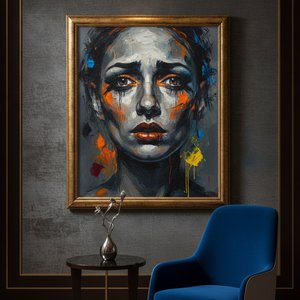
Color in Neo-Expressionism serves as an emotional conductor. Designers will find that these works often employ jarring combinations—striking shades of pink, deep blues, and aggressive blacks—that collide to create a sense of psychological tension. Artists like Antonio Dias dos Santos utilized vibrant, often fragmented forms and textured surfaces to convey urgency, while others used muted, somber palettes to evoke the weight of history and loss. For an interior professional, selecting pieces from this movement allows for precise control over the atmospheric temperature of a space; one can choose high-contrast, energetic works to stimulate a lounge environment or more brooding, monochromatic compositions to ground a sophisticated executive suite.
Strategic Implementation: Integrating Neo-Expressionist Art into Hospitality and Corporate Interiors
Integrating Neo-Expressionist works into hospitality and corporate environments requires a strategic approach to balance intensity with architectural harmony. Because these pieces are inherently high-impact, they function best as focal points within a larger design narrative. In a hotel lobby, a large-scale Neo-Expressionist canvas can serve as the primary anchor, setting a tone of contemporary luxury and cultural sophistication. The movement's rejection of "polite" art makes it an ideal choice for brands looking to project an image of boldness, creativity, and forward-thinking leadership.
When selecting works for corporate spaces, consider the relationship between the painting’s energy and the room's function. In high-traffic areas like corridors or reception zones, the movement's ability to command attention can guide movement and create memorable wayfinding landmarks. However, in more contemplative spaces such as boardrooms or private lounges, one might opt for works that emphasize the movement's more structural, subdued elements—such as the architectural motifs found in the New Leipzig School. The key is to use the art to complement the existing color palette and material textures of the interior, using the painting's inherent drama to elevate the surrounding architecture rather than overwhelm it.
Curating Large-Scale Impact: Utilizing Multi-Panel Layouts and Custom Dimensions for Architectural Spaces
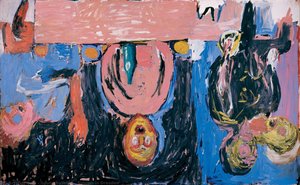 Supper in Dresden
A Masterpiece of Inversion: Reimagining History in Baselitz's Supper in Dresden In the vast, commanding expanse of Supper in Dresden , viewers are invited into a world where reality is turned on its head—quite literally. This monumental oil on canvas...
For the professional decorator managing large-scale projects, the true potential of Neo-Expressionism is unlocked through custom dimensions and multi-panel configurations. The movement's emphasis on expansive, sweeping gestures lends itself perfectly to the "multi-panel" trend, where a single, powerful image is split across three, four, or even five panels. This technique is particularly effective for covering wide feature walls or long staircases, creating a cohesive, modern architectural look that feels integrated into the very structure of the building. These expanded compositions allow the viewer to experience the "flow" of the brushstrokes as they move across the physical boundaries of the panels.
Furthermore, the ability to commission custom-sized reproductions allows for unparalleled precision in design execution. Whether it is a massive mural-style canvas designed to mimic a fresco or a specifically scaled piece intended to fit between architectural columns, the flexibility of professional reproduction ensures that the art serves the space perfectly. By utilizing advanced techniques such as MirrorWrap or ExtendedWrap—where the artist continues the painting around the edges of the stretcher bars—designers can achieve a seamless, frameless look that emphasizes the raw, uncontained energy of the Neo-Expressionist spirit. This level of customization ensures that every installation is not just a decoration, but a bespoke component of a masterfully designed environment.