


The Golden Glow: How 17th-Century Prosperity Fueled an Artistic Revolution
 Illuminating Realism: Exploring the Dutch Golden Age of Painting (1600-1700)
The Rise of a Republic: Historical Context & Artistic Flourishing The 17th century Netherlands, a period often lauded as the Dutch Golden Age, wasn’t merely defined by economic prosperity and colonial expansion; it was an era of unprecedented artisti...
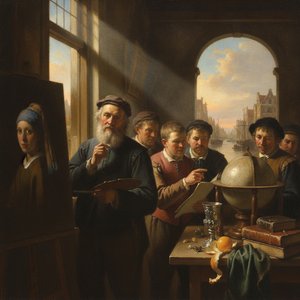
To understand the sheer visual impact of the Dutch Golden Age, one must first look beyond the canvas and into the surging heartbeat of a nation in ascent. The seventeenth century in the Netherlands was not merely a period of historical significance; it was an era of unprecedented economic explosion. Following decades of grueling struggle for independence from Spanish rule, the newly established Dutch Republic emerged as a global titan of maritime trade and mercantile prowess. This was a world shaped by the immense wealth of the East India Company and the bustling docks of Amsterdam, where prosperity flowed like the tides of the North Sea.
Unlike the grand, monarchical traditions of neighboring France or Italy, where art served to glorify kings and the Church through massive religious frescoes and sprawling palaces, the Dutch market was fundamentally different. It was driven by a burgeoning middle class—merchants, sailors, and craftsmen who possessed both the means and the desire to decorate their private homes with beauty. This shift in patronage democratized the aesthetic experience. Art moved from the cathedral to the parlor, transitioning from the divine to the domestic. The result was an artistic revolution that prioritized the tangible, the local, and the exquisitely real, creating a legacy of works that celebrate the quiet grandeur of human existence.
Chiaroscuro Mastery: The High-Contrast Drama of Light and Shadow
 Chiaroscuro
In art, chiaroscuro (English: kee-AR-ə-SKOOR-oh, -SKURE-, Italian: [ˌkjaroˈskuːro]; lit. 'light-dark') is the use of strong contrasts between light and dark, usually bold contrasts affecting a whole composition. It is also a technical term used by a...
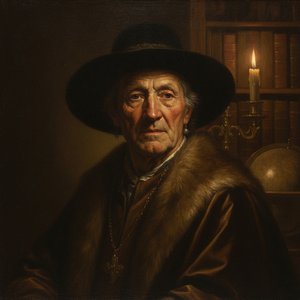
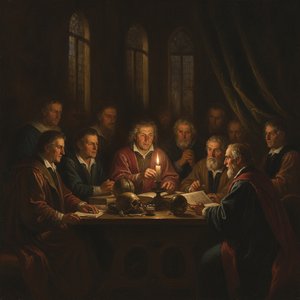
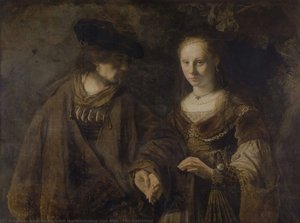
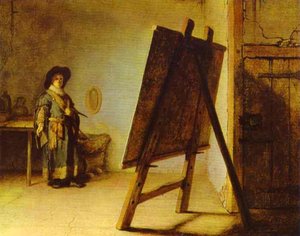
If wealth provided the canvas, then light provided the soul. The most striking characteristic of this era is the masterful command of chiaroscuro—the dramatic interplay between profound darkness and piercing illumination. This technique was far more than a mere stylistic choice; it was a tool for psychological depth and three-dimensional volume. By utilizing stark contrasts, artists could direct the viewer's eye with surgical precision, pulling figures out of an abyssal background to create a sense of sudden, breathtaking presence.
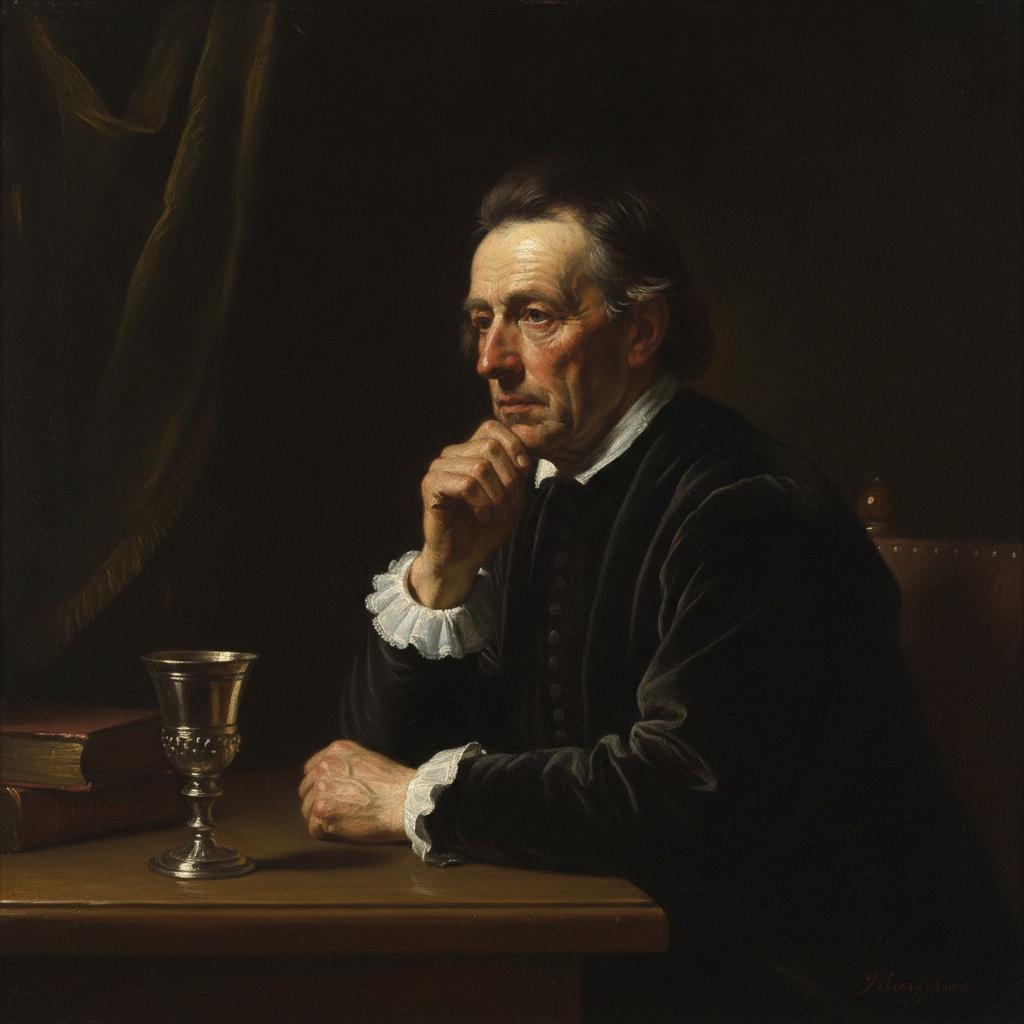
Consider the way light interacts with a subject in the works of the era’s greats. It is rarely a flat, uniform glow; instead, it is a directional force that sculpts faces, catches the edge of a silk sleeve, or glints off the surface of a silver goblet. This manipulation of shadow allows for an incredible sense of realism, where objects possess weight and figures possess breath. In the hands of masters like Abraham Storck or even the enigmatic Nicolaes Keyser, light becomes a character in itself—a silent narrator that can evoke everything from the chilling atmosphere of an Arctic whaling expedition to the warm, intimate glow of a candlelit study. This tension between the seen and the unseen is what gives Dutch art its enduring, cinematic energy.
Genre Painting & Intimacy: Elevating Everyday Moments to Masterpieces
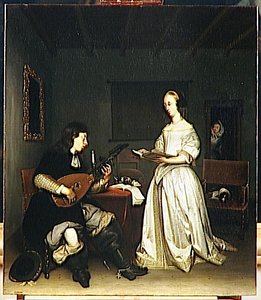 LE DUO CHANTEUSE ET JOUEUR DE LUTH THEORBE
LE DUO CHANTEUSE ET JOUEUR DE LUTH THEORBE – A Window into Dutch Golden Age Intimacy Gerard ter Borch’s “Le Duo: chanteuse et joueur de luth théorbé,” painted around 1669-1670, stands as a quintessential example of Dutch genre painting—a movement tha...
Perhaps the most revolutionary aspect of the Dutch Golden Age was its refusal to look away from the mundane. While other European traditions chased mythological legends and epic battles, Dutch genre painters found divinity in the everyday. They turned their gaze toward the quiet corners of domestic life, capturing scenes of music-making, letter writing, and household labor with a reverence usually reserved for saints.
In works such as Gerard ter Borch’s Le Duo: chanteuse et joueur de lute théorbé, we are invited into a private, serene moment. There is no grand drama here, only the delicate synchronization of a singer and her accompanist. Yet, through meticulous observation, Ter Borch elevates this simple domestic tableau into something profound. Similarly, Pieter de Hooch’s interiors invite us to witness the rhythmic beauty of daily chores, where light dances across tiled floors and window frames. These paintings serve as windows into the soul of a culture, proving that there is an extraordinary, almost sacred beauty to be found in the textures of our own lives—the sheen of satin, the grain of wood, and the quiet dignity of human connection.
Texture and Detail: The Meticulous Realism of the Dutch Masters
 Realism (arts)
In art, realism is generally the attempt to represent subject-matter truthfully, without artificiality, exaggeration, or speculative or supernatural elements. The term is often used interchangeably with naturalism, although these terms are not necess...
To gaze upon a true Dutch Masterpiece is to undergo a sensory experience defined by texture. The artists of this period were obsessed with the tactile reality of the world around them. They did not merely paint a subject; they painted the feeling of the subject. This level of detail required an almost scientific approach to observation, fueled by the era's growing fascination with natural history and empirical truth.
The brilliance lies in the variation of surfaces: the heavy, weathered hull of a ship navigating icy Spitsbergen waters; the translucent, fragile skin of a grape; the complex, shimmering weave of a golden thread. This commitment to materiality is what makes these works feel so alive centuries later. When an artist captures the way light penetrates a glass of wine or how shadow settles into the folds of heavy velvet, they are engaging in a form of visual alchemy. It is this hyper-realistic attention to detail that allows the viewer to step out of their own time and inhabit the meticulously crafted reality of the seventeenth century.
Modern Remix: Bringing Golden Age Aesthetics into Contemporary Interiors
 Dutch Masters: 10 Golden Age Paintings That Still Inspire |
Introduction Imagine stepping into a world bathed in soft northern light, where everyday life is elevated to extraordinary beauty and quiet contemplation reigns supreme. This is the realm of the Dutch Golden Age – a period of unprecedented artistic f...
While the Dutch Golden Age belongs to history, its visual language remains incredibly potent for the modern collector. The bold contrasts and rich textures of the era are perfectly suited for contemporary spaces that demand high-impact, sophisticated focal points. Today’s design-conscious professionals often look to these historical aesthetics to provide a sense of permanence and depth in an increasingly digital world.
The beauty of this movement lies in its versatility. A large-scale, multi-panel reproduction of a maritime scene can anchor a modern loft with a sense of adventure and scale. Conversely, a smaller, intimate genre piece can add a layer of quiet sophistication to a minimalist study. We are currently seeing a fascinating trend where the "Old Masters" are being reimagined through a contemporary lens—blending the dramatic chiaroscuro of the past with the clean lines of modern architecture. Whether through a faithful hand-painted reproduction or a bold, stylized remix, the light and shadow of the Dutch Golden Age continue to illuminate the most exquisite corners of modern design.
At ArtsDot.com, we specialize in preserving this legacy for the modern era. Our master artists use traditional techniques to create breathtaking oil reproductions that capture every brushstroke and tonal nuance of these historical treasures. From custom portrait commissions that place your own story within a classical framework to large-format murals that transform entire rooms, we bring the grandeur of the Golden Age into your personal collection with unparalleled craftsmanship and global delivery.