![Black Circle [1913] State Russian Museum, — Kazimir Malevich](/media/artworks/images/thumbnails/29/9f/299f2153e48d4d70918e77144b5835a6.jpg)
The Genesis of Suprematism: Breaking from Representation
To understand the seismic shift that occurred in the early 20th century, one must look beyond the familiar landscapes and portraits that had long defined the Western canon. At the dawn of a new era, a radical spirit began to stir within the Russian avant-garde, seeking to strip away the layers of narrative, sentimentality, and literalism that tethered art to the physical world. This was not merely a change in style, but a profound rebellion against the very concept of mimesis. The artists of this period sought to liberate color and form from the burden of describing objects, yearning instead for a state of pure, unadulated feeling.
This movement, which would eventually be known as Suprematism, emerged from a desire to reach what Kazimir Malevich described as the supremacy of pure sensation. It was a rejection of the decorative and the anecdotal, a move toward an art that did not rely on the recognition of a tree, a face, or a horizon line to convey meaning. By severing the umbilical cord between art and reality, these pioneers opened a gateway to a spiritual dimension where the only truth resided in the interaction of weightless shapes and vibrant hues, unencumbered by the gravity of the material world.
The Language of Geometry: Analyzing Malevich’s Pure Form
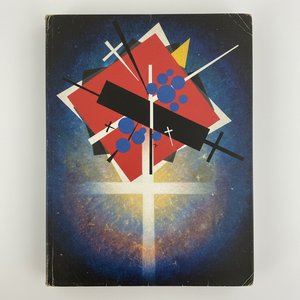
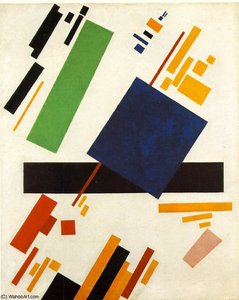
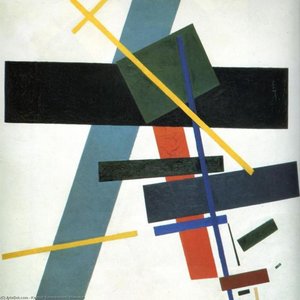
In the hands of Kazimir Malevich, geometry became more than just a mathematical tool; it became a sacred alphabet. The movement utilized a vocabulary of fundamental shapes—the square, the circle, and the cross—to construct a new visual reality. These forms were not intended to represent anything other than themselves. When we observe works such as Suprematist Painting 7, we see how the strategic placement of blue squares and vibrant accents creates a sense of rhythmic movement and depth without ever resorting to traditional perspective. The geometry serves as a structural foundation for an emotional architecture.
The power of this geometric language lies in its ability to evoke complex psychological states through simplicity. A single, bold yellow square, as seen in the seminal work Guard (1914), can command the viewer's attention with an intensity that a thousand detailed figures could not achieve. The interaction between these shapes—their overlapping, their rotation, and their perceived tension—creates a dynamic energy. This is the essence of the Suprematist method: using the most basic elements of visual perception to trigger profound, non-objective experiences in the observer.
Beyond the Canvas: The Philosophical Weight of the Zero Point
At the heart of Suprematism lies a concept often referred to as the "zero point" of painting. This was the moment where the artist intentionally reached the end of representational history and began anew. It was an act of artistic annihilation, a clearing of the slate that allowed for the birth of a new consciousness. To reach this zero point, Malevich pushed abstraction to its absolute limit, stripping away all traces of the recognizable until only the essence remained. This was not a void of emptiness, but a void of infinite potential.
This philosophical pursuit required a radical detachment from the ego and the external world. The artist’s task was to navigate the "desert" of non-objectivity, finding meaning in the tension between light and dark, or between the stillness of a shape and the perceived motion of its placement. In his Sketchbook entries from 1916, we see the iterative process of this exploration—circles and upward arrows that suggest a trajectory toward a higher, more spiritual plane of existence. For the collector, understanding this movement requires appreciating that the "nothingness" on the canvas is actually a dense, concentrated presence of pure thought.
Mastering the Void: Key Works and the Evolution of Abstraction
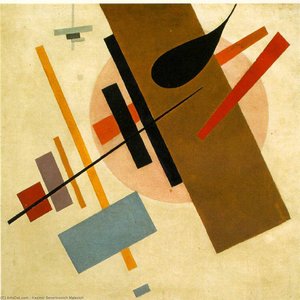
The evolution of Suprematist works demonstrates a masterful command over the concept of space. Early experiments often focused on the stability of the square, but as the movement matured, the compositions became increasingly complex and kinetic. The shapes began to appear as if they were floating in an infinite, white abyss, unanchored by any sense of ground or sky. This use of "white space" was revolutionary; it transformed the background from a passive setting into an active, cosmic medium that allowed the geometric elements to breathe and drift.
As the movement progressed, the interplay of color became more sophisticated. While black and white provided the foundational contrast, the introduction of primary colors and subtle gradients added layers of sensory depth. The mastery of this void is evident in how a viewer can feel the weight of a dark shape or the lightness of a translucent one. These works do not merely sit on the wall; they inhabit the space around them, challenging our perceptions of gravity, balance, and the very nature of what it means to "see" art.
Suprematist Influence on Modern Design and Contemporary Collecting
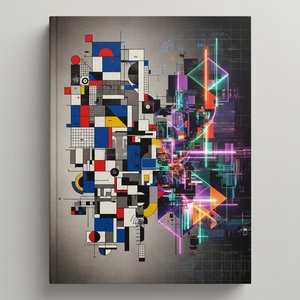
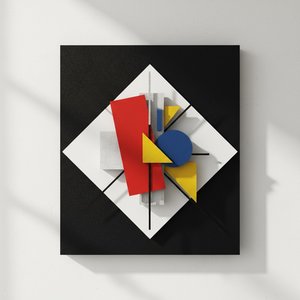
The legacy of Suprematism extends far beyond the early 20th-century Russian avant-garde. Its fingerprints are visible in the clean lines of Bauhaus architecture, the minimalist aesthetics of modern graphic design, and the streamlined forms of contemporary industrial products. The movement taught us that simplicity is not a lack of complexity, but rather the ultimate refinement of it. This principle continues to resonate in the high-end interiors of today, where collectors seek pieces that offer intellectual rigor and visual clarity.
For the modern art collector, Suprematist-inspired works offer a timeless elegance that transcends fleeting trends. Whether through the acquisition of historical reproductions or contemporary pieces that echo this geometric spirit, there is an enduring value in art that speaks to the fundamental structures of our universe. The movement remains a cornerstone of modernism, providing a blueprint for how we can find beauty and profound meaning in the most essential elements of existence.