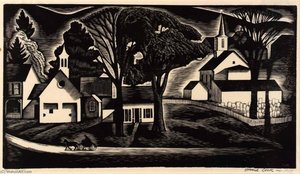
Early Life & European Influences: Shaping Cook's Artistic Foundation
Howard Norton Cook (1901–1980) was an American artist, particularly known for his wood engravings and murals. Cook spent much of the 1920s in Europe and returned to live in Taos, New Mexico. Cook first came to Taos, New Mexico in 1926 commissioned b...
Howard Norton Cook, born in 1901, wasn’t immediately destined for the sun-drenched landscapes of New Mexico that would ultimately define his artistic vision. His formative years unfolded amidst the burgeoning art scene of Boston and a pivotal sojourn to Europe during the 1920s. While initially drawn to painting, it was the discipline of wood engraving – a medium demanding both precision and expressive force – that truly captured his attention. This period wasn’t merely about technical training; it was an immersion in the modernist currents sweeping across the continent. Cook absorbed influences from German Expressionism, with its raw emotionality, and the clean lines of Scandinavian design, elements that would later subtly inform his own distinct style. He studied at the Boston School of Practical Art and then ventured to Europe, seeking a deeper understanding of artistic traditions and contemporary movements. This early exposure wasn’t about imitation but rather a critical engagement with diverse aesthetics, laying the groundwork for Cook's eventual synthesis of regional subject matter with modernist sensibilities.
The Taos Years: Regionalism, Woodcuts, and Collaboration with Barbara Latham
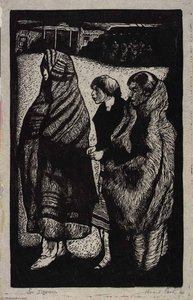 San Ildefonso
Explore Howard Cook’s ‘San Ildefonso,’ a striking 1927 woodcut depicting figures in a dramatic black & white scene. An Expressionist masterpiece by an American artist.
In 1926, a commission from *The Forum* magazine to create woodcut illustrations for Willa Cather’s “Death Comes for the Archbishop” brought Cook to Taos, New Mexico. This marked a turning point in his career, initiating a profound connection with the American Southwest and its unique cultural landscape. The stark beauty of the high desert, the adobe architecture, and the traditions of the Pueblo people resonated deeply with the artist. It was in Taos that he met Barbara Latham, also an artist, who would become his lifelong collaborator and wife. Their partnership wasn’t simply a shared life but a dynamic artistic dialogue. Together, they embraced Regionalism – a movement seeking to depict authentic American scenes and values – yet Cook's approach remained nuanced. His woodcuts weren’t sentimental portrayals; they were powerful statements about the land, its people, and the interplay of light and shadow. Works like “Southwest Design” exemplify this period, showcasing trains and sun motifs rendered with striking clarity and a modernist sensibility that elevated it beyond mere illustration.
Documenting the American Landscape: 'Death Comes for the Archbishop' and Beyond
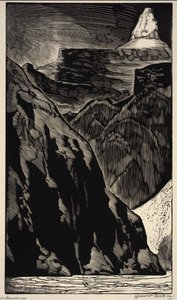 Colorado River
Howard Cook’s ‘Colorado River’ (1927) is a stunning woodcut capturing American landscape beauty. Explore this masterpiece's serene tones & powerful lines – a must-see print!
The illustrations for Cather’s novel were more than just professional assignments; they became a vehicle for Cook to explore his burgeoning artistic voice. The black-and-white woodcuts, imbued with dramatic contrast and carefully considered composition, captured the spiritual weight of the narrative and the austere beauty of New Mexico. “San Ildefonso” (1927), another striking example from this period, reveals a mastery of line and form, depicting figures in a scene charged with emotion and mystery. Beyond “Death Comes for the Archbishop,” Cook continued to document the American landscape, focusing on the Colorado River and other iconic Western vistas. “Colorado River” (1927) is particularly compelling, its serene tones and powerful lines evoking both the grandeur and fragility of nature. These weren’t simply picturesque scenes; they were meditations on the relationship between humanity and the environment, imbued with a sense of quiet reverence.
New Deal Murals & Wartime Service: Art as Social Commentary and Witness
Howard Cook from Joseph Pennell. By isolating stylistic matters from ... Grant Wood— A Study in American Art and Culture, New York, Viking Press, ...
The economic hardships of the Great Depression prompted Cook to engage with government-sponsored art projects. He secured commissions through the New Deal’s Section of Painting and Sculpture, creating murals for courthouses in Pittsburgh and Springfield, Massachusetts. These works reflected a commitment to social realism, depicting scenes of everyday life and celebrating the dignity of labor. In 1937, he completed a significant fresco cycle, “The Importance of San Antonio in Texas History,” demonstrating his ability to translate his woodcut aesthetic into large-scale public art. However, Cook’s artistic engagement extended beyond domestic concerns. During World War II, he led an art unit accompanying the U.S. Army's 43rd Infantry Division throughout the Asiatic-Pacific Theater. This experience profoundly impacted his work, resulting in a series of drawings and watercolors documenting the realities of war – a stark contrast to the idyllic landscapes of his earlier career. These wartime images, part of the “The Army at War” exhibition, served as powerful visual testimonies.
Cook’s Evolving Style: From Expressionism to Abstract Tendencies
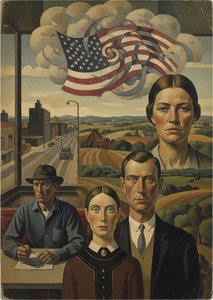
Abstract expressionism in the United States emerged as a distinct art movement in the aftermath of World War II and gained mainstream acceptance in the 1950s, a shift from the American social realism of the 1930s influenced by the Great Depression an...
While firmly rooted in Regionalism, Cook's artistic trajectory wasn’t static. Throughout his career, he experimented with form and technique, gradually moving towards more abstract expressions. The influence of German Expressionism remained palpable, but it was tempered by a growing interest in simplification and the exploration of pure visual elements. His later works often feature bold compositions and dynamic interplay of light and shadow, hinting at an underlying abstraction. This evolution wasn’t a complete abandonment of representational imagery but rather a refinement of his artistic language, seeking to convey emotion and meaning through increasingly subtle means. He never fully embraced Abstract Expressionism – the dominant movement that followed the war – yet his later works demonstrate a clear affinity for its emphasis on spontaneity and emotional intensity.
Legacy and Influence: Howard Cook in the Context of 20th-Century American Art
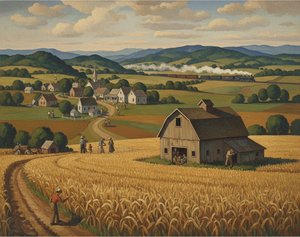
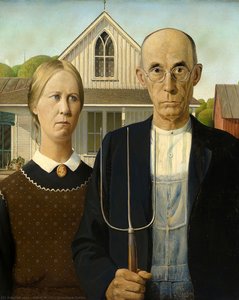
American Regionalism is an American realist modern art movement that included paintings, murals, lithographs, and illustrations depicting realistic scenes of rural and small-town America, primarily in the Midwest. It arose in the 1930s as a response ...
Howard Cook’s contribution to 20th-century American art lies in his ability to synthesize regional subject matter with modernist aesthetics. He wasn't merely a documentarian of the Southwest; he was an interpreter, imbuing his woodcuts and murals with a unique sense of place and emotional depth. His work stands as a testament to the power of artistic collaboration – particularly his partnership with Barbara Latham – and his commitment to using art as a vehicle for social commentary and personal expression. Though perhaps less widely celebrated than some of his Regionalist contemporaries, Cook’s legacy continues to inspire artists and art enthusiasts alike. His prints, murals, and drawings offer a compelling glimpse into the American experience during a period of profound change, reminding us of the enduring power of art to capture both the beauty and complexity of the world around us. Explore the captivating works of Howard Cook – available now at ArtsDot.com, where you can bring his timeless artistry into your own home.