The Allure of Ruins: Robert’s Early Influences & Artistic Formation
 Wikipedia: Hubert Robert
Hubert Robert (French pronunciation: [ybɛʁ ʁɔbɛʁ]; 22 May 1733 – 15 April 1808) was a French painter in the school of Romanticism, noted especially for his landscape paintings and capricci, or semi-fictitious picturesque depictions of ruins in Italy ...
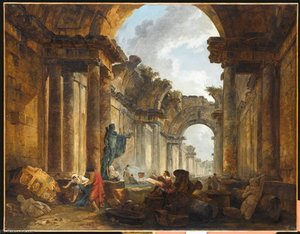
Hubert Robert, a name synonymous with the evocative power of ruins, occupies a unique position within the transition from Rococo exuberance to the burgeoning Romantic sensibility of the late 18th century. Born in Paris in 1733, his artistic journey wasn’t one of immediate acclaim but rather a gradual unfolding shaped by rigorous training and, crucially, an extended sojourn in Italy. Unlike many artists who briefly visited Rome as part of their education, Robert spent eleven formative years immersed in the ancient world, a period that fundamentally altered his aesthetic vision. His father's connections to the French diplomatic service initially facilitated this opportunity, but it was Robert’s own insatiable curiosity and burgeoning talent that allowed him to flourish within the Roman artistic milieu.
Early influences were diverse. He began his studies with Michel-Ange Slodtz, a sculptor who emphasized design and perspective – foundational skills that would later prove invaluable in rendering the complex architectural forms of his paintings. However, it was his encounter with Giovanni Paolo Panini, a celebrated *veduta* painter specializing in Roman views, that exerted a particularly strong influence. While Robert initially absorbed Panini’s techniques for depicting existing monuments, he quickly moved beyond mere topographical accuracy. He wasn't interested simply in recording what *was*, but rather in constructing imagined landscapes populated with fragments of the past, imbued with a sense of poetic melancholy.
The albums of sketches and drawings Robert meticulously assembled during his Roman years became a lifelong source of inspiration. These weren’t merely preparatory studies; they were repositories of architectural motifs, atmospheric effects, and fleeting impressions that he would later synthesize into his signature *capricci*. The presence of the Abbé de Saint-Non, a discerning connoisseur who accompanied Robert on travels to Naples and Pompeii in 1760, further refined his sensibility. Witnessing the excavated remains of Pompeii – a city frozen in time by volcanic ash – undoubtedly sparked a fascination with decay, impermanence, and the poignant beauty of lost civilizations.
Capriccio and Imagination: Defining Robert's Unique Style
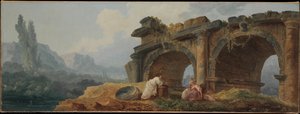 Arches in Ruins
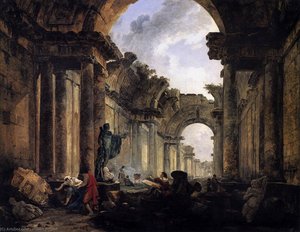
Hubert Robert’s "Arches in Ruins" captures Roman antiquity with atmospheric Romanticism. Explore this oil painting's ruins, figures & serene landscape – a timeless piece of French art.
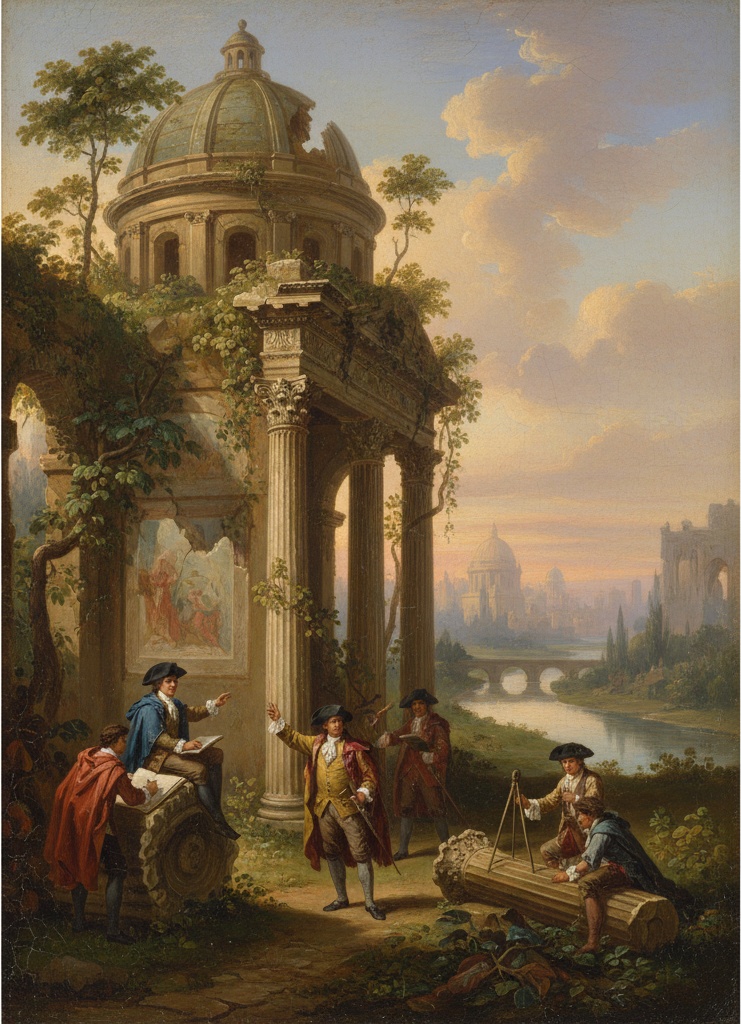
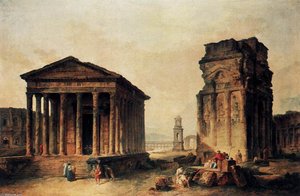
The term *capriccio*, derived from the Italian word for “whimsy,” aptly describes Robert’s distinctive artistic approach. Unlike traditional landscape painting that aimed to faithfully represent nature, his works were deliberately constructed fantasies—assemblages of real and imagined architectural elements, often juxtaposed in illogical yet visually compelling ways. He masterfully blended iconic Roman ruins with lush French landscapes, creating scenes that felt both familiar and utterly dreamlike. This wasn’t simply a matter of artistic license; it was an attempt to explore the relationship between history, memory, and imagination.
Robert's genius lay in his ability to imbue these invented spaces with a profound sense of atmosphere. He employed a sophisticated understanding of light and shadow, creating dramatic contrasts that heightened the emotional impact of his scenes. The ruins themselves weren’t merely picturesque backdrops; they were imbued with symbolic weight, representing the fragility of human endeavor and the inexorable passage of time. Figures within his paintings often appear dwarfed by the monumental scale of the architecture, emphasizing humanity's smallness in the face of historical forces.
Consider works like “Flight of Galatea,” a captivating example of Robert’s 18th-century *capriccio*. The painting seamlessly integrates Roman ruins with verdant French landscapes, creating a harmonious yet unsettling juxtaposition. Or examine "Arches in Ruins," where the atmospheric Romanticism captures the essence of antiquity and serenity. These paintings weren't intended as precise historical reconstructions but rather as evocative meditations on the beauty of decay and the power of memory. The visible brushstrokes and textures further enhance this sense of immediacy, reminding the viewer that they are looking at an interpretation—a carefully constructed vision rather than a literal representation.
A Royal Commission: The 'Monuments de France' Series and its Historical Context
Robert’s talent didn’t go unnoticed. In 1786, he received a prestigious commission from the Comte d’Angiviller, Director-General of Buildings, Art, and Curiosities for King Louis XVI. The task was ambitious: to create a series of paintings documenting significant monuments throughout France – a project known as the ‘Monuments de France.’ This commission marked a turning point in Robert’s career, elevating him to the status of official court artist.
However, the ‘Monuments de France’ series wasn't simply an exercise in topographical documentation. While Robert faithfully depicted the architectural details of each site, he also infused his paintings with a distinct artistic sensibility. He often included figures engaged in everyday activities, adding a sense of life and scale to the scenes. More importantly, the commission coincided with a growing interest in national identity and cultural preservation within France. The series can be seen as an attempt to celebrate the country’s rich architectural heritage at a time when political tensions were rising.
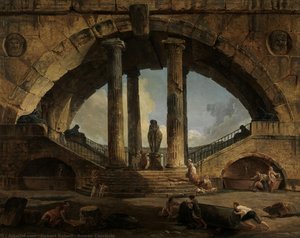
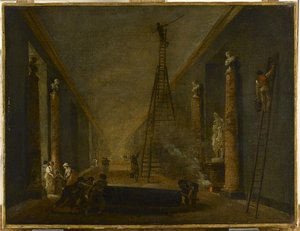
The paintings also reflect Enlightenment discourses on architecture and urban transformation. Robert's depictions of ruins weren't merely aesthetic choices; they were often juxtaposed with scenes of contemporary demolition projects in Paris, prompting viewers to contemplate the relationship between past glory and present decay. Works like “Staircase with Columns” exemplify this tension, showcasing both the grandeur of ancient structures and the inevitable erosion of time.
Robert and the Spirit of Romanticism: Nature, Decay, and Emotional Resonance
Romanticism (also known as the Romantic movement or Romantic era) was an artistic and intellectual movement that originated in Europe towards the end of the 18th century. The purpose of the movement was to advocate for the importance of subjectivity...
Hubert Robert’s work is inextricably linked to the broader Romantic movement that swept across Europe in the late 18th and early 19th centuries. While he predates many of the most celebrated Romantic painters, his emphasis on emotion, imagination, and the sublime foreshadowed key themes of the era. The Romantics rejected the rationalism of the Enlightenment, advocating for a more intuitive and subjective understanding of the world. They found inspiration in nature, history, and the power of individual experience.
Robert’s fascination with ruins perfectly aligned with Romantic sensibilities. Ruins weren't simply remnants of past civilizations; they were imbued with symbolic weight, representing the fragility of human endeavor and the inexorable passage of time. The decay itself became a source of beauty, evoking feelings of melancholy, nostalgia, and awe. His paintings often feature dramatic lighting effects and atmospheric perspectives that heighten this emotional resonance.
Furthermore, Robert’s emphasis on landscape painting resonated with Romantic ideals. He wasn't interested in depicting nature as a pristine wilderness but rather as a dynamic force shaped by history and human intervention. The integration of ruins into his landscapes created scenes that felt both familiar and otherworldly, inviting viewers to contemplate the relationship between humanity and the natural world.
Beyond Representation: Exploring Themes of Memory, Time & Loss in Robert’s Oeuvre
To view Hubert Robert solely as a painter of picturesque ruins would be a profound disservice. Beneath the surface beauty lies a deeper exploration of fundamental human themes—memory, time, and loss. His paintings aren't simply about what *was* but rather about how we remember the past and grapple with its inevitable decay.
The figures within his paintings often serve as intermediaries between the viewer and the ruins, prompting us to contemplate our own relationship to history. They are not merely incidental details; they are embodiments of human experience, engaging in activities that evoke a sense of nostalgia or contemplation. The inclusion of contemporary elements alongside ancient structures further emphasizes this tension between past and present.
Robert’s personal experiences also informed his artistic vision. His imprisonment during the French Revolution – an ordeal during which he created numerous drawings documenting prison life – undoubtedly deepened his awareness of fragility, impermanence, and the power of memory. Even after his release, the trauma of this experience continued to resonate in his work.
Collecting Hubert Robert: A Legacy of Visionary Landscapes
Today, Hubert Robert’s paintings are highly sought-after by collectors worldwide. His works represent a unique intersection of Rococo elegance and Romantic sensibility, appealing to those who appreciate both technical mastery and emotional depth. Owning a painting by Robert is not merely acquiring a beautiful object; it's possessing a piece of history—a testament to the power of imagination and the enduring allure of the past.
ArtsDot.com offers exquisite handmade oil paintings reproducing Robert’s masterpieces, allowing art enthusiasts to experience his visionary landscapes firsthand. Each reproduction is meticulously crafted by skilled artists using professional-grade materials, ensuring a faithful representation of the original artwork. Whether you're seeking a grand statement piece or a more intimate study, ArtsDot provides access to a timeless collection that will enrich your home and inspire generations to come. Explore our selection today and discover the captivating world of Hubert Robert.