Early Life and Artistic Foundations: From Bourgeois Beginnings to Initial Training
 Wikipedia: Jean-Baptiste-Camille Corot
Jean-Baptiste-Camille Corot (UK: KORR-oh, US: kə-ROH, kor-OH; French: [ʒɑ̃ batist kamij kɔʁo]; 16 July 1796 – 22 February 1875), or simply Camille Corot, was a French landscape and portrait painter as well as a printmaker in etching. A pivotal figu...
Jean-Baptiste-Camille Corot, a name synonymous with the serene beauty of French landscape painting, emerged not from a lineage of established artists but from the solid respectability of Parisian bourgeois life. Born in 1796, his early years were marked by a comfortable upbringing – his father a successful wigmaker, his mother a skilled milliner. This financial security, unusual for aspiring painters of the era, allowed Corot a freedom to pursue his artistic inclinations without the immediate pressure of commercial necessity. However, this path wasn’t initially direct. His scholastic record was unremarkable; he lacked the early aptitude often associated with prodigies and initially showed little inclination towards art. A brief apprenticeship in drapery followed, an experience he reportedly detested, finding “business tricks” incompatible with his temperament. Yet, even within this seemingly unrelated trade, Corot honed a sensitivity to color and texture that would later inform his delicate palette.
The turning point arrived around 1821 when, at the age of twenty-five, he finally secured his father’s consent to dedicate himself fully to painting. This decision wasn't born from sudden inspiration but a gradual realization that art was not merely a pastime but a calling. He rented a studio on the quai Voltaire and began a period of rigorous study under Achille Etna Michallon, a landscape painter already respected for his adherence to classical principles. Michallon’s influence proved crucial, grounding Corot in the fundamentals of composition and observation – skills that would serve as the bedrock of his future achievements. This early training emphasized outdoor sketching followed by meticulous finishing work indoors, a practice common among artists seeking to balance fidelity to nature with artistic refinement.
The Barbizon Circle: Corot’s Embrace of Naturalism and Landscape Painting
Corot's artistic trajectory truly blossomed with his discovery of the Forest of Fontainebleau in 1829. This vast woodland, a short distance from Paris, became a magnet for a group of artists who shared a growing dissatisfaction with the rigid conventions of academic painting. This collective, later known as the Barbizon School, represented a shift towards naturalism – an honest depiction of the landscape without idealization or dramatic embellishment. Unlike the historical landscapes favored by Neoclassical painters, which often served as backdrops for mythological narratives, the Barbizon artists focused solely on the beauty and inherent dignity of nature itself.
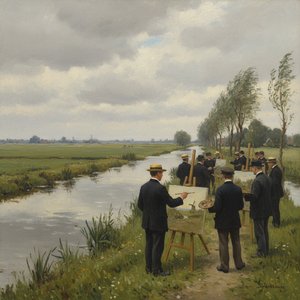
Corot quickly found kinship with figures like Théodore Rousseau, Paul Huet, Constant Troyon, and Jean-François Millet. These were not merely colleagues but kindred spirits united by a shared passion for capturing the subtle nuances of light, atmosphere, and rural life. He participated in their informal gatherings, exchanging ideas and techniques while painting *en plein air* – directly from nature. While Corot’s early work already demonstrated a refined sensibility, his time with the Barbizon circle encouraged him to embrace a looser brushstroke and a more direct engagement with the landscape. He wasn't solely focused on topographical accuracy; rather, he sought to convey the *feeling* of being immersed in the natural world.
A Tonal Master: Exploring Corot’s Signature Style and Techniques
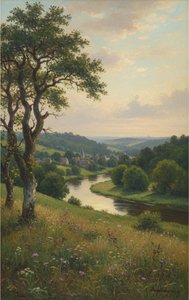
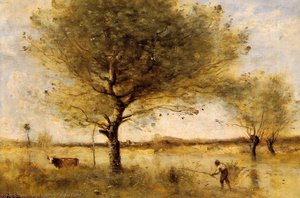
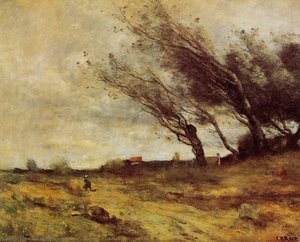
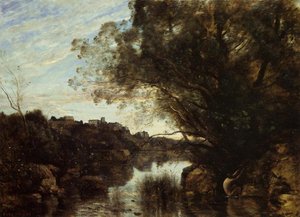
What distinguishes Corot’s paintings is not simply his subject matter – idyllic forests, tranquil riverscapes, and humble rural scenes – but rather *how* he depicted them. He became renowned as a “tonal master,” skillfully manipulating light and shadow to create an atmosphere of serene contemplation. His palette was typically restrained, favoring subtle gradations of browns, greens, grays, and blues. He layered thin washes of oil paint, building up depth and luminosity through careful glazing – a technique that allowed him to achieve remarkable atmospheric effects.
Corot’s approach wasn't about meticulous detail but rather suggestion. Forms are often softened, edges blurred, creating an impressionistic quality decades before the emergence of the Impressionist movement. He frequently employed a “divided brushstroke,” applying small touches of color that blend optically when viewed from a distance. This technique, combined with his masterful use of light and shadow, gives his paintings a remarkable sense of depth and realism. He wasn’t interested in replicating reality but rather evoking its essence – the feeling of warmth on skin, the scent of damp earth, the gentle rustling of leaves.
Corot’s Salon Success and Enduring Popularity in the 19th Century
Despite his commitment to naturalism, Corot wasn't entirely detached from the established art world. He regularly exhibited at the prestigious Paris Salons, achieving considerable success by the 1850s. Collectors and dealers eagerly sought his paintings, recognizing their unique beauty and emotional resonance. His works fetched increasingly high prices, culminating in a first-class medal at the 1855 Universal Exposition – a testament to his growing reputation. Emperor Napoleon III even purchased one of his landscapes, further solidifying his position within the artistic elite.
However, Corot’s popularity wasn't without its complexities. His later works, characterized by a more poetic and consciously refined style, were particularly sought after during his lifetime. Yet, demand often outstripped supply, leading to numerous imitations and forgeries. Ironically, it was the earlier, more naturalistic sketches – those that perhaps best captured his genuine connection with nature – that would gain greater appreciation in the 20th century. His prolific output—over 3,000 paintings—demonstrates a lifelong dedication to his craft, fueled not by ambition but by an intrinsic love of painting.
Bridging Traditions: Corot as a Precursor to Impressionism
While firmly rooted in the Barbizon tradition, Corot’s work also foreshadowed the innovations of Impressionism. His emphasis on capturing fleeting moments of light and atmosphere, his loose brushwork, and his rejection of rigid academic conventions all paved the way for artists like Monet, Renoir, and Pissarro. He didn't actively seek to break with tradition but rather subtly expanded its boundaries, creating a space for a new generation of painters to explore the possibilities of *plein air* painting.
Corot’s influence on these younger artists was profound. He provided them with a model for capturing the subjective experience of light and color, encouraging them to embrace spontaneity and direct observation. While he never fully abandoned his classical training, his willingness to experiment with new techniques and his unwavering commitment to painting from nature laid the groundwork for the Impressionist revolution. He stands as a pivotal figure—a bridge between the Neo-Classical tradition and the radical innovations of modern art.
Legacy and Influence: The Lasting Impact of Corot on Modern Art
Jean-Baptiste-Camille Corot’s legacy extends far beyond his own prolific output. He remains one of the most beloved landscape painters in history, admired for his serene beauty, technical mastery, and profound emotional resonance. His paintings continue to captivate audiences with their ability to evoke a sense of tranquility and connection with nature.
His influence can be seen in countless artists who followed, from the Post-Impressionist Vincent van Gogh—who meticulously copied over twenty of Corot’s works—to contemporary painters seeking to capture the beauty of the natural world. Corot demonstrated that landscape painting wasn't merely a descriptive exercise but a powerful means of expressing emotion and conveying a sense of place. At ArtsDot.com, we celebrate his enduring legacy by offering high-quality reproductions of his masterpieces, allowing art enthusiasts to experience the beauty and tranquility of Corot’s world firsthand. Explore our collection today and discover the timeless appeal of this remarkable artist.