Early Life & Artistic Foundations: Shaping a Viennese Vision
 Wikipedia: Koloman Moser
Koloman Moser (German: [ˈkoːloman ˈmoːzɐ]; 30 March 1868 – 18 October 1918) was an Austrian artist who exerted considerable influence on twentieth-century graphic art. He was one of the foremost artists of the Vienna Secession movement and a co-found...
Koloman Moser, born in Vienna in 1868, emerged from a milieu steeped in tradition yet yearning for change. His father, Josef Moser, was a successful porcelain painter, and it was within this environment of meticulous craftsmanship that the young Koloman first encountered the world of art. However, his artistic trajectory wasn’t simply one of inheritance; it was forged through rigorous academic training at the Wiener Akademie der bildenden Künste and later, at the Kunstgewerbeschule – the School of Applied Arts. These institutions provided him with a solid foundation in drawing, painting, and design principles, but it was his insatiable curiosity and burgeoning dissatisfaction with prevailing artistic norms that truly set him on a path toward innovation. Early influences included the historical revival styles prevalent at the time, yet Moser quickly gravitated towards a more holistic approach, one that sought to unify art and life – a concept central to the emerging Art Nouveau movement.
His initial work as an illustrator for Meggendorfer Blätter, a popular German illustrated magazine, honed his skills in graphic design and composition. This period was crucial in developing his distinctive style—characterized by elegant lines, intricate patterns, and a subtle yet powerful use of symbolism. It wasn’t merely about creating aesthetically pleasing images; it was about conveying meaning through visual language, a skill that would become paramount in his later endeavors. The seeds of the Vienna Secession were being sown during these formative years, as Moser began to question the rigid boundaries between fine art and applied arts.
The Vienna Secession: Rebellion, Innovation, and 'Ver Sacrum'
The Vienna Secession (German: Wiener Secession; also known as the Union of Austrian Artists or Vereinigung Bildender Künstler Österreichs) is an art movement, closely related to Art Nouveau, that was formed in 1897 by a group of Austrian painters, gr...
In 1897, a pivotal moment arrived for Viennese art. Disillusioned with the conservative policies of the Association of Austrian Artists, a group of forward-thinking artists—including Gustav Klimt, Josef Hoffmann, and Koloman Moser—made the bold decision to secede. This act of rebellion wasn’t simply about breaking away from an institution; it was a declaration of artistic independence, a commitment to exploring new forms of expression free from academic constraints. The Vienna Secession aimed to create a platform for all modern art forms, encompassing painting, sculpture, architecture, and design.
Central to the Secession’s identity was Ver Sacrum (“Sacred Spring”), the group's official magazine. Moser assumed a leading role in its artistic direction, transforming it into a stunning showcase of Art Nouveau aesthetics. As art director, he meticulously oversaw every aspect of the publication—from typography and layout to illustrations and graphic design. Each issue was a Gesamtkunstwerk – a total work of art – embodying the Secession’s ideals of unity and harmony. The magazine served as a vital conduit for disseminating new ideas and showcasing the work of both Austrian and international artists, solidifying Vienna's position at the forefront of the modernist movement.
Wiener Werkstätte: A Pursuit of the Gesamtkunstwerk
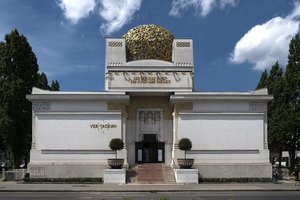 Secession
218
While the Secession provided a crucial platform for artistic expression, it lacked a dedicated workshop to realize its ambitious vision. In 1903, Koloman Moser and Josef Hoffmann co-founded the Wiener Werkstätte (Vienna Workshop), an enterprise designed to bridge the gap between art and craft. The Werkstätte wasn’t merely about producing beautiful objects; it was about creating a new way of life—one where every aspect of daily existence, from furniture and tableware to jewelry and fashion, would be imbued with artistic value.
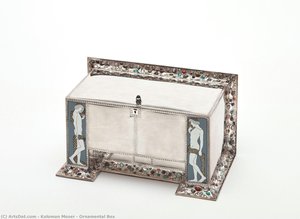
Moser's role within the Wiener Werkstätte was multifaceted. He served as an artist-designer, creating countless designs for textiles, glassware, ceramics, and silverware. His work exemplified a commitment to quality craftsmanship, elegant simplicity, and functional beauty. The Werkstätte’s philosophy rejected mass production in favor of handmade objects created by skilled artisans—a direct response to the perceived vulgarity of industrialization. However, maintaining financial stability proved challenging, and Moser eventually withdrew from the Werkstätte in 1907, focusing instead on his painting.
Moser’s Diverse Oeuvre: From Graphic Design to Stained Glass
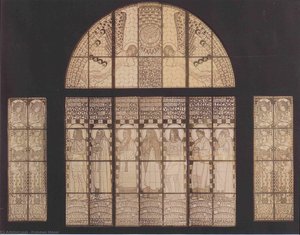 Church Am Steinhof, drawing of western window
Explore Koloman Moser’s ‘Church Am Steinhof’ stained glass drawing – a stunning example of Art Nouveau/Gothic Revival. Discover intricate geometric patterns & biblical symbolism in this unique 19th-century masterpiece.
Koloman Moser's artistic output was remarkably diverse. While he is perhaps best known for his graphic design work and contributions to the Wiener Werkstätte, his talents extended far beyond these realms. He excelled in stained glass art, creating breathtaking windows that infused sacred spaces with light and color. His designs for the Kirche am Steinhof (Church at the Steinhof), a psychiatric hospital near Vienna, are particularly noteworthy—featuring intricate geometric patterns and biblical symbolism rendered in vibrant hues. These windows weren’t simply decorative elements; they were integral to the overall architectural vision, designed to evoke a sense of spiritual tranquility.
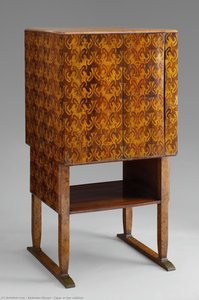
Beyond stained glass, Moser also ventured into furniture design, porcelain painting, and even stamp design – notably, an unaccepted proposal for Emperor Charles I in 1917. This demonstrates his unwavering commitment to applying his artistic principles across various mediums. His work consistently reflected a fascination with classical Greek and Roman art, incorporating clean lines, repetitive motifs, and a sense of harmonious balance. He also explored the possibilities of abstract design, foreshadowing later developments in modern art.
Legacy & Influence: Koloman Moser's Enduring Impact on Modern Art
Koloman Moser’s influence on twentieth-century graphic art is undeniable. His work helped to define the aesthetics of the Vienna Secession and Wiener Werkstätte, leaving an indelible mark on the fields of design, architecture, and applied arts. His commitment to the Gesamtkunstwerk—the idea of a unified artistic vision encompassing all aspects of life—continues to inspire artists and designers today.
Though he faced personal struggles and financial challenges throughout his career, Moser remained steadfast in his pursuit of artistic excellence. His designs continue to be celebrated for their elegance, sophistication, and timeless beauty. From the intricate patterns of Ver Sacrum to the luminous stained glass windows of the Kirche am Steinhof, Koloman Moser’s legacy endures as a testament to the power of art to transform our world. Discover his captivating works and explore the rich history of Viennese Art Nouveau with ArtsDot, where masterpieces are brought to life through exquisite handmade oil paintings and museum-quality prints.