
The Vienna Roots and Parisian Flourishing of Raphael Kirchner
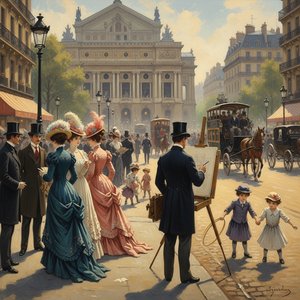
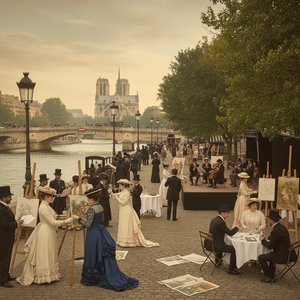
Raphael Kirchner, a name perhaps less immediately recognizable than some of his Art Nouveau contemporaries, nevertheless occupies a pivotal position in the aesthetic landscape of the late 19th and early 20th centuries. Born in Vienna in 1875, Kirchner’s artistic journey began within the fertile creative environment of Austria's imperial capital. While he received formal training at the Academy of Fine Arts Vienna, it was his relocation to Paris around 1900 that truly ignited his distinctive style and propelled him into prominence. Paris, at the turn of the century, was a crucible of artistic innovation – a city brimming with new ideas, burgeoning cabarets, and a public hungry for fresh visual experiences. Kirchner arrived during the height of the Belle Époque, an era characterized by optimism, prosperity, and a blossoming of decorative arts. This vibrant atmosphere proved to be the ideal catalyst for his unique talent, allowing him to synthesize influences from Japanese woodblock prints, the flowing lines of Art Nouveau, and a distinctly Viennese sensibility.
Early in his Parisian career, Kirchner found work illustrating for magazines like La Vie Parisienne, a publication that catered to a sophisticated audience with its depictions of fashionable life and social events. This early exposure honed his skills in capturing the elegance and allure of contemporary women – a theme that would become central to his oeuvre. However, it wasn’t merely technical proficiency that set Kirchner apart; he possessed an innate ability to imbue his subjects with a sense of personality and grace, foreshadowing the iconic ‘Kirchner Girls’ that would soon define his artistic reputation.
Kirchner Girls: Defining an Aesthetic – Alluring Figures and Japanese Influences
 Raphael Kirchner
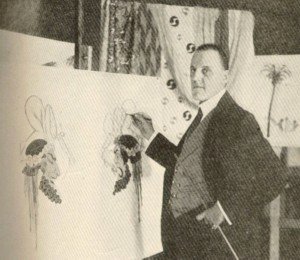
Raphael Kirchner (1875-1917) was a Viennese visionary and illustrator known for his ‘Kirchner Girls’ – alluring figures & Japanese influences, pioneering the pin-up aesthetic.
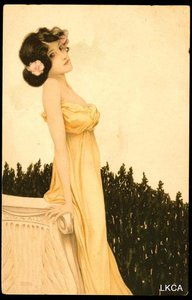
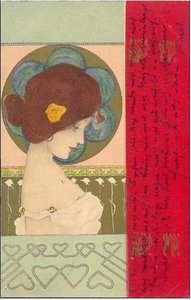
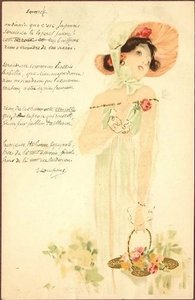
The “Kirchner Girls” are arguably his most enduring legacy. These weren't simply portraits; they were embodiments of a new feminine ideal—independent, stylish, and possessing a subtle yet captivating sensuality. Unlike the often-idealized depictions of women in academic art, Kirchner’s figures felt remarkably modern, reflecting the changing social roles and attitudes towards women during the Belle Époque. They weren't overtly provocative, but rather exuded an air of self-assuredness and playful charm.
A key element contributing to their distinctive aesthetic was Kirchner’s masterful integration of Japanese artistic principles. The influence of ukiyo-e woodblock prints – particularly in terms of composition, flattened perspective, and bold use of color – is readily apparent in his work. He wasn't simply copying Japanese styles; he was skillfully adapting them to a Western context, creating a unique fusion that resonated with the public’s growing fascination with Eastern art. The delicate floral motifs, flowing robes, and often-stylized backgrounds further enhanced this exotic allure. Kirchner’s ability to blend these disparate influences – Viennese elegance, Parisian fashion, and Japanese artistry – resulted in an instantly recognizable style that captured the spirit of a changing era.
Art Nouveau's Embrace: Style, Motifs, and the Belle Époque Context
Art Nouveau ( AR(T) noo-VOH; French: [aʁ nuvo] ; lit. 'New Art'), Jugendstil in German, is an international style of art, architecture, and applied art, especially the decorative arts. It was often inspired by natural forms such as the sinuous curves...
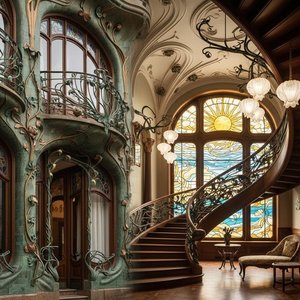
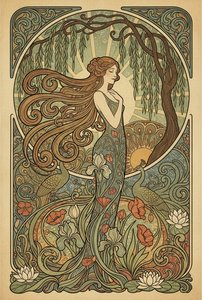
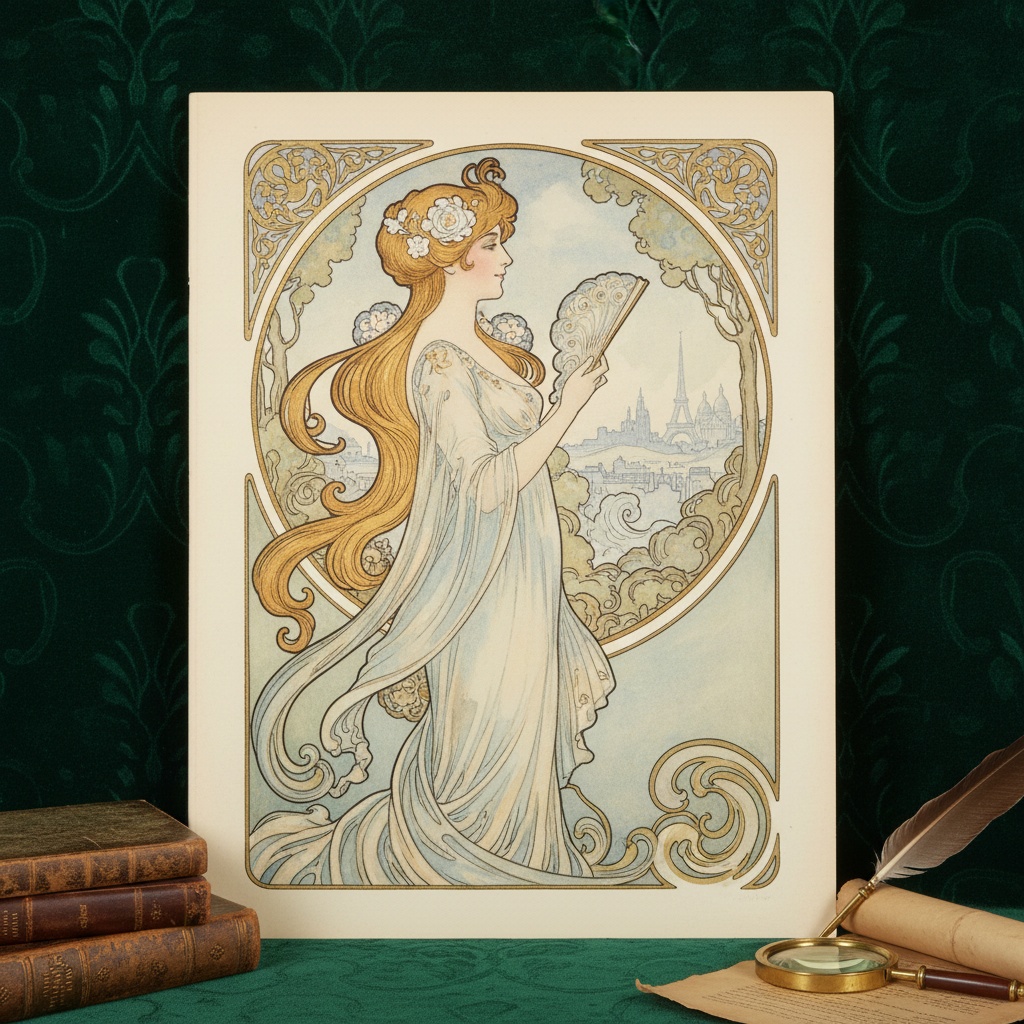
Raphael Kirchner was deeply embedded within the Art Nouveau movement, though his work possesses a unique character distinct from some of its more overtly organic or fantastical expressions. Art Nouveau, as it flourished between 1890 and 1910, represented a deliberate rejection of academicism in favor of natural forms, sinuous curves, and a sense of dynamism. Kirchner embraced these principles, but tempered them with his own refined sensibility.
His compositions often feature flowing lines that echo the organic shapes found in nature – particularly flowers and foliage. These motifs weren’t merely decorative; they served to frame and accentuate the beauty of his female subjects, creating a harmonious balance between figure and background. The Belle Époque provided the perfect backdrop for Art Nouveau's flourishing. The era’s technological advancements—new printing techniques, innovative materials like iron and glass—allowed artists to experiment with form and create increasingly elaborate designs. Kirchner skillfully exploited these possibilities, producing hundreds of lithographs that brought his art into the homes of a wide audience.
From Postcards to Pin-Ups: The Commercial Success and Cultural Impact of Kirchner’s Work
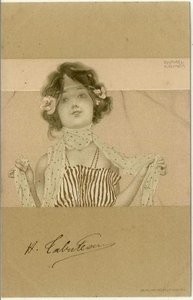 Girls between brown-green borders
Admire 'Girls between brown-green borders,' a stunning Art Nouveau painting by Raphael Kirchner (1901). Explore its serene beauty & elegant details – a unique masterpiece for art lovers.
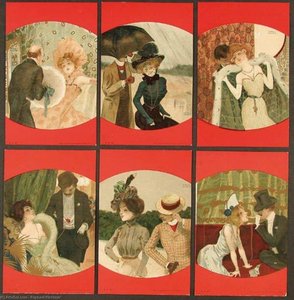
Kirchner's genius lay not only in his artistic talent but also in his understanding of the burgeoning commercial possibilities of mass reproduction. He recognized the potential of picture postcards as a medium for disseminating his art, and he quickly became one of the most prolific postcard artists of his time. Producing over a thousand published paintings and drawings, primarily in postcard format, Kirchner’s work reached an unprecedented audience.
His “Geisha” series proved particularly popular, with over 40,000 cards sold – a testament to the public's fascination with exotic imagery. However, it was his depictions of fashionable women that truly cemented his reputation. These images weren’t simply decorative; they subtly challenged conventional notions of femininity and sexuality. While not overtly scandalous, Kirchner’s work paved the way for the development of the pin-up aesthetic – a genre that would become hugely influential in the 20th century. His paintings offered a glimpse into a world of glamour and sophistication, appealing to both men and women alike.
Technical Mastery and Artistic Process: A Closer Look at Kirchner’s Lithography
The medium Kirchner favored – lithography – was crucial to his artistic success. Lithography allowed for the reproduction of delicate lines, subtle gradations of tone, and vibrant colors, making it ideally suited to his style. The process involved drawing with a greasy crayon or ink onto a stone surface, which was then treated chemically to create an image that could be transferred to paper.
Kirchner’s skill in lithography wasn't merely technical; he understood how to exploit the medium’s unique qualities to achieve specific artistic effects. His compositions often feature carefully layered colors and textures, creating a sense of depth and luminosity. He also demonstrated a remarkable attention to detail, capturing the intricate patterns of fabrics, the delicate features of his subjects, and the subtle nuances of light and shadow. The hand-painted reproductions available today allow us to appreciate the artistry and craftsmanship that went into each of Kirchner’s creations – a testament to his enduring legacy.
Kirchner’s Legacy: Influence on Vargas and the Evolution of the Pin-Up Genre
Raphael Kirchner's influence extended far beyond the Belle Époque. His work served as an early inspiration for Peruvian painter Alberto Vargas, who would later become a leading figure in the American pin-up art scene. Vargas openly acknowledged Kirchner’s impact on his style, citing his elegant depictions of women and his mastery of composition as key influences.
Kirchner's paintings helped to establish many of the conventions that would define the pin-up genre – the emphasis on feminine beauty, the subtle sensuality, and the playful charm. Even during World War II, Kirchner’s work was still recognized for its influence on the pin-up aesthetic favored by soldiers. His lasting contribution lies in his ability to capture the spirit of a changing era—a time of optimism, prosperity, and evolving social norms—and translate it into images that continue to captivate audiences today. Through ArtsDot.com, Kirchner’s timeless artistry is now accessible to art lovers worldwide, ensuring that his poetic vision continues to inspire for generations to come.