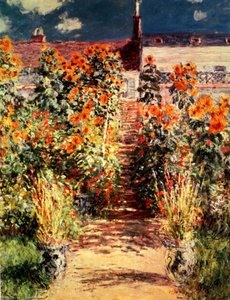
The Impressionist Rebellion: Breaking from Academic Tradition
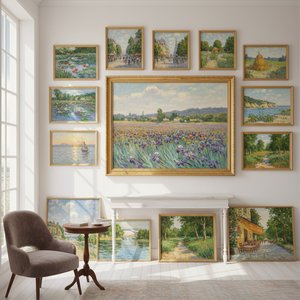 Impressionist Landscapes: 10 Masterpieces for Your Home | ArtsDot
Introduction Imagine stepping into a world bathed in dappled sunlight, where colors dance and shimmer with an ethereal quality. This is the realm of Impressionism – a revolutionary art movement that forever altered how we perceive light, color, and t...
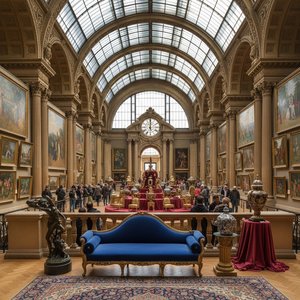
To understand the seismic shift brought about by Claude Monet, one must first envision the rigid, somber world of the nineteenth-century French Salon. For decades, the art establishment demanded meticulous detail, historical gravity, and a polished finish that obscured the artist's hand. The Academy favored mythological grandeur and smooth, invisible brushwork, creating a window into a perfected, static reality. However, a group of young rebels—including Monet, Renoir, and Pissarro—began to chafe under these constraints. They sought not to depict what they knew to be true through historical dogma, but to capture the raw, immediate sensation of what they actually saw.
This rebellion was more than a mere change in subject matter; it was an ontological revolution. When Monet exhibited Impression, soleil levant in 1874, the term "Impressionism" was initially hurled as a derisive critique by critics who found his loose, unfinished style scandalous. Yet, within these seemingly incomplete strokes lay a profound truth: reality is not a fixed entity of lines and shadows, but a fluid, vibrating experience. By rejecting the heavy, dark palettes of the academic masters, Monet and his contemporaries embraced a brighter, more spontaneous approach that prioritized the sensory impact of the moment over the anatomical or architectural precision of the past.
This era of defiance laid the essential groundwork for modernism. It invited the viewer to participate in the creation of meaning, as the eye was required to blend the fragmented colors and light on the canvas into a coherent image. For the contemporary collector, owning a piece that embodies this spirit is not merely about decoration; it is about preserving a moment of historical courage when art first learned to breathe.
The Science of Sight: Monet’s Obsession with Light and Atmosphere
 Claude Monet
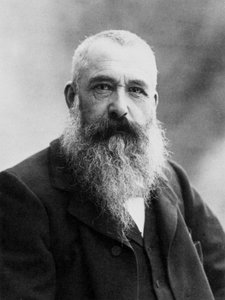
A Life Immersed in Light: The World of Claude Monet Oscar-Claude Monet, a name synonymous with Impressionism, wasn't merely a painter of landscapes; he was a chronicler of fleeting moments, a poet of light and color. Born in Paris on November 14, 184...
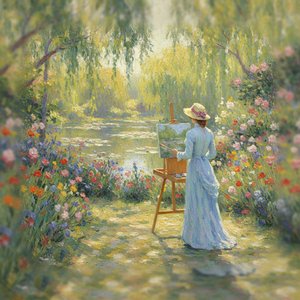
Claude Monet was far more than a painter of landscapes; he was a chronicler of the ephemeral. His true subject was never merely the haystack, the bridge, or the cathedral, but the very air that enveloped them. Influenced by his early mentor Eugène Boudin, Monet embraced the practice of en plein air painting—working directly from nature to capture the fleeting nuances of sunlight and weather. He understood that light is a transformative force, capable of altering the perceived color and texture of an object within minutes.
This obsession required a scientific level of observation. Monet studied how shadows were not simply black or grey, but composed of reflected blues, purples, and deep violets. He observed how the midday sun could bleach a landscape into high-contrast brilliance, while the twilight hour could dissolve solid forms into soft, hazy silhouettes. His technique involved applying short, broken brushstrokes of pure color, allowing the viewer's eye to perform the optical mixing that occurs in nature. This method captured the "vibration" of light, creating a sense of movement and atmosphere that traditional glazing techniques could never achieve.
Even as his physical vision changed later in life due to cataracts, Monet’s dedication to the essence of sight remained undiminished. He continued to push the boundaries of color theory, exploring how different temperatures of light—warm golds versus cool azures—interact to create depth and emotion. To gaze upon a true Impressionist work is to witness a master attempting to pin down the wind and the sun on a two-dimensional surface.
The Power of the Series: From Haystacks to Rouen Cathedral
 Haystacks (Monet series)
Haystacks is the common English title for a series of impressionist paintings by Claude Monet. The principal subject of each painting in the series is stacks of harvested wheat (or possibly barley or oats: the original French title, Les Meules à Give...
Perhaps Monet’s most profound contribution to the evolution of art was his development of the "series" concept. Beginning in earnest around 1889, Monet moved away from the idea of a single, definitive masterpiece toward a repetitive exploration of a single subject under varying conditions. This approach transformed the canvas from a static portrait into a temporal narrative. By painting the same subject dozens of times, he proved that the subject itself was secondary to the light that touched it.
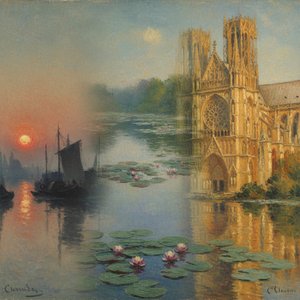
The Haystacks (or Les Meules) series is a quintessential example of this rhythmic exploration. In these works, the humble stacks of harvested wheat become vessels for studying the transition of seasons and times of day. A stack seen at dawn might glow with a delicate pink hue, while the same stack under a summer noon appears heavy with golden heat. Similarly, his Rouen Cathedral series captures the stone facade of the great Norman cathedral as it undergoes a metamorphosis through different lighting conditions—from the cool, misty blues of early morning to the fiery, dramatic oranges of sunset.
This serial vision challenged the very notion of what a painting represents. It suggested that truth is not found in a single moment, but in the accumulation of many moments. This technique also extended to his London works, such as Charing Cross Bridge, Reflections on the Thames, where he captured the industrial atmosphere and the swirling fog of the Thames. Through these series, Monet taught the world that repetition is not redundancy, but a profound way to deepen our understanding of the natural world.
Giverny and the Water Lilies: A Final Masterpiece of Perception
 Water Lilies (Monet series)
Water Lilies (French: Nymphéas [nɛ̃.fe.a]) is a series of approximately 250 oil paintings by French Impressionist Claude Monet (1840–1926). The paintings depict his flower garden at his home in Giverny, and were the main focus of his artistic product...
In the final decades of his life, Monet retreated into the sanctuary of his garden at Giverny. Here, he became both the artist and the architect of his own subject matter. He meticulously designed a water garden, complete of lily ponds and Japanese-inspired bridges, creating a controlled environment where he could study the interplay of reflection, water, and flora with unparalleled intensity.
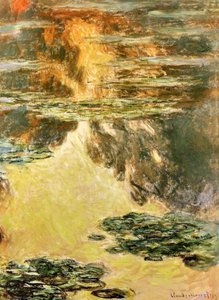
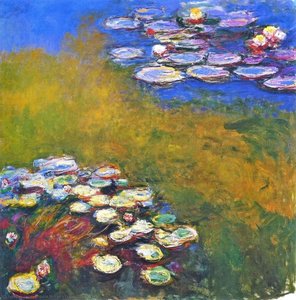
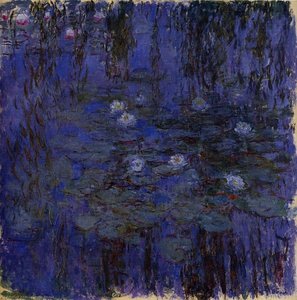
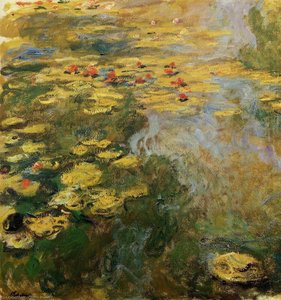
The Water Lilies (Nymphéas) series represents the zenith of his career and the culmination of his lifelong pursuit of light. These massive, immersive canvases often lack a horizon line or a fixed perspective, pulling the viewer directly into the center of the pond. The distinction between the water's surface and the sky's reflection becomes blurred, creating an almost abstract experience of color and form. In these works, Monet moved toward a state of pure impression, where the boundaries of objects dissolve into a shimmering tapestry of light.
These late works are deeply emotional and profoundly spiritual. They reflect a man grappling with mortality while simultaneously celebrating the eternal cycle of nature. The scale of these paintings—some of which were intended for the oval rooms of the Musée de l'Orangerie—demands an immersive engagement, much like a window into another dimension. They remain some of the most beloved works in the history of art, offering a sense of tranquility and cosmic connection that transcends time.
Legacy of a Visionary: How Serial Painting Redefined Modernism
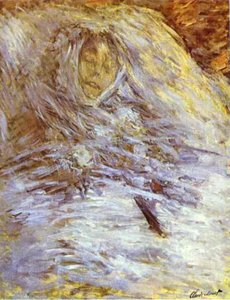 Camille Monet on Her Deathbed
The Artist: Claude Monet Claude Monet , born Oscar-Claude Monet (1840-1926), was a French artist who played a pivotal role in founding Impressionist painting, significantly influencing modernism. His philosophy, primarily based on capturing immediate...
The legacy of Claude Monet extends far beyond the boundaries of Impressionism. By breaking the grip of academic realism, he opened the floodgates for every major movement that followed. His emphasis on the materiality of paint and the subjectivity of perception paved the way for Post-Impressionism, Fauvism, and eventually, the total abstraction of the twentieth century. He proved that art could be an exploration of the artist's internal response to the external world.
Monet’s life was a testament to the power of persistence. From his early days selling charcoal caricatures in Le Havre to his final, monumental achievements at Giverny, he remained committed to the pursuit of the "impression." He taught us that beauty is found in the fleeting, the overlooked, and the ever-changing. His work invites us to slow down, to observe the subtle shifts in our surroundings, and to find wonder in the way light dances upon a leaf or reflects in a pool.
For those who wish to bring this transformative energy into their own lives, the preservation of these masterpieces is essential. At ArtsDot.com, we honor this legacy by offering museum-quality, hand-painted oil reproductions that capture the true soul of Monet’s work. Our master artists utilize traditional techniques—layering oils on 100% cotton canvas to recreate the palpable texture and depth of the original brushstrokes. Whether you seek a delicate print or a large-scale, textured oil painting to anchor a room, our collection allows you to possess a piece of this revolutionary history. We invite you to explore our curated selection and bring the eternal light of Monet into your home.