The Renaissance Departure: Understanding the Rise of Mannerism
 Mannerism
Mannerism is a style in European art that emerged in the later years of the Italian High Renaissance around 1520, spreading by about 1530 and lasting until about the end of the 16th century in Italy, when the Baroque style largely replaced it. Northe...
To understand the seismic shift that occurred in the European consciousness during the sixteenth century, one must first look back at the serene stability of the High Renaissance. For decades, the masters—Leonardo, Raphael, and the early Michelangelo—had pursued a divine equilibrium, a perfection of proportion, balance, and naturalistic clarity that seemed to capture the very essence of a rational universe. However, as the sixteenth century progressed, this era of harmonious ideals began to fracture. The certainty of the Renaissance was replaced by an era of profound tension, giving birth to Mannerism. This movement did not emerge from a lack of skill, but rather from a deliberate reaction against the perceived limitations of naturalism.
Emerging around 1520 and flourishing until the late sixteenth century, Mannerism sought to move beyond the imitation of nature toward the expression of maniera—the artist's unique style or virtuosity. It was a period where the intellectual sophistication of the artist became as important as the subject matter itself. The stability of the pyramid composition was abandoned in favor of more complex, often unsettling arrangements. This departure marked the beginning of an era where art no longer sought to mirror the world as it appeared, but rather to interpret it through a lens of heightened emotion and stylistic artifice.
Artifice and Elegance: The Distorted Beauty of the Mannerist Style
 Chiaroscuro
In art, chiaroscuro (English: kee-AR-ə-SKOOR-oh, -SKURE-, Italian: [ˌkjaroˈskuːro]; lit. 'light-dark') is the use of strong contrasts between light and dark, usually bold contrasts affecting a whole composition. It is also a technical term used by a...
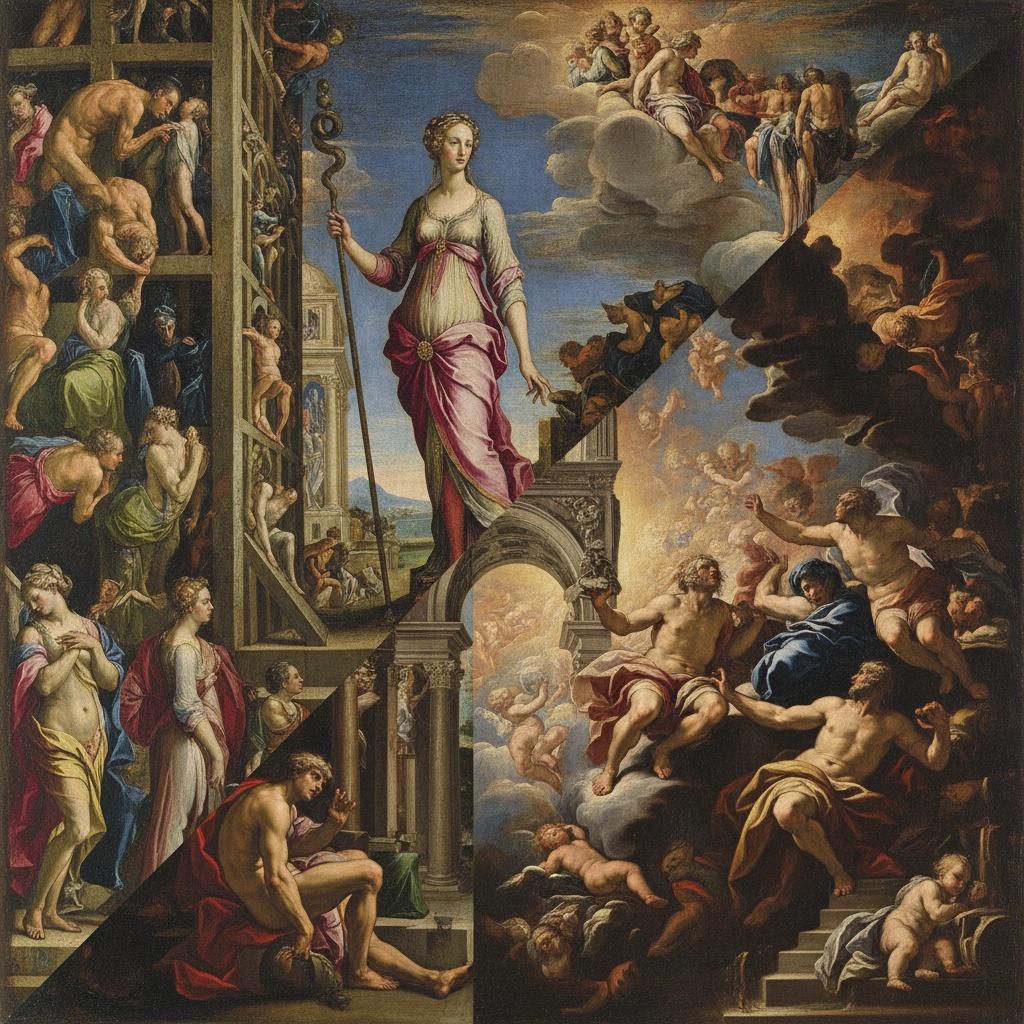
Mannerism is often characterized by its embrace of the unnatural, a deliberate cultivation of elegance that borders on the surreal. Where the Renaissance celebrated anatomical accuracy, Mannerist painters delighted in figura serpentinata—the serpentine figure—and elongated limbs that defied biological reality. One need only look at the works of Parmigianino to witness this breathtaking distortion; his compositions often feature slender, graceful necks and tapering fingers that evoke a sense of aristocratic refinement and otherworldly grace.
This aesthetic was not merely about eccentricity; it was an intellectual pursuit of complexity. Mannerist compositions frequently utilized asymmetrical arrangements and crowded, claustrophical spaces to create a sense of psychological instability. The colors, too, shifted away from the primary, balanced palettes of the previous century toward more acidic, iridescent, and unexpected hues. This intentional use of artifice served to remind the viewer that they were witnessing a creation of the human mind, a sophisticated performance of skill that prioritized grace and tension over the mere reproduction of visible reality.
The Counter-Reformation Catalyst: How Faith Fueled Baroque Grandeur
 The Dramatic Flourish: Exploring the Baroque Movement's Enduring Legacy in Art History
The Genesis of Grandeur: Historical Context & The Counter-Reformation Wikipedia: Counter-Reformation The Counter-Reformation (Latin: Contrareformatio), also sometimes called the Catholic Revival, was the period of Catholic resurgence that was initiat...
As the sixteenth century drew to a close, the artistic landscape underwent another profound transformation, driven not by stylistic whim, but by the tectonic shifts of religious and political upheaval. The Protestant Reformation had challenged the very foundations of the Catholic Church, prompting a period of intense spiritual crisis known as the Counter-Reformation. In response, the Church recognized that art could serve as a potent visual counter-offensive—a tool to reassert its authority and inspire renewed devotion among the faithful.
This era gave birth to the Baroque, a movement that moved away from the intellectualized distortions of Mannerism toward a visceral, immersive experience. The Baroque was designed to move the soul through spectacle. It sought to bridge the gap between the divine and the human by creating art that was overwhelmingly grand, emotionally charged, and undeniably persuasive. From the soaring ceilings of Roman churches to the opulent altarpieces of the Jesuit order, every element was meticulously crafted to evoke awe, utilizing scale and narrative power to reaffirm the majesty of both faith and the state.
Chiaroscuro and Spectacle: The Technical Mastery of Baroque Drama
 Baroque Masterpieces: 10 Paintings That Defined an Era |
Introduction To gaze upon the masterpieces of the Baroque is to step into a world ablaze with drama, emotion, and an almost overwhelming sense of grandeur. This wasn’t merely a style; it was a cultural earthquake, reshaping art, architecture, music, ...
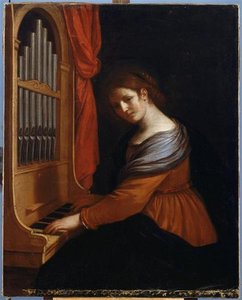
The technical hallmark of the Baroque era is perhaps nothing more than the masterful manipulation of light and shadow, a technique known as chiaroscuro. If Mannerism was defined by line and form, the Baroque was defined by volume and atmosphere. Artists like Caravaggio revolutionized painting by using extreme contrasts to focus the viewer's attention on the most dramatic elements of a scene. This "spotlight" effect created a cinematic intensity, pulling subjects out of deep, impenetrable darkness into sudden, brilliant illumination.
This interplay of light and dark did more than just create depth; it heightened the psychological stakes of every narrative. In the works of masters like Agostino Carracci or the later Baroque visionaries, the use of shadow allows for a sense of mystery and profound spiritual weight. The texture of the paint itself became part of the drama, with thick, expressive brushstrokes—often approaching the impasto technique—adding a tactile dimension to the emotional intensity. This was art that did not just ask to be seen; it demanded to be felt, enveloping the spectator in a world of movement, light, and shadow.
From Tension to Triumph: Tracing the Evolution from Mannerism to Baroque
 The Visceral Stage: Exploring Dramatic Narratives & Emotional Intensity in Baroque Art
The Baroque Embrace of Emotion: A Shift from Renaissance Rationality Wikipedia: Baroque painting Baroque painting is the painting associated with the Baroque cultural movement. The movement is often identified with Absolutism, the Counter Reformation...
Tracing the lineage from Mannerism to Baroque reveals a fascinating evolution of human expression. We see a transition from the tension of the sixteenth century to the triumph of the seventeenth. While Mannerism thrived on instability, ambiguity, and the intellectualized "unnatural," the Baroque embraced the monumental, the certain, and the overwhelmingly real. The movement took the expressive energy found in late Mannerist works and channeled it into a structured, albeit highly dramatic, framework of realism and grandeur.
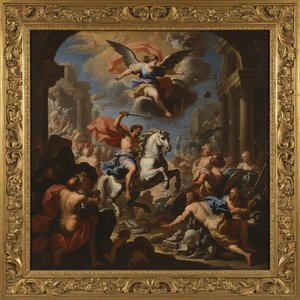
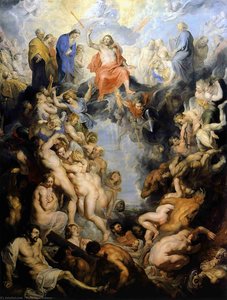
This evolution was not a rejection of the past but an expansion of its possibilities. The Baroque artists inherited the technical virtuosity of their predecessors but redirected it toward a more accessible, sensory-driven purpose. Where a Mannerist painting might leave a viewer contemplating a complex puzzle of form, a Baroque masterpiece—such as those found in the breathtaking halls of the Staatsgalerie Schleissheim—aims to overwhelm the senses with color, motion, and light. It is a journey from the cerebral to the visceral, from the artifice of the studio to the theatricality of the stage.
Curating the Era: Bringing Baroque Opulence into the Modern Interior
 Baroque Drama: Bringing Opulence & Emotion into Contemporary Interiors
The Allure of Baroque: A Historical Overview The 17th and 18th centuries witnessed a dramatic shift in artistic expression, one that moved away from the restrained elegance of the Renaissance towards an aesthetic of grandeur, emotion, and theatricali...
Today, the legacy of these eras continues to inspire those who seek to infuse their living spaces with character and historical depth. The dramatic flair of the Baroque is remarkably well-suited to contemporary interior design, offering a way to introduce focal points that command attention and evoke a sense of timelessness. Whether through large-scale canvases that mimic the grandeur of a palace or smaller, intimate works that capture the chiaroscuro of a private moment, these styles allow for a sophisticated layering of history within a modern home.
For the discerning collector or enthusiast, bringing such masterpieces into a home is an act of preserving human creativity. At ArtsDot.com, we specialize in making this historical grandeur accessible. We offer exquisite, hand-painted oil reproductions that capture the true essence of these movements—from the visible brushstrokes and deep tonal ranges of Baroque masters to the textured complexity of Mannerist elegance. Our artists, trained in the highest academic traditions, recreate these works on 100% cotton canvas, ensuring that the soul of the original is preserved in every stroke. Whether you are looking for a multi-panel set to adorn a grand staircase or a custom "remixed" portrait that brings a historical aesthetic to a personal memory, we provide the bridge between the museums of the past and the homes of the present.